Prices shown were verified on Amazon on September 15, 2026 and change frequently — always check the current price before buying.
Most water treatment content on the internet compares two products at a time, which is useful right up until you realize there are actually four distinct categories of whole-house water equipment, and they solve almost entirely different problems. This post puts all four side by side in one matrix: water softeners, whole-house carbon/sediment filters, salt-free (TAC) conditioners, and whole-house reverse osmosis. If you’ve read our softener vs. filter comparison, this post covers the same ground plus a fourth category — whole-house RO — that isn’t a fit for the pairwise framing of that post. As an Amazon Associate we earn from qualifying purchases; full policy on our affiliate disclosure page.
What Each Category Actually Is
Before the matrix, a one-line mechanical summary of each, because the names get used loosely in marketing:
- Water softener (ion exchange): swaps dissolved calcium and magnesium for sodium (or potassium) ions on a resin bed, then periodically flushes the resin with brine. Removes hardness minerals from the water entirely.
- Whole-house filter (carbon/sediment): passes water through sediment media and activated carbon to catch particulates and adsorb chlorine, chloramine, and some organic compounds. Doesn’t touch dissolved minerals.
- Salt-free conditioner (TAC — template-assisted crystallization): doesn’t remove hardness minerals at all. It converts them into inert microscopic crystals that don’t stick to pipe walls, reducing new scale formation without changing what a lab hardness test would show.
- Whole-house reverse osmosis: forces water through a semi-permeable membrane under pressure, rejecting dissolved solids (not just particulates) — this is the only one of the four that meaningfully reduces TDS, fluoride, nitrates, and arsenic at the point of entry to the whole house rather than at one tap. See our companion post, Whole-House Reverse Osmosis: Are They Worth It Over a Standard Filter?, for the full buying guide on this category specifically.
The Decision Matrix
| Water Softener | Whole-House Filter | Salt-Free Conditioner | Whole-House RO | |
|---|---|---|---|---|
| What it removes | Calcium, magnesium (hardness) | Chlorine/chloramine, sediment, taste/odor compounds (media-dependent) | Nothing removed — converts mineral crystal structure only | Dissolved solids broadly: TDS, fluoride, nitrates, arsenic (rejection depends on oxidation state — pentavalent As(V) rejects well, trivalent As(III) needs pre-oxidation to reject as effectively), lead, PFAS (95-99% reduction commonly cited for RO membranes), plus chlorine/sediment via pre-filter stages |
| What it does NOT remove | Chlorine, sediment, dissolved contaminants, bacteria | Dissolved minerals/hardness, most fluoride, arsenic, nitrates, TDS in general | Anything — minerals stay in the water, just less scale-forming | Rejects the large majority of dissolved solids and many contaminant classes, but isn’t a universal barrier — dissolved gases (like radon) and some low-molecular-weight organics can still pass through, which is why RO is typically paired with carbon pre/post-filtration rather than used alone |
| Typical equipment cost | ~$340-$1,500+ | ~$150-$500+ | ~$340-$1,350+ | ~$1,100-$5,800+ (tankless commercial-style units at the low end; storage-tank whole-house systems at the high end) |
| Maintenance burden | Monthly salt refills, occasional servicing, resin lasts ~10-15 yrs | Cartridge swaps every 3-12 months depending on micron rating/media | Lowest — media replacement every few years, no salt, no drain line | Highest — membrane replacement (roughly 1-3 yrs), pre-filter changes, storage tank upkeep, booster pump service |
| Install complexity | Bypass valve + drain line for brine discharge | Simplest tie-in of the salt-based/filtered group; no drain line for standard cartridge units | No drain line, no electrical connection — generally the easiest of the four to fit into an existing space | Most complex — often needs a storage tank (165-220+ gallons on true whole-house units), a booster pump, a drain connection for reject water, and adequate incoming pressure |
| Needs a drain line? | Yes (brine discharge) | No (standard cartridge systems) | No | Yes (concentrate/reject water) |
| Adds sodium? | Yes, unless using potassium chloride media | No | No | No — RO actually strips minerals, which is why remineralization is a real design debate (more in the companion post) |
| Symptom it actually solves | Scale on fixtures, poor lathering, water heater scale buildup, dry skin/hair from hard water | Chlorine taste/odor throughout the house, visible sediment, cloudy water | Scale reduction without a brine tank or added sodium — not a true “soft water” feel | Elevated TDS, fluoride, nitrates, arsenic, or a general “something’s dissolved in this water” result from a lab test that a softener or carbon filter can’t touch |
Which Symptom Points to Which System
If you’re trying to work backward from what you’re actually noticing (or what a water test flagged), this is roughly the mapping:
- White scale on faucets/shower doors, soap won’t lather, water heater failing early — water softener. See our Best Water Softeners for Hard Water roundup.
- Chlorine smell/taste at every tap, visible sediment on well water — whole-house carbon/sediment filter. See Whole-House Water Filtration Systems Compared.
- Want less scale but don’t want a brine tank or added sodium, and don’t specifically need a “soft water” feel — salt-free TAC conditioner. See Best Salt-Free Water Conditioners.
- Lab test shows elevated TDS, fluoride, nitrates, or arsenic; you want reduction of those at every tap in the house, not just a filter pitcher at the kitchen sink — whole-house reverse osmosis. Covered in full in our companion post linked above.
- Well water with hardness + sediment + chlorine or iron, all at once — typically a filter installed upstream of a softener, not RO by itself. Whole-house RO is a poor fit as a first-line sediment/iron solution; those contaminants should be handled by pre-filtration ahead of an RO membrane regardless, to protect the membrane from fouling.
One Real Example From Each Category
These are single representative picks, not exhaustive roundups — see the linked posts above for fuller comparisons within each category.
Water Softener: Aquasure Harmony Series 40,000 Grain
A salt-based ion-exchange softener with a digital metered control head, sized reasonably for a 3-4 bathroom household on moderately hard municipal water.

- Typical price: about $580 (at time of writing)
- View on Amazon
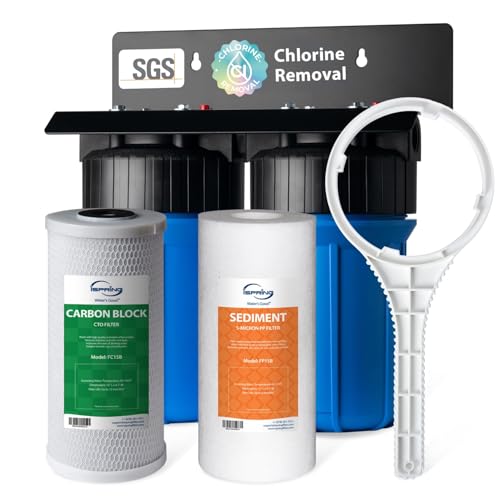
Whole-House Filter: iSpring WGB21B 2-Stage
A sediment-plus-carbon system covering the basics — chlorine taste/odor and particulate filtration — at a lower entry price than multi-stage systems.
- Price on Amazon: See current price (at time of writing)
- View on Amazon
Salt-Free Conditioner: Premier 10 GPM TAC Salt-Free Descaler
A genuine template-assisted crystallization system rated by the manufacturer for 10 gallons per minute of flow, no brine tank or drain line required.

- Price on Amazon: See current price (verified September 21, 2026)
- View on Amazon
Whole-House RO: iSpring CRO1000 4-Stage Tankless Commercial RO, 1000 GPD
A tankless, high-flow RO system explicitly marketed by iSpring for house-scale use (alongside restaurant/light commercial), which avoids the large storage tank footprint of some whole-house RO setups by producing filtered water on demand at a higher flow rate. Sourced fresh via the Creators API for this post.

- Typical price: about $1,150
- View on Amazon
Installation Note
All four categories tie into your home’s main water line, and softeners and whole-house RO systems additionally require a drain connection — work that’s covered by plumbing code in most jurisdictions and may require a permit. We’re intentionally not providing DIY installation steps here; get a quote from a licensed plumber, who can also confirm local permit requirements, size any bypass or drain connections correctly, and check your incoming water pressure against what an RO system needs to perform properly. For a deeper look at what a softener install specifically runs, see our Water Softener Install Cost post.
Bottom Line
These four categories aren’t tiers of the same product — they’re different tools for different water problems, and buying the wrong one means paying for equipment that doesn’t address what’s actually wrong with your water. Test your water first (hardness, chlorine, and if you’re on a well, a broader contaminant panel), match the result to the matrix above, and only then start comparing specific products within that category. A household with hard, chlorinated water and no dissolved-contaminant concerns doesn’t need RO; a household with a lab report flagging elevated fluoride or nitrates isn’t well served by a softener alone, no matter how well-reviewed it is.
Pingback: Best Under-Sink Reverse Osmosis Systems: Tank vs. Tankless Compared - homemechanicals.com
Pingback: iSpring Water Treatment Systems: A 2026 Buyer's Guide for Homeowners - HomeMechanicals
Pingback: Waterdrop Buyer's Guide 2026: RO and Whole-House Filters - HomeMechanicals