HomeMechanicals.com is an Amazon Associate and earns from qualifying purchases. Product details come from manufacturer listings; see our research process.
EcoFlow is a consumer energy company that built its name on lithium battery power stations and matching solar panels, and has since expanded into modular home backup systems with hardwired smart panels. For homeowners, that means the brand now spans two very different purchases: a plug-in box you carry to a job site or an RV, and a stacked battery system that backs up part or all of an electrical panel. This guide covers the EcoFlow models most relevant to home backup in 2026, what the published specs actually tell you, who each one fits, and what has to happen before any of them is tied into house wiring. Everything below is based on manufacturer-published specifications and listing details plus well-established general knowledge about lithium battery backup. No performance, savings or rebate outcome is promised here.
How the EcoFlow lineup is organized
The models in this guide fall into three families, and understanding the split saves a lot of comparison-shopping time.
- DELTA Pro Ultra and DELTA Pro Ultra X — the whole-home tier. These use a separate inverter and stackable battery modules rather than a single sealed unit, and they are built for whole-home use alongside EcoFlow’s Smart Home Panel line (the Ultra X bundle includes Smart Home Panel 3), which acts as the automatic switchover point for backed-up circuits. Confirm panel compatibility for your exact configuration with EcoFlow. Capacity grows by adding battery modules; output grows by adding inverters. This is the family to look at if the goal is running 240V loads and backing up most of a house.
- DELTA Pro 3 — the high-output portable tier. A single unit delivers 120V and 240V, carries a handle, and needs no installation to be useful. It expands with extra batteries or a smart generator, so it can start as a plug-in unit and later grow into a larger backup bank.
- DELTA 3 Ultra Plus — the mid-capacity tier. Lower continuous output and smaller base capacity than the Pro 3, but still expandable, and sized for essential circuits, RV use and extended trips rather than central air conditioning and well pumps.
Cutting across all three are solar bundles. EcoFlow sells several of these units packaged with 400W portable panels so the kit arrives ready to recharge off-grid. The power station inside the bundle is the same hardware sold on its own; the panels are what change. A second cross-cutting theme is chemistry: every model here uses LFP (lithium iron phosphate) cells, the chemistry most commonly chosen for stationary and home backup duty because of its cycle life and thermal behavior.
The models worth knowing
EcoFlow DELTA Pro Ultra X with Smart Home Panel 3
This is the highest-capacity system in this guide: a 12,288Wh LFP system with 120/240V output rated at 12,000W AC, expandable to 180kWh of capacity and 12–36kW of output as inverters and batteries are added. It ships bundled with the Smart Home Panel 3, which is the control and transfer point for the backed-up circuits and is also compatible with other EcoFlow batteries, generators and solar panels. EcoFlow publishes a grid-failure switchover time of under 20 milliseconds, and the system is designed to manage circuits intelligently — shifting between solar, battery and grid power and letting you prioritize which circuits stay live. EcoFlow also notes the inverter, battery and panel arrive in separate packages.
It fits homeowners who want whole-home or near-whole-home backup including 240V loads such as a well pump, range or EV charger, and who are prepared to have a licensed electrician install the Smart Home Panel 3 under permit. EcoFlow emphasizes that the batteries themselves are not hardwired, which is a genuine difference from a fixed wall battery — but the panel that performs the automatic switchover is still electrical work on your service.
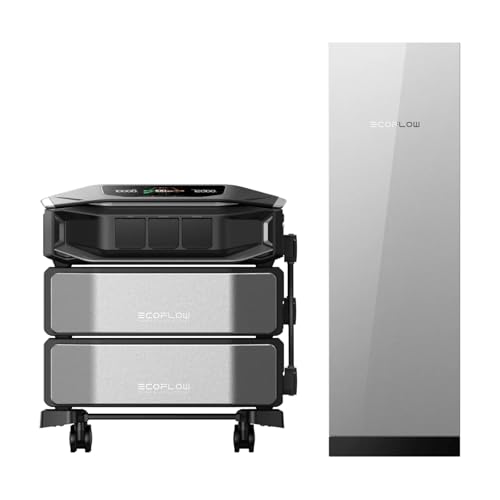
- Save All Day, Every Day. DELTA Pro Ultra X works nonstop to lower your energy bills. It automatically switches between solar, batt…
- Reliable Power. Instant Response. When the grid fails, DELTA Pro Ultra X restores power in under 20 milliseconds—faster than a bli…
- Smart Energy Management. EcoFlow Smart Home Panel 3 is the center of your whole-home backup system. Compatible with EcoFlow DELTA …
EcoFlow DELTA Pro 3 with Extra Battery (8kWh)
This bundle pairs the DELTA Pro 3 with one extra battery for about 8kWh of LFP storage (two 4,096Wh batteries), expandable to 48kWh with additional batteries or smart generators. The inverter supports 120V and 240V with 4,000W continuous output, 6,000W with X-Boost, and up to 12,000W when units are combined. EcoFlow lists 7 charging inputs and 18 combination charging methods, a 10ms UPS switchover, X-Quiet operation as low as 30 dB, automotive-grade LFP cells with IP65-rated cell-to-chassis packaging, and a 5-year warranty.
The appeal here is flexibility. Unlike the whole-home systems, it requires no installation to be useful: plug it in, connect appliances directly, and keep the option of adding a transfer switch or smart panel later. It suits homeowners facing occasional multi-day outages who also want a unit they can take to an RV or a remote property.

- [Energize Almost Everything] The EcoFlow DELTA Pro 3 supports 120V/240V voltage and has a 4000W output (6000W with X-Boost, scalab…
- [Forget Refueling] Featuring a 4096Wh LFP battery capacity, expandable to 48kWh with extra batteries or smart generators, providin…
- [Plug and Play] Experience hassle-free power with the DELTA Pro 3, a versatile portable power station that's easy to set up, even …
EcoFlow DELTA Pro Ultra (6144Wh)
The standard DELTA Pro Ultra pairs one inverter with one 6,144Wh battery and delivers 120V and 240V at 7,200W. Capacity scales up to 15 batteries for a maximum of 90kWh. EcoFlow publishes a 2-hour full recharge for a single battery and lists EV charging stations, solar, wall outlets and generators among the input options. It operates as an online UPS with a 20ms transfer time, and the listing notes fans stay off for the first half hour at 2,000W output. EcoFlow also states it is certified to both UL1973 and UL9540.
This is the entry point into the modular whole-home architecture. It fits homeowners who want a panel-based whole-home approach and room to expand, but do not need the Ultra X’s higher output on day one. Those UL listings matter in practical terms too: some jurisdictions and inspectors look for UL9540 on energy storage systems, so confirm requirements with your local building department before ordering.

- One Powers All. The unit of DELTA Pro Ultra whole house generator includes an inverter and a battery. One inverter supports 120V &…
- Strong Power Security. Scalable from one battery of 6144Wh, two days of essential power, all the way to 15, it multiplies the ener…
- Multi Ways to Charge. One battery of 6144Wh can be fully recharged in 2 hours. Faster than any other 6kWh solar generator. Users c…
EcoFlow DELTA Pro 3 Solar Generator with 2 × 400W Panels
Same DELTA Pro 3 hardware as above — 4,096Wh LFP, 120/240V, 4,000W continuous (6,000W with X-Boost, scalable to 12,000W), 10ms switchover, expandable to 48kWh — but packaged with two 400W portable solar panels instead of a second battery. That changes the use case from capacity to recharging independence: 800W of nameplate panel capacity gives the unit a way to top up during an extended outage or off-grid stay, though real-world harvest depends on sun angle, season, shading and panel placement.
It fits buyers whose main worry is running out of stored energy with no grid to recharge from — rural properties, long storm outages, extended camping or RV trips. If you expect to recharge mainly from the wall and simply want more runtime, the extra-battery bundle is the more direct answer.

- Energize Almost Everything. The EcoFlow DELTA Pro 3 supports 120V/240V voltage and has a 4000W output (6000W with X-Boost, scalabl…
- Forget Refueling. Featuring a 4096Wh LFP battery capacity, expandable to 48kWh with extra batteries or smart generators, providing…
- Plug and Play. Experience hassle-free power with the DELTA Pro 3, a versatile portable power station that's easy to set up, even a…
EcoFlow DELTA 3 Ultra Plus with 400W Solar Panel
The DELTA 3 Ultra Plus is a 3,072Wh LFP station rated at 3,600W continuous with 7,200W surge, expandable from 3kWh to 11kWh with extra batteries. EcoFlow lists six charging methods (home outlets, solar, car charger, EV stations, generators and the EcoFlow Smart Generator), X-Stream charging to 80% in under an hour, a UPS switchover under 10 milliseconds, and X-Quiet 3.0 noise control. This bundle includes one 400W panel, shipped separately from the station.
This is the sensible size for essential-circuit backup: refrigeration, networking, lights, CPAP and other sensitive electronics, plus power tools and RV loads. At 3,600W continuous it is generally not sized for a central air conditioner or an electric range. Anyone relying on a CPAP or other medical device should check the device’s power needs and keep a backup plan, since no consumer battery is guaranteed to run uninterrupted. Buyers who later need more should check the expansion path before committing, since 11kWh is the ceiling here.
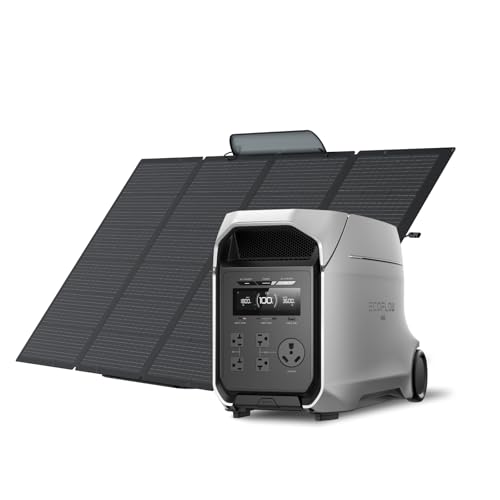
- Easily Scales Up. Adapt power to your lifestyle with expandable capacity from 3kWh to 11kWh. Add extra batteries to cover multi-da…
- 6 Ways to Charge Up. From home outlets to solar panels, car chargers, EV stations, generators, and the EcoFlow Smart Generator, DE…
- <10ms UPS for Uninterrupted Backup. Stay connected when it matters most. DELTA 3 Ultra Plus automatically switches to battery powe…
Model comparison
| Model | Type | Capacity (base / max) | AC output | Best fit |
|---|---|---|---|---|
| DELTA Pro Ultra X + Smart Home Panel 3 | Modular whole-home system | 12,288Wh / 180kWh | 120/240V, 12,000W (12–36kW scalable) | Whole-home backup with 240V loads and automatic switchover |
| DELTA Pro 3 with Extra Battery | Portable, expandable | 8kWh / 48kWh | 120/240V, 4,000W (6,000W X-Boost, 12,000W combined) | Multi-day outages without installation; dual home and RV use |
| DELTA Pro Ultra (6144Wh) | Modular whole-home system | 6,144Wh / 90kWh | 120/240V, 7,200W | Entry into the modular panel architecture with room to grow |
| DELTA Pro 3 Solar Generator + 2×400W panels | Portable solar kit | 4,096Wh / 48kWh | 120/240V, 4,000W (6,000W X-Boost) | Off-grid recharging and long outages far from the grid |
| DELTA 3 Ultra Plus + 400W panel | Portable solar kit | 3,072Wh / 11kWh | 3,600W continuous, 7,200W surge | Essential circuits, electronics, RV and job-site loads |
How to choose
Start with load, not capacity. Continuous wattage decides what you can run; watt-hours decide how long. A 3,600W unit is generally undersized for a central air conditioner regardless of how many batteries sit behind it, while a 120/240V unit at 4,000W or more can support some 240V loads such as many well pumps and mini-split systems. Electric ranges and large air conditioners often need the higher-output whole-home systems, so check each appliance’s nameplate rating. Add up the running watts of everything you actually need during an outage and check surge demands on anything with a motor or compressor before you choose a tier. Our generator size calculator works the same way for battery systems.
Then decide whether you want a plug-in appliance or an installed system. The DELTA Pro 3 and DELTA 3 Ultra Plus can be used from day one by plugging appliances in directly (use appropriately rated cords). The DELTA Pro Ultra and Ultra X are built around the Smart Home Panel 3 and automatic switchover, which is a different project with an electrician, a permit and an inspection. If you are undecided, the trade-offs are laid out in portable power station vs. home battery backup.
Next, match capacity to the outages you actually get. Short, frequent interruptions reward fast UPS switchover more than huge capacity. Long regional outages reward expandable capacity and a way to recharge without the grid. For multi-day planning, see best backup power for a 3-day outage, and if you are leaning toward a solar bundle, check realistic panel counts in how many solar panels do you need to recharge a home battery. One solar bundle panel is a top-up tool, not a replacement for grid charging.
Finally, think about expansion before you buy, not after. Every model here has a different ceiling — 11kWh, 48kWh, 90kWh, 180kWh — and expansion batteries must match the family. Buying the smallest unit in a family you can grow into is usually easier than discovering you have outgrown a platform.
Installation and safety
Using any of these units as a plug-in appliance — cords run directly from the station to individual devices — is straightforward and typically needs no permit, though local rules vary. Everything beyond that is electrical work.
- Anything that powers house circuits needs proper equipment installed by a licensed electrician: a manual or automatic transfer switch, a smart panel such as the EcoFlow Smart Home Panel 3, or a breaker interlock kit. Permits and inspection apply per your local code, and requirements vary by jurisdiction.
- Never backfeed. Energizing a circuit by plugging a power station into an outlet or dryer receptacle without a transfer device is dangerous to you, to anyone else in the house and to utility crews, and it is prohibited under standard electrical codes.
- Confirm code acceptance before ordering if you are planning an installed system. Some jurisdictions require specific energy-storage listings, and inspectors may have rules about where battery modules can be located relative to living space, exits and garages.
- Follow the manual on placement and clearance. Batteries produce no combustion exhaust, which is the key safety advantage over fuel-burning generators, but they still need clearance, ventilation and protection from water and temperature extremes as specified by EcoFlow.
- Solar panel mounting is its own job. Portable panels are fine on the ground or a patio. Roof-mounted arrays and any permanent DC wiring are a licensed, permitted installation.
- If a 240V appliance is involved — well pump, range, EV charger, heat pump — have the electrician verify circuit sizing and that the load is compatible with the inverter’s output and surge rating before you rely on it.
Frequently asked questions
Can an EcoFlow power station back up a whole house?
Some configurations are designed for it. The DELTA Pro Ultra X is rated for 120/240V output at 12,000W and scales to 36kW and 180kWh, and the DELTA Pro Ultra delivers 7,200W and scales to 90kWh — both designed for use with an EcoFlow smart panel for automatic switchover across selected circuits (confirm compatibility with EcoFlow). Whether that covers your whole house depends on your total load, your largest motor loads and how many batteries you install. The smaller portable units are better understood as essential-circuit backup.
Do I need an electrician for a portable EcoFlow unit?
Not if you use it with cords plugged directly into appliances. You do need a licensed electrician the moment you want house circuits to be powered by it, because that requires a transfer switch, interlock or smart panel installed to code with the appropriate permits. Many owners start with cords and add a transfer device later.
How does a battery system compare with a gas or propane generator?
They are different trade-offs rather than better and worse. Batteries are quiet, produce no exhaust, can sit indoors per the manufacturer’s instructions and switch over in milliseconds, which fuel generators typically cannot match. Fuel generators can run as long as fuel is available, which batteries cannot without solar or grid recharging. Climate, outage length and fuel access usually decide it — see home battery vs. generator by climate.
Will these units work in cold weather?
LFP batteries generally discharge acceptably in cold conditions but have manufacturer-defined temperature limits for charging, and lithium chemistries in general lose usable capacity as temperatures drop. Check the operating and charging temperature ranges in EcoFlow’s documentation for the specific model and plan placement accordingly — a conditioned garage or utility room is usually better than an unheated shed in a cold climate.
Specifications above reflect manufacturer-published figures and listing details for these models and can change between production runs; confirm current specs, included components and warranty terms with EcoFlow before purchase, and confirm installation requirements with your local building department and a licensed electrician.