HomeMechanicals.com is an Amazon Associate and earns from qualifying purchases. Product details come from manufacturer listings; see our research process.
Anker is a consumer electronics brand that built its name on charging accessories and batteries, and SOLIX is the sub-brand it uses for solar generators, portable power stations and, more recently, permanently mounted home backup hardware. The lineup now spans two very different kinds of product: boxes you can carry out to a job site or a campsite, and panel-connected systems that are installed once and left alone. This guide walks through the Anker SOLIX models supplied here, explains how the families relate to each other, and gives you a framework for matching capacity and output to what your house actually needs. Everything below comes from published specifications and listing features plus general knowledge about how battery backup works — current pricing appears in the product cards.
How the Anker SOLIX lineup is organized
Three distinct families show up in the products covered here, and they solve different problems.
The E10 family is Anker SOLIX’s whole-home tier. It pairs stackable battery packs with a Power Dock that ties into your electrical service and handles automatic transfer. This is the category that competes with wall-mounted home batteries rather than with portable units — it is weather-rated for outdoor mounting, scales well past what a portable unit can reach, and is designed to be installed by a professional.
The F3800 Plus family sits in the middle. These are large power stations with 120V/240V dual-voltage output, meaning they can address 240V loads such as a dryer or well pump rather than just 120V outlets. They expand with BP3800 battery packs, and they can be paired with each other through a Power Hub for higher combined output. The F3800 Plus can be used as a standalone emergency unit or, with the right professionally installed hardware, as a panel-connected backup source.
The C2000 family is the portable tier — a smaller, more portable unit sized for a refrigerator, electronics, tools, CPAP machines, and some window or RV air conditioners. It is the right starting point if you want backup for a handful of critical loads rather than for the whole house.
Across all three, Anker SOLIX uses LFP (lithium iron phosphate) cells, which the category generally favors for cycle life and thermal stability over older lithium-ion chemistries. If you are still deciding between a battery system and a fuel-burning unit, our portable power station vs. home battery backup comparison covers the structural differences.
The models worth knowing
Anker SOLIX E10 Power Dock and Extra Battery
The E10 is the whole-home end of the range. According to the published specs, it starts at 12kWh with two battery packs and expands to 90kWh, with 7.6kW continuous output that scales to 22.8kW across three units and a 10kW turbo output that scales to 30kW. The Power Dock provides 200A whole-home coverage, so rather than backing up a subpanel of selected circuits, it is designed to connect to the entire panel. The 200A figure is the dock’s coverage rating, not the system’s output: the stated 7.6kW continuous (10kW turbo) per unit is far less than a 200A service can draw, so heavy loads such as electric heat, a dryer and central air running together can still exceed what the system supplies. Anker lists a switchover time of 20ms or less, and Anker describes the switchover as seamless.
Hardware details matter here because this unit lives outdoors: the E10 is NEMA 4 rated and the Dock is NEMA 3R, with a stated operating range of -4°F to 131°F, wall or floor mounting, and EV-class LFP cells with a 10-year stated lifespan. Anker lists a 5-year warranty on the E10 and 10 years on the Dock, plus up to 9kW of solar input per unit and compatibility with a smart generator for extended runtime. This is the model to look at if you want a permanent, hands-off system and you are prepared to involve a licensed electrician and pull permits.
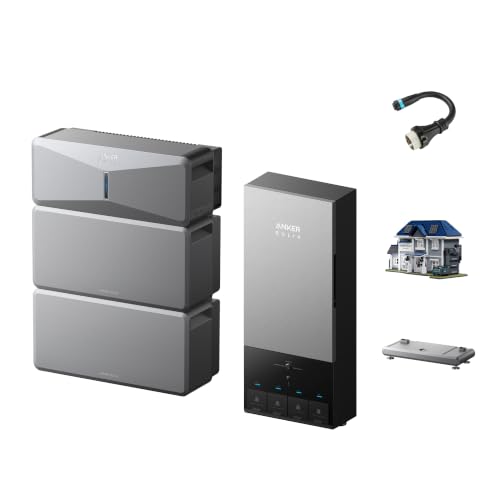
- Limited-Time Perks: E10 Metal Pad and AC Generator Adapter, Up to 12-Month 0% APR
- Whole-Home Power: 7.6kW Continuous, scales to 22.8kW. 10kW Turbo Output, scales to 30kW Turbo with triple units. 200A Power Dock c…
- Infinite Backup: 12kWh (2 Packs) expandable to 90kWh. 9kW solar per unit. Compatible with Smart Generator for infinite backup.
Anker SOLIX F3800 Plus and Double Power Hub
This bundle is the high-output configuration of the F3800 Plus platform: 7,680Wh of LiFePO4 capacity in the listed package, up to 12,000W maximum AC output when two units are paired, 3,200W solar input, and 120V/240V dual-voltage support. The Double Power Hub is the piece that lets two F3800 Plus units work together and feed a common output, which is how you get from a single unit’s 6,000W to the 12,000W figure.
Capacity scaling is the headline: Anker says the platform starts at 3.84kWh, expands to 26.9kWh with six batteries, and doubles to 53.8kWh with twelve. Recharging is flexible — solar, generator, home power panel or AC outlet — with a stated 63-minute fast recharge and a 6,000W bypass that accepts a 240V gas generator. This configuration fits a homeowner who wants near-whole-home capability but prefers modular, relocatable hardware over a fixed wall installation. Note that the station and hub ship separately. The listing title names one station plus a hub, while the 7,680Wh and 12,000W figures imply two stations, so confirm exactly what is in the package before ordering.

- The F3800 Plus Power Station and Double Power Hub will be dispatched separately. If you receive one item before the others, please…
- Power Your Home for Weeks: F3800 Plus starts at 3.84kWh, enough to power your home for a full day. Need more? Expand to 26.9kWh wi…
- Power More Appliances Simultaneously: F3800 Plus offers a massive 6,000W output, 58% more than other portable power stations at th…
Anker SOLIX F3800 Plus and BP3800 Expansion Battery
Same power station, different companion. Instead of a second unit and a hub for more output, this bundle pairs the F3800 Plus with one BP3800 expansion battery for more runtime — 7,680Wh total as listed, with 6,000W output from the single station, 3,200W solar input and the same dual-voltage and generator-ready capabilities.
The choice between this and the Double Power Hub bundle comes down to whether your constraint is how much you can run at once or how long you can run it. If you have a short list of loads but want multi-day endurance, extra battery is the better buy. If you need to start a well pump, a central air handler and a range at the same time, output is the limiting factor and the hub configuration makes more sense. These items also ship separately.

- The F3800 Plus Power Station and BP3800 Expansion Battery will be dispatched separately. If you receive one item before the others…
- 𝗣𝗼𝘄𝗲𝗿 𝗬𝗼𝘂𝗿 𝗛𝗼𝗺𝗲 𝗳𝗼𝗿 𝗪𝗲𝗲𝗸𝘀: F3800 Plus starts at 3.84kWh, enough to power your home for a full day. Need more? Expand to 26.9kWh wi…
- 𝗣𝗼𝘄𝗲𝗿 𝗠𝗼𝗿𝗲 𝗔𝗽𝗽𝗹𝗶𝗮𝗻𝗰𝗲𝘀 𝗦𝗶𝗺𝘂𝗹𝘁𝗮𝗻𝗲𝗼𝘂𝘀𝗹𝘆: F3800 Plus offers a massive 6,000W output, 58% more than other portable power stations at th…
Anker SOLIX BP3800 Expansion Battery
The BP3800 is a 3,840Wh LiFePO4 pack designed specifically for the F3800 series. It has no inverter of its own — it connects to a host station with the included battery-to-host cable and simply adds runtime. Anker lists up to six packs to reach 26.9kWh on a single host, a 10-year lifespan claim based on its InfiniPower design and EV-class LFP cells, and a 5-year full-device warranty.
Buy this if you already own an F3800-series station and found your runtime short during an actual outage. Because it has no inverter of its own, it adds runtime only; output stays limited to the host station.

- Huge Capacity Up to 26.9kWh: Anker SOLIX F3800 has 3.84kWh to power your family's needs for one day. If that's not enough, add up …
- Long-Lasting 10-Year Lifespan: Anker SOLIX F3800 is built to last over a decade, even with everyday use, thanks to Anker InfiniPow…
- Peace of Mind with 5-Year Warranty: Instead of the average industry warranty length of 2 years, you can purchase Anker SOLIX F3800…
Anker SOLIX C2000 Gen 2 with 400W Bifacial Panel
The C2000 Gen 2 is the portable option here: a 2,048Wh LiFePO4 station rated at 2,400W continuous with 4,000W peak, expandable to 4kWh with an expansion battery. Anker cites 9W standby draw and runtimes of up to 32 hours for a dual-door refrigerator on the base unit, or up to 64 hours with the expansion battery. Six recharge methods are listed, with 80% in 45 minutes and a full charge in 58 minutes.
The bundled PS400 bifacial solar panel is listed at 21.9 lb and 22.3 × 38.7 × 3.2 inches folded. That combination suits apartment dwellers, RV owners, and homeowners who want a credible fridge-and-electronics backup without touching the electrical panel. Anker says the 2,400W rated and 4,000W peak output can run most window and RV air conditioners; check your unit’s startup draw. If you are unsure how much panel you need, see how many solar panels you need to recharge a home battery.
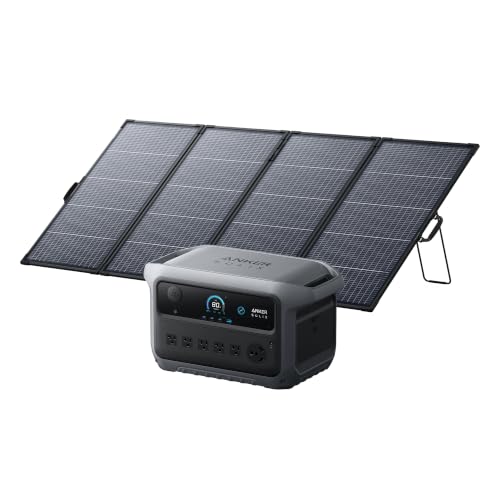
- C2000 Gen 2 Portable Power Station and PS400 Solar Panel will be shipped separately. Scan the QR code on the package to track the …
- Ultra-Efficient Power for Longer Runtime: Uses only 9W on standby, powering a dual-door fridge for up to 32 hours.
- Up to 4kWh Expandable Capacity: Add an expansion battery to reach 4kWh and run a dual-door fridge for up to 64 hours.
Anker SOLIX model comparison
| Model | Type | Capacity | Output | Best fit |
|---|---|---|---|---|
| SOLIX E10 + Power Dock | Panel-connected home battery | 12kWh (2 packs), expandable to 90kWh | 7.6kW continuous / 10kW turbo; scales to 22.8kW / 30kW; 200A dock coverage | Permanent whole-panel backup, outdoor mounting, professional install |
| F3800 Plus + Double Power Hub | Paired power stations | 7,680Wh listed; platform expands to 26.9kWh or 53.8kWh | Up to 12,000W max AC with two units; 120V/240V; 3,200W solar input | Maximum simultaneous load without a fixed installation |
| F3800 Plus + BP3800 | Power station + expansion battery | 7,680Wh listed | 6,000W AC; 120V/240V; 3,200W solar input | Longer runtime on a moderate set of circuits |
| BP3800 Expansion Battery | Add-on battery (no inverter) | 3,840Wh; up to six packs for 26.9kWh | N/A — connects to F3800-series host | Existing F3800 owners adding runtime |
| C2000 Gen 2 + PS400 panel | Portable power station + solar | 2,048Wh, expandable to 4kWh | 2,400W rated / 4,000W peak; 400W bifacial panel | Fridge, electronics, tools, RV and travel use |
How to choose
Start with the load list, not the capacity number. Write down every appliance you want running during an outage and note both its running watts and its surge draw. Motor loads — refrigerators, well pumps, furnace blowers, air conditioners — spike hard on startup, and a system that is fine on average watts can still trip on inrush. Our generator size calculator works just as well for sizing a battery.
Then decide between whole-panel and selected loads. The E10’s 200A dock coverage is designed to connect to an entire panel, but output limits still apply, so it is worth listing which large loads you would actually run together. The F3800 Plus approach — whether through a transfer switch or used as a standalone unit with extension cords — is typically scoped to a smaller set of circuits. Neither is inherently better; the whole-panel route costs more and requires more installation work, while the selected-load route demands you think about priorities up front.
Match runtime to your real outage profile. A region with frequent two-hour blips is a different problem from one with multi-day winter storms. Our guide to the best backup power for a 3-day outage walks through how capacity, solar recharge and generator input interact when the grid stays down. For a region-by-region view of whether batteries or fuel generators make more sense, see home battery vs. generator by climate.
Consider the recharge path. A battery with no way to refill is a one-shot device. Both the E10 and F3800 Plus accept substantial solar input and can work alongside a generator, which is what turns a fixed-capacity battery into an indefinite supply. If you have no roof access, no yard space and no generator, lean toward more stored capacity up front.
Compare across brands before committing. Anker SOLIX is one of several manufacturers in this space; it is worth reading our EcoFlow buyer’s guide and BLUETTI buyer’s guide alongside this one, since ecosystem lock-in is real once you start buying expansion batteries.
Installation and safety
Any battery system that feeds your home’s wiring has to be connected through a transfer switch, interlock kit or smart panel installed by a licensed electrician, with permits pulled according to your local code. This applies squarely to the E10 and its Power Dock, and to any F3800 Plus configuration you intend to wire into a panel. The Power Dock’s automatic switchover function is a transfer device, and transfer devices are permitted, inspected equipment in essentially every jurisdiction.
Never attempt to backfeed your panel through a dryer outlet or any other receptacle. That practice energizes the utility lines outside your home, which is a lethal hazard to line crews and to anyone nearby, and it bypasses the protections that keep your own wiring from being overloaded.
A few additional points specific to this hardware. The E10 is rated for outdoor installation — NEMA 4 on the battery, NEMA 3R on the Dock — but that rating assumes correct mounting, clearances and conduit entries; follow Anker’s documentation and your installer’s judgment. Keep the stated -4°F to 131°F operating range in mind if you live at a temperature extreme, since LFP cells have charging limits in the cold. Portable units like the C2000 Gen 2 and standalone F3800 Plus should be operated in a ventilated, dry location and never run inside a sealed cabinet. If you are pairing a battery with a fuel generator for extended backup, the generator itself must stay outdoors and well away from windows and doors, with working CO alarms inside the home — our winter outage generator guide covers carbon monoxide safety in detail.
Finally, check how your chosen configuration interacts with any existing rooftop solar inverter or utility interconnection agreement. Some utilities require notification or an approved interconnection for storage systems even when they never export to the grid.
Frequently asked questions
What is the difference between the E10 and the F3800 Plus?
The E10 is a fixed, outdoor-rated home battery system with a Power Dock that covers a 200A panel and switches over automatically in 20ms or less. The F3800 Plus is a large but relocatable power station that can be used standalone or wired in through separate hardware. The E10 scales higher — to 90kWh and 30kW turbo output across three units — while the F3800 Plus platform tops out at 53.8kWh with twelve batteries and 12,000W with two paired units.
Can one of these run a central air conditioner or an electric dryer?
Both the E10 and the F3800 Plus support 240V loads, and Anker specifically mentions a dryer for the F3800 Plus. Whether a given central AC will start depends on its locked-rotor amperage, not just its running watts, so check the nameplate data and have your electrician confirm. The C2000 Gen 2 is sized for window and RV air conditioners rather than central systems, and the supplied listing does not list 240V output.
How long will an expansion battery add to my runtime?
Divide the pack’s capacity by your average draw. A BP3800 adds 3,840Wh; a load averaging 400W would draw on it for roughly nine and a half hours before inverter and conversion losses. Anker’s own example for the C2000 Gen 2 follows the same logic — a dual-door refrigerator goes from up to 32 hours to up to 64 hours when capacity doubles to 4kWh.
Do I need solar panels, or can I just recharge from the grid?
Grid recharging works fine for short, predictable outages, and all of these units accept AC input. Solar matters when the outage outlasts your stored capacity. The E10 accepts up to 9kW of solar per unit and the F3800 Plus up to 3,200W; the C2000 Gen 2 bundle includes a 400W bifacial panel, which is a realistic daily top-up for a portable unit rather than a fast full recharge.
For broader context on how backup power fits alongside water and HVAC planning, see our complete power and backup guide. Specifications cited here come from the manufacturer’s published listings and may change; confirm current details and warranty terms before purchase, and review our disclaimer.