HomeMechanicals.com is an Amazon Associate and earns from qualifying purchases. Product details come from manufacturer listings; see our research process.
Waterdrop is a water filtration brand best known for tankless under-sink reverse osmosis (RO) systems and cartridge-based whole-house filter assemblies sold through major online retailers. Its under-sink line is built around compact, pump-driven units that skip the pressurized storage tank, and its whole-house line uses large replaceable cartridges in a multi-stage housing plumbed into the incoming service line. This guide covers six Waterdrop models currently worth knowing, what each one actually is according to its published specifications, who each one fits, and the installation and safety realities you should plan for before you buy. Model details below come from each Amazon listing’s stated specs (manufacturer claims, not independent test results) and widely accepted general knowledge about how these categories work — no performance claims beyond what the specs support.
How the Waterdrop lineup is organized
The models in this guide fall into two clearly separated families, and they solve different problems. Confusing the two is the single most common mistake homeowners make when shopping this brand.
Tankless under-sink reverse osmosis systems treat a single cold-water point of use — almost always the kitchen sink, with an optional line to a refrigerator or ice maker. They push water through a semi-permeable RO membrane, which requires an electric booster pump and a drain connection for the reject stream. Because there is no storage tank, output is rated in gallons per day (GPD): the higher the GPD, the faster the system refills a glass or a pot. The four RO systems here — the X12, G3P800, T3-M and G2 — span 400 to 1200 GPD and differ mainly in flow rate, stage count, drain efficiency, whether minerals are added back after the membrane, and how much information the faucet or display gives you.
Within that family there is a second split: standard RO versus remineralization RO. RO membranes are indiscriminate — they reduce dissolved minerals along with dissolved contaminants, which is why RO water tastes flat to some people. The X12 and T3-M add calcium, magnesium and other minerals back after the membrane stage. The G3P800 and G2 listings do not describe a remineralization stage.
Whole-house cartridge filters sit on the main line where water enters the house and treat every fixture — showers, laundry, toilets, hose bibs and the water heater. They use sediment and carbon media plus specialty media, and they are rated by flow (GPM), micron rating and total gallon capacity rather than GPD. The two models here are both 3-stage, 15 GPM, 5-micron systems with 1-inch inlet and outlet ports, but they target different water problems: the WHF3E-SKH is aimed at scale, heavy metals and sediment, while the WHF3T-FG is built around iron and manganese reduction (note that both listing titles say ‘for Well Water’).
A point worth stating plainly: neither whole-house filter is a water softener. Cartridge filters with anti-scale media are not ion-exchange softeners and do not remove hardness minerals from the water. The WHF3E-SKH listing uses scale-reduction and ‘softer water’ wording; that is anti-scale language, so don’t read it as ion-exchange softening. If your issue is genuine hardness, see our water treatment decision matrix before you commit to a filter-only approach.
The models worth knowing
Waterdrop X12 Alkaline Mineral Reverse Osmosis System (1200 GPD)
The X12 is the highest-output system in this group at 1200 GPD, with 11 stages of filtration including a 0.0001-micron RO membrane described as a 16-layer construction. Per the listing, it is tested and certified by IAPMO R&T against NSF/ANSI 42, 58 and 372 (42 covers aesthetic effects such as chlorine taste and odor, 58 covers reverse osmosis systems, and 372 covers lead-free materials), and additionally tested by SGS. The listing does not state NSF/ANSI 53. Two features set it apart from the rest of the lineup: a healthy-boost stage that infuses alkaline minerals such as calcium and magnesium after the membrane, and a smart digital faucet that shows TDS and filter life and supports quantitative dispensing — selecting a volume rather than holding the handle. The drain efficiency is rated 3:1 pure to drain, and the RO filter is specified for a 24-month service interval.
This is the model to look at if you have a large household, you fill a lot of pitchers, bottles and pots, and you want remineralized water plus on-faucet readouts without a separate display module. The trade-offs are physical and electrical: it may take more under-sink room than the compact models (check the listing’s dimensions) and, like every tankless RO, it needs a nearby outlet and a drain connection.

- [Trusted certification] Tested and certified by IAPMO R&T against NSF/ANSI 42 & 58 & 372 standard, and tested by SGS to reduce har…
- [1200 GPD fast filtration] Experience the ultimate upgrade in water purification with our 1200 GPD high-speed tankless reverse osm…
- [11-Stage RO filtration] This reverse osmosis water filter features 11-stage precision filtration including a robust 0.0001 μm RO …
Waterdrop G3P800 Tankless Reverse Osmosis System (800 GPD)
The G3P800 listing states the broadest certification set in this group: IAPMO R&T certification against NSF/ANSI 58 for TDS reduction plus NSF/ANSI 42, 53 and 372. NSF/ANSI 53 is the health-effects standard, but the listing ties NSF/ANSI 42 and 53 to chlorine, taste and odor, so confirm exactly which claims are certified in the certifier’s public database before relying on it for a specific contaminant. The listing describes 10-stage filtration with SGS testing (a lab test, distinct from the NSF/ANSI certifications) for reduction of PFAS, fluoride, heavy metals including lead and chromium, and salts such as nitrate and chloride. Output is 800 GPD at a 3:1 pure-to-drain ratio, and the smart faucet displays TDS with an LED indicator.
It fits a medium-to-large household that wants the broadest certification list in the lineup and does not need minerals added back (the listing describes no remineralization stage). If you prefer remineralized water, the X12 or T3-M are the better match within the same brand.
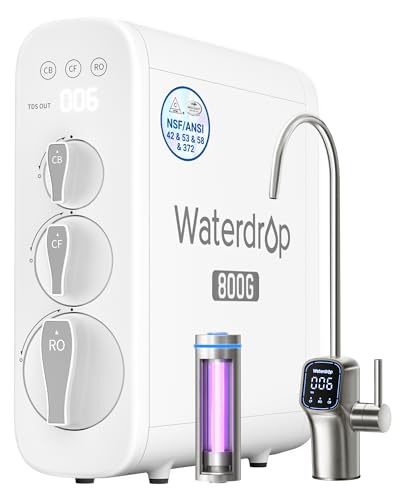
- [10-Stage filtration] Tested by official third-party laboratory (SGS), through 10-stage filtration, G3P800 can effectively reduce …
- [NSF/ANSI standard 42 & 53 & 58 & 372 certified] This tankless reverse osmosis system is certified by IAPMO R&T against NSF/ANSI 5…
- [800 GPD high capacity, 3:1 pure to drain ratio] The Waterdrop G3P800 reverse osmosis system offers a higher water capacity (800 g…
Waterdrop WHF3E-SKH 3-Stage Whole House Water Filter System
The WHF3E-SKH is a main-line cartridge system described as 9 layers of filtration across three stages, with a 5-micron rating, 1-inch inlet and outlet, flow up to 15 GPM and a stated capacity of up to 250,000 gallons. The manufacturer’s figures cite 93.63% scale reduction, 98% chlorine reduction and 99.9% lead reduction from its internal R&D laboratory testing; the listing’s own footnote says actual performance varies with water quality and usage, and the listing title says 99% lead reduction while the body says 99.9%. It is certified to NSF/ANSI 372 for low-lead materials and tested by the Waterdrop laboratory with reference to NSF/ANSI 42 and 53 — note the distinction between third-party certification and in-house testing against a standard. Construction details include dual-sided reinforced threads, dual sealing O-rings and top-sealed push-in cartridges.
This is a point-of-entry system for homeowners dealing with sediment, chlorine taste and odor, and scale and metal concerns across the whole house, and it is often paired with an under-sink RO for drinking water. For how this approach compares with other whole-house strategies, see our whole-house water filtration comparison.

- 【𝟗-𝐒𝐭𝐚𝐠𝐞 𝐅𝐢𝐥𝐭𝐫𝐚𝐭𝐢𝐨𝐧 & 𝟗𝟑.𝟔𝟑% 𝐒𝐜𝐚𝐥𝐞 𝐑𝐞𝐝𝐮𝐜𝐭𝐢𝐨𝐧*】Featuring 9 layers of effective filtration, this Waterdrop whole house water filter …
- 【𝐍𝐒𝐅/𝐀𝐍𝐒𝐈 𝟑𝟕𝟐 𝐂𝐞𝐫𝐭𝐢𝐟𝐢𝐞𝐝, 𝐓𝐞𝐬𝐭𝐞𝐝 𝐭𝐨 𝟒𝟐 & 𝟓𝟑】Certified to NSF/ANSI 372 for low-lead safety, this whole house water filtration system…
- 【𝟏𝟓 𝐆𝐏𝐌 𝐅𝐥𝐨𝐰 & 𝟐𝟓𝟎,𝟎𝟎𝟎-𝐆𝐚𝐥 𝐂𝐚𝐩𝐚𝐜𝐢𝐭𝐲】Delivering a flow rate of up to 15 GPM, the system supports simultaneous household activities …
Waterdrop WHF3T-FG 3-Stage Whole House Water Filter System
The WHF3T-FG shares the same basic format — three stages, 5 micron, 15 GPM, 1-inch ports — but is specifically engineered around well water. It uses a double iron and manganese removal cartridge paired with a carbon fiber filter across what the listing calls 7 stages (the same listing’s title calls it a 3-stage system, so the stage count is described inconsistently), with SGS testing cited at 95.9% iron and 99.7% manganese reduction (test conditions are not given in the listing), alongside chlorine, taste, odor, sediment and rust reduction. Materials are NSF/ANSI 372 certified for lead-free construction, and the listing states that the iron and manganese media itself meets NSF/ANSI 61, 44, 53 and 58 plus FDA and REACH requirements; that is a media-material statement, not a certification of the complete system. Service intervals are given as every 6–12 months for the iron and manganese cartridge and every 12 months for the GAC filter.
Choose this one if a water test shows iron staining or manganese in well water and you want main-line treatment. Choose the WHF3E-SKH instead if scale and sediment are the primary complaints. Always test the well first — iron and manganese levels, pH and whether the iron is dissolved or already oxidized all affect whether a cartridge filter is the right tool. Sediment, carbon and iron-media cartridges do not remove or disinfect bacteria (including iron bacteria), and hydrogen sulfide odor is a separate issue; heavy iron loads may call for a different approach, and a licensed water treatment professional can advise.

- [SGS Tested and Certified] Tested by SGS, Waterdrop whole house water filter system effectively reduces 95.9% of iron、99.7% of man…
- [Certified Safe Materials] NSF/ANSI 372 certified for lead-free materials. The filter media meets NSF/ANSI 42, RoHS, and other key…
- [7-Stage Filtration] Using double iron and manganese removal cartridge and covered with high-quality carbon fiber filter achieve d…
Waterdrop T3-M Remineralization Reverse Osmosis System (450 GPD)
The T3-M is the mid-size remineralization option: 9-stage filtration, a 0.0001-micron RO membrane, and calcium and magnesium infused back into the output. It is NSF/ANSI 372 certified for lead-free materials and, per the listing, tested by an unnamed third-party laboratory to reduce heavy metals, chlorine, PFOA and PFOS. Output is 450 GPD at a 2:1 pure-to-drain ratio. Practical touches include an all-in-one cartridge for quick replacement (the listing also gives separate 6-, 12- and 24-month intervals for the CF, CB and RO filters, so check what is actually replaced together), smart filter-change alerts, an LED light and continuous automatic flushing. The listing notes a plug-in power connection is required.
It suits a small-to-medium household that wants mineral-added RO water in a simpler package than the X12, and who values single-cartridge maintenance over maximum flow rate.
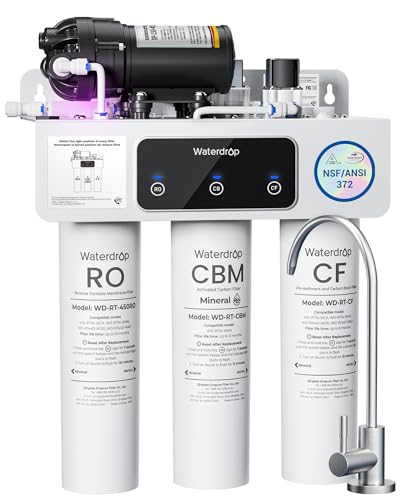
- [Advanced 9-Stage Filtration]: The Waterdrop Reverse Osmosis Water Filter — WD-T3-M uses advanced 9-stage filtration to reduce hea…
- [Mineral-Infused]: Enjoy mineral-rich water with our advanced reverse osmosis system. Infused with calcium, magnesium and other es…
- [450GPD Fast Flow & Smart Alerts]: Experience fast, steady 450GPD water flow. Our under-sink RO system's smart alerts remind you w…
Waterdrop G2 Reverse Osmosis System (400 GPD)
The G2 is the entry point: 400 GPD, 7-stage composite filtration, NSF/ANSI 372 certification for lead-free materials, and a 1:1 pure-to-drain ratio. Waterdrop states a cup of filtered water in roughly 12 seconds. The tankless housing is described as saving over 70% more under-sink storage space than ‘the ordinary RO system’ (the listing does not define that comparison), with integrated electrical and water circuits to reduce leak risk and an airtight housing to cut noise. Two filters ship in the box; replacements are the G2CF and G2MRO cartridges.
This is the practical choice for one or two people, a small kitchen, an apartment or a second sink where TDS displays and remineralization are not priorities. The trade-off versus the rest of the line is the 1:1 drain ratio, meaning more water sent to drain per gallon produced, and no remineralization stage listed.

- [NSF/ANSI 372 Certified] 400 GPD & 1:1 low drain ratio & Tankless Design & Easy installation. Two filters are included in the pack…
- [7 Stage Filtration & effective filtration] The G2 system is certified by NSF/ANSI 372 for lead-free materials. The G2 RO System a…
- [400 GPD & 1:1 pure to drain ratio] The Waterdrop G2 reverse osmosis system offers a fast water flow rate of up to 400 GPD. Get a …
Waterdrop model comparison
| Model | Type | Key capacity / output | Power | Best fit |
|---|---|---|---|---|
| X12 Alkaline Mineral | Tankless under-sink RO, remineralizing, 11-stage | 1200 GPD; 3:1 pure to drain; 24-month RO filter | Electric (pump + smart faucet display) | Large households wanting maximum flow, minerals and on-faucet TDS readout |
| G3P800 | Tankless under-sink RO, 10-stage | 800 GPD; 3:1 pure to drain | Electric (pump + smart LED faucet) | Medium-to-large households prioritizing NSF/ANSI 42, 53, 58 and 372 certification |
| WHF3E-SKH | 3-stage whole-house cartridge filter, 9 layers | 15 GPM; 5 micron; up to 250,000 gal; 1″ inlet/outlet | None (no electricity required) | Whole-home scale, sediment, chlorine and heavy-metal concerns |
| WHF3T-FG | 3-stage whole-house cartridge filter, 7-stage, well-focused | 15 GPM; 5 micron; 1″ inlet/outlet; 6–12 mo and 12 mo cartridges | None (no electricity required) | Well water with iron and manganese, rust, taste and odor issues |
| T3-M Remineralization | Tankless under-sink RO, remineralizing, 9-stage | 450 GPD; 2:1 pure to drain; all-in-one cartridge | Electric (plug-in required) | Small-to-medium households wanting minerals and simple cartridge swaps |
| G2 | Tankless under-sink RO, 7-stage | 400 GPD; 1:1 pure to drain; G2CF + G2MRO filters | Electric (pump) | One to two people, tight cabinets, straightforward drinking-water filtration |
How to choose
Start with a water test, not a product page. A certified lab test or your utility’s annual water quality report tells you whether you are solving for hardness and scale, chlorine taste, iron staining, heavy metals, or dissolved solids. The right answer for iron in well water is a different machine from the right answer for TDS at the kitchen tap.
Decide point-of-use or point-of-entry — or both. Under-sink RO treats drinking and cooking water only. Whole-house cartridge filters protect plumbing and appliances and improve water at every fixture but do not reduce dissolved solids the way an RO membrane does. Many homeowners end up with a whole-house filter plus an under-sink RO, which can reduce the sediment and chlorine load on the RO prefilters. Our guide to tank versus tankless under-sink RO walks through the format decision in more detail.
Match GPD to household demand, not to the biggest number. GPD is a membrane rating under test conditions, so real-world output varies with water temperature and pressure. A 400 GPD tankless unit is generally adequate for one or two people. Larger families filling multiple bottles and cooking pots back to back benefit from 800 or 1200 GPD. Check each listing’s dimensions against your cabinet.
Weigh the drain ratio. Across this lineup the published ratios range from 1:1 to 3:1 pure to drain. A higher pure-to-drain ratio sends less water down the drain per gallon produced, which matters more in regions with water restrictions or metered sewer charges.
Decide whether you want minerals added back. The X12 and T3-M list a remineralization stage; the G3P800 and G2 listings do not. This is largely a taste preference, and either approach is a legitimate choice.
Plan filter replacement before you buy. Cartridge intervals vary from 6 months to 24 months across these models. Recurring cartridge cost over several years is often as consequential as the purchase itself, and using non-specified cartridges or skipping changes can affect warranty coverage, so check the warranty terms — see what actually voids water treatment warranties. For broader category context across brands and system types, our complete water systems guide is a good next stop.
Installation and safety
Under-sink RO installation involves tapping the cold water supply, adding a drain connection and mounting a dedicated faucet, which usually means drilling the countertop or sink deck if there is no existing third hole. Every tankless model here requires electricity, so a dedicated, properly protected receptacle under the sink is part of the job — running an extension cord into a cabinet that also contains water lines is not an acceptable substitute. Electrical circuits and receptacle placement must follow local code; where that code or the product warranty requires licensed work, use a licensed plumber and a licensed electrician. Some listings describe installation as DIY-friendly; whether that is appropriate depends on your skills, local code and the warranty, and a licensed plumber is the safer route for the supply tap and drain connection.
Whole-house systems are a bigger undertaking. They require cutting into the main service line after the meter or well pressure tank, installing isolation valves and ideally a bypass loop, supporting the weight of the housing assembly, and confirming the 1-inch ports are compatible with existing pipe size and material. Plumbing modifications to the main line are permit-triggering work in many jurisdictions and are best handled by a licensed plumber. Backflow protection requirements, drain line air gaps and local plumbing code provisions all apply.
A few additional points: no filter in this guide is a disinfection device. Water that is or may be microbiologically unsafe requires a separate, appropriate treatment approach — and for private wells, routine bacteriological testing. Cartridge filters have pressure-drop characteristics, so if your home already has marginal pressure, verify incoming static pressure before adding a point-of-entry system. Freezing temperatures will damage housings and membranes, so unheated garages and crawl spaces need protection. Finally, confirm that sediment prefilters are sized for your water; heavy sediment loads can clog a 5-micron cartridge faster than the stated interval. See our disclaimer for the limits of general guidance like this.
Frequently asked questions
Do Waterdrop tankless RO systems need electricity?
Yes. All four under-sink RO systems in this guide use an internal booster pump to drive water across the membrane, so they need a plug-in power connection — the T3-M and G2 listings state this explicitly. That also means they typically will not produce filtered water during a power outage, and under-sink receptacle placement should follow local electrical code. The two whole-house cartridge filters, by contrast, require no electricity at all.
What does “3:1 pure to drain” actually mean?
Reverse osmosis works by rejecting concentrated water to a drain line. A 3:1 pure-to-drain ratio means roughly three parts of filtered water for every one part sent to drain; a 1:1 ratio means about one part each. Within this lineup the X12 and G3P800 are rated 3:1, the T3-M 2:1 and the G2 1:1. All RO systems send some water to drain — the ratio tells you how efficiently a given unit does it.
Can a Waterdrop whole-house filter replace a water softener?
No. The WHF3E-SKH cites scale reduction and the WHF3T-FG targets iron and manganese, but neither is an ion-exchange softener and neither removes hardness minerals from the water. If a test shows significant hardness and you want softened water for fixtures, appliances and laundry, a softener or a conditioner is a separate decision — one these filters can complement but not substitute for.
How often do the filters need to be replaced?
It varies by model and by your incoming water quality. The X12 specifies a 24-month RO filter. The WHF3T-FG calls for its iron and manganese cartridge every 6–12 months and its GAC filter every 12 months. The WHF3E-SKH is listed at up to 250,000 gallons, with its three filters stated to last up to one year. Several RO models include filter-life indicators or smart alerts. Heavier sediment, higher chlorine or higher TDS will shorten real-world life, so treat published intervals as a baseline rather than a guarantee.