HomeMechanicals.com is an Amazon Associate and earns from qualifying purchases. Product details come from manufacturer listings; see our research process.
AprilAire is a US manufacturer of indoor air quality equipment that has been in the category since 1954, and its product listings describe the company as the inventor of the whole-home evaporative humidifier. Unlike portable room appliances, almost everything AprilAire builds is designed to be installed as part of a home’s HVAC system or dedicated ductwork, which means the buying decision is less about features on a box and more about how the unit will be integrated into your house. This guide covers the AprilAire whole-house dehumidifiers and humidifiers available on Amazon for single-family homes in 2026, how the families differ, and which household conditions point toward each one.
How the AprilAire lineup is organized
The models in this guide fall into three distinct families. They solve opposite problems, and some homes in mixed climates end up with one of each: a dehumidifier for humid summers and a humidifier for dry winter heating season.
E Series Pro whole-house dehumidifiers (E080 Pro, E100 Pro, E130 Pro). These are ducted or free-standing dehumidifiers sized by pints of moisture removed per day (PPD). They are intended for basements, sealed crawl spaces, or whole-home duty, and they drain continuously rather than collecting water in a tray. All three are listed as ENERGY STAR Most Efficient certified and built with corrosion-resistant aluminum coils. The practical difference between them is capacity and the square footage each is rated to serve. Keep in mind that the pints-per-day figures in the listings are “up to” ratings measured at warm, humid test conditions (AprilAire’s E080 spec sheet cites 80°F and 60% relative humidity for its 80-pint rating). ENERGY STAR’s product database, which uses the cooler DOE test point, lists lower figures for some models (for example 65 pints per day for the E080 Pro), and a cool basement will typically see lower real-world output than the headline number.
Fan-powered evaporative humidifiers (700, 720AKZ). These mount on or beside the furnace plenum and use a built-in fan to pull heated air through a wetted water panel. Because the unit supplies its own airflow, it does not depend on a bypass duct, which can simplify installation where a bypass duct is impractical; an installer can confirm what fits your furnace. Output is rated in gallons per day (GPD).
Steam humidifiers (Model 800). A steam humidifier generates moisture electrically rather than evaporating it off a panel, so its output does not depend on furnace heat. That is why steam is often considered for very large homes, homes with heat pumps or lower supply-air temperatures, and homes where a fan-powered unit cannot keep up. If you are still deciding between the three approaches, our overview of bypass, fan-powered, and steam whole-house humidifiers walks through the trade-offs in more detail.
The models worth knowing
AprilAire E130 Pro 130-Pint Whole-House Dehumidifier
The E130 Pro is the largest dehumidifier in this group, removing up to 130 pints (16 gallons) of moisture per day and rated for homes up to 7,200 square feet. It ships with the AprilAire Model 76 digital wall-mount dehumidifier control, which communicates with the unit from a different location — useful when the dehumidifier itself sits in a crawl space or an unfinished corner of the basement and you would rather not go down there to change a setting. Smart sensing starts dehumidification automatically when humidity rises above the target you set.
This is the model to look at for large footprints, damp walk-out basements, or a sealed crawl space plus living space served by one machine. The Amazon listing describes it as ENERGY STAR Most Efficient certified with corrosion-resistant aluminum coils, states it is designed and assembled in the USA using US and global components, and cites a 5-year warranty.
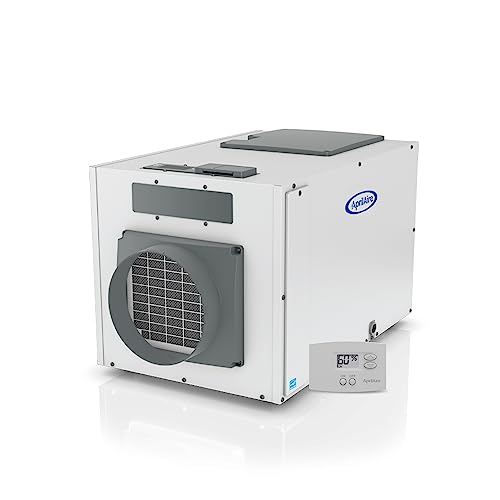
- BALANCED HUMIDITY FOR HEALTH AND HOME PRESERVATION – Help prevent mold, mildew, dust mites, and odors caused by excess moisture to…
- ENERGY EFFICIENT – This ENERGY STAR Most Efficient certified dehumidifier removes up to 130 pints (16 gallons) of moisture per day…
- SET IT AND FORGET IT – There is no messy water tray to empty and set up is simple. Set the target humidity and smart sensing techn…
AprilAire E100 Pro 100-Pint Whole-House Dehumidifier
The E100 Pro removes up to 100 PPD and is rated for basements, crawl spaces, or whole-house duty up to 5,500 square feet. It carries the same core design as the rest of the E Series Pro line: smart sensing automatic operation, no water tray to empty, and a setup that can either run to a hose or sit over a floor drain. It is also listed as ENERGY STAR Most Efficient certified.
For a typical mid-size to large home with a persistently damp basement, the E100 Pro is the middle of the three dehumidifiers covered here — more reserve capacity than the 80-pint unit for homes that struggle through long humid stretches, without stepping up to the largest chassis. Note that the Model 76 wall control is listed as included with the E130 Pro; treat remote control as a separate consideration for this model.

- PROTECT YOUR HOUSE – Reduces & controls basement & whole home humidity to help prevent damp carpeting and furnishings, mold, milde…
- SET AND FORGET – Smart sensing technology automatically starts dehumidification when humidity above target is sensed
- ENERGY EFFICIENT – Energy Star Most Efficient Certified Dehumidifier removes up to 100 PPD of moisture using less energy, reducing…
AprilAire E080 Pro 80-Pint Whole-House Dehumidifier
The E080 Pro removes up to 80 PPD and is rated for spaces up to 4,400 square feet. It is the smallest of the three E Series Pro models in this guide (the listing calls it commercial-grade) and is aimed at a single target area, such as a sealed crawl space or a basement that is damp but not actively wet. Like its larger siblings it drains continuously, uses corrosion-resistant aluminum coils, and is listed as ENERGY STAR Most Efficient certified.
Undersizing a dehumidifier means it runs nearly constantly and still may not reach the target humidity, so the square-footage rating should be read as a ceiling under reasonable conditions rather than a guarantee for an unusually wet space.
- PROTECT YOUR HOUSE – Reduces & controls basement & whole home humidity to help prevent damp carpeting and furnishings, mold, milde…
- SET AND FORGET – Smart sensing technology automatically starts dehumidification when humidity above target is sensed
- ENERGY EFFICIENT – Energy Star Most Efficient Certified Dehumidifier removes up to 80 PPD of moisture using less energy, reducing …
AprilAire 800 Whole-House Steam Humidifier
The Model 800 is AprilAire’s high-output steam humidifier, rated for homes up to 10,300 square feet in tightly built construction. It offers six output levels adding 11.5 to 34.6 gallons of moisture per day depending on voltage and installation, which is a far wider range than any evaporative unit in the lineup. Dual sensors monitor outdoor temperature and indoor relative humidity so the unit adjusts automatically.
It uses electrode technology, which relies on the mineral content already present in tap water to conduct electricity — so water filtration is not recommended, and purified water is not required. Because a steam humidifier makes its own moisture, it can run independently of furnace heat, which is why it is typically specified for very large homes, for homes where heating supply air is cooler, or where a panel-type humidifier cannot deliver enough moisture. The trade-off is a more involved electrical installation and higher electrical demand than a fan-powered unit.

- BUY WITH CONFIDENCE This high output steam humidifier was designed with electrode technology and manufactured in the U. S. A. by A…
- FULL COVERAGE up to 10,300 square feet in tightly built homes. Choose from 6 levels of output adding 11. 5 to 34. 6 gallons of moi…
- AUTOMATIC HUMIDIFIER with dual sensors to monitor and respond to both outdoor temperature and indoor relative humidity to deliver …
AprilAire 720AKZ Whole-House Fan-Powered Evaporative Humidifier
The 720AKZ is the current high-capacity evaporative model, delivering 21 gallons per day and rated for homes up to 6,250 square feet. Three design changes separate it from the long-running 700: a recirculation valve that the Amazon listing says sends 60% less water down the drain compared with the 700, a hybrid fan the listing describes as delivering twice the evaporative efficiency on high speed versus the 700, and a one-piece disposable HydroCore water panel cartridge that pops in and out for annual replacement and is made with recycled plastic.
It also has a reversible fan module, so the unit can be configured with the fan on the left or right to suit tight installs and horizontal furnace configurations. The included digital control runs in Automatic Mode based on outdoor temperature or in Manual Mode. An installation kit is included. The listing positions it as the higher-capacity, water-saving option in the evaporative line; actual output, water use, and panel life depend on the home, the furnace, and local water quality.
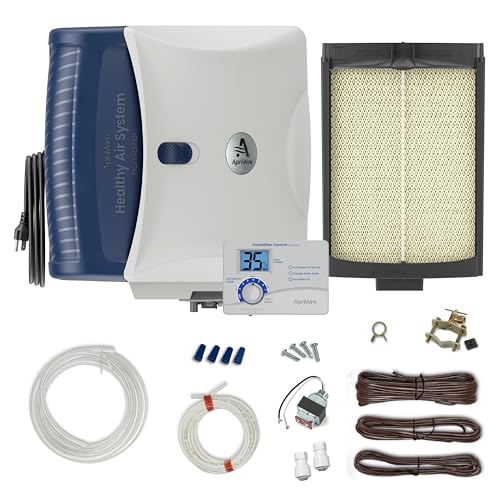
- INDUSTRY-LEADING CAPACITY – Delivers 21 gallons per day of humidification and balances humidity quicker than ever to satisfy large…
- 60% LESS WASTEWATER* – Built with superior sustainability in mind. The innovative recirculation valve recycles water to increase p…
- ONE-PIECE HYDROCORE – The one-piece disposable HydroCore water panel cartridge quickly pops in and out for fast replacement and is…
AprilAire 700 Whole-House Humidifier
The 700 is the established fan-powered evaporative humidifier in the line: 18 gallons per day, rated for homes up to 5,300 square feet in tightly built construction. A built-in fan pulls heated air directly from the furnace through the water panel, and dual sensors track outdoor temperature and indoor relative humidity for automatic operation.
Its established place in the line may be a practical consideration for some buyers, since installers are likely to be familiar with it; confirm replacement water panel availability for your area before buying. It fits homes within its square-footage range where the priority is a proven, straightforward evaporative unit rather than the water-saving and maintenance refinements of the 720AKZ.

- BUY WITH CONFIDENCE This humidifier was designed and manufactured in the USA by AprilAire – the inventor of the whole home evapora…
- FULL COVERAGE up to 5,300 square feet in tightly built homes with a capacity of 18 gallons per day
- AUTOMATIC HUMIDIFIER with dual sensors to monitor and respond to both outdoor temperature and indoor relative humidity to deliver …
Model comparison
| Model | Type | Rated capacity | Coverage | Power / water notes | Best fit |
|---|---|---|---|---|---|
| E130 Pro | Whole-house dehumidifier | Up to 130 pints (16 gal.) per day | Up to 7,200 sq. ft. | Electric; continuous drain to hose or floor drain; Model 76 wall control included | Large homes, big or very damp basements, crawl space plus living space |
| E100 Pro | Whole-house dehumidifier | Up to 100 PPD | Up to 5,500 sq. ft. | Electric; continuous drain to hose or floor drain | Mid-size to large homes needing reserve dehumidification capacity |
| E080 Pro | Whole-house dehumidifier | Up to 80 PPD | Up to 4,400 sq. ft. | Electric; continuous drain to hose or floor drain | A single target area such as a sealed crawl space or moderately damp basement |
| 800 | Steam humidifier | 11.5–34.6 gal. per day across 6 output levels | Up to 10,300 sq. ft. | Electric steam, electrode technology; output varies by voltage and installation; water filtration not recommended | Very large or tightly built homes; where furnace heat alone cannot drive enough evaporation |
| 720AKZ | Fan-powered evaporative humidifier | 21 gal. per day | Up to 6,250 sq. ft. | Water supply and drain; recirculation valve cuts wastewater 60% vs. 700; HydroCore cartridge | Larger homes wanting maximum evaporative output and low water waste |
| 700 | Fan-powered evaporative humidifier | 18 gal. per day | Up to 5,300 sq. ft. | Water supply and drain; built-in fan draws heated air from the furnace | Homes within range wanting a long-established evaporative unit |
How to choose
- Start with the problem, not the product. Static shocks and gaps opening in wood floors during winter can point to air that is too dry, while a musty basement or damp-feeling stored items in summer can point to excess moisture. Window fogging in winter is more often a sign of too much indoor humidity than too little, so it is a reason to be cautious about adding humidity. These symptoms have several possible causes; a licensed HVAC contractor can help confirm which applies. Mixed climates can have both, and the two are handled by separate equipment.
- Treat square-footage ratings as conditional. The Amazon listings state humidifier coverage figures for tightly built homes. An older house with leaky windows, a fireplace flue, and significant air infiltration will see less effective coverage from the same unit, which is a common reason installers size up or recommend steam.
- Check the furnace configuration before choosing a humidifier. Available clearance around the plenum, whether the furnace is horizontal, and how much supply-air temperature you have all steer the choice between a fan-powered evaporative unit and a steam unit. The 720AKZ’s reversible fan module exists specifically to deal with tight installs.
- Confirm a drain and a water line. Evaporative humidifiers need both a water supply and a drain. The E Series Pro dehumidifiers need gravity drainage to a hose run or a floor drain; if neither exists where the unit must sit, a condensate pump becomes part of the job.
- Think about who will change the water panel. Evaporative humidifiers need an annual water panel replacement, and mineral-heavy water shortens panel life. The 720AKZ’s one-piece HydroCore cartridge is designed to make that a quick swap. Steam units have their own periodic service requirements — follow the manual and your installer’s guidance.
- Coordinate with other HVAC work. Adding a humidifier or dehumidifier can be more convenient, and may reduce separate labor, when a contractor already has the system open. If a furnace or air handler replacement is on the horizon, read our guide to the best time of year to install HVAC equipment and bundle the accessory into that scope. Our complete heating and cooling guide covers how these accessories fit the rest of the system.
Installation and safety
None of the equipment in this guide is a casual drop-in purchase. Some E Series Pro dehumidifier variants are cord-and-plug and others are hard-wired, but every product here ties into drains, ductwork, or the home’s HVAC system. Whole-house humidifiers typically involve cutting into the furnace plenum or ductwork, a potable water connection, a drain, low-voltage control wiring to the furnace board, and a humidistat location that reads the air accurately. Steam humidifiers typically also need a dedicated electrical circuit sized to the model and supply voltage, plus a drain connection for the unit’s flush cycle. All of this should be done by a licensed HVAC contractor, with permits and inspection where your jurisdiction requires them, and in accordance with local mechanical, plumbing and electrical codes and the manufacturer’s installation instructions.
A few additional points worth raising with your installer:
- Humidity targets. The Amazon listings cite 40–60% relative humidity as a target range. In cold weather, indoor humidity near the top of that range can cause condensation on windows and inside wall cavities, which can contribute to mold or moisture damage over time. Ask your installer for a setpoint suited to your climate and construction, watch windows for fogging or moisture, and keep the automatic outdoor-temperature adjustment enabled rather than forcing a fixed high setpoint.
- Water chemistry. The Model 800 uses electrode technology that depends on impurities in the water to conduct electricity, and the Amazon listing states water filtration is not recommended for it. Evaporative units are affected the opposite way: hard water leaves mineral deposits on the water panel. Have your water characteristics in hand before the install conversation.
- Dehumidifier placement and drainage. E Series Pro units drain continuously, so the drain path has to stay clear and freeze-free, and condensate and drain routing (including any condensate pump) should follow local plumbing code and be handled by a licensed professional. In a crawl space, dehumidification works best in a space that has been properly sealed and vapor-barriered first; a dehumidifier is not a substitute for fixing bulk water intrusion, grading or gutter problems.
- Total cost and ongoing upkeep. Installed cost is typically more than the equipment price once plumbing, drain, electrical, ductwork, and any condensate pump are included, so get written quotes from licensed contractors. Plan for recurring items: humidifier water panels, steam cylinder service on the Model 800, and dehumidifier filter and drain checks. Humidifier water panels and wet surfaces can collect minerals and microbial growth if neglected, so follow the manual’s cleaning and seasonal shut-off guidance. Dehumidifiers also have operating limits: the E080 spec sheet lists inlet air of roughly 50–104°F for dehumidification, so very cold spaces may not suit them.
- Warranty and documentation. Register the equipment, keep the installer’s invoice, and understand what the furnace manufacturer requires of accessories added to its equipment. Our explainer on what actually voids HVAC coverage is a good pre-install read.
These are mechanical systems that affect moisture inside your building envelope. Nothing here should be read as a promise of energy savings, health outcomes, or added home value — the goal is appropriate, controlled humidity for comfort and for protecting the building and its contents.
Frequently asked questions
What size whole-house dehumidifier does a basement need?
Match the unit’s rated coverage to the space it will serve, then account for how wet that space actually is. The E080 Pro is rated to 4,400 square feet, the E100 Pro to 5,500, and the E130 Pro to 7,200. A space with high groundwater pressure, a walk-out door, or a large unsealed crawl space connected to it behaves like a bigger load than its floor area suggests, and an undersized unit will simply run continuously without hitting the target. A contractor who can measure existing humidity levels over several days will give a better answer than square footage alone.
How do fan-powered and steam humidifiers differ in day-to-day operation?
A fan-powered evaporative unit such as the 700 or 720AKZ uses a built-in fan to move heated air across a wetted panel, so its output is tied to the furnace supplying warm air. The Model 800 steam humidifier generates moisture electrically across six output levels, from 11.5 to 34.6 gallons per day depending on voltage and installation, so it is not dependent on furnace heat. Steam generally covers more area — up to 10,300 square feet for the 800 — while evaporative units are mechanically simpler and have lighter electrical requirements.
Does a whole-house humidifier waste water?
Evaporative humidifiers send some water to the drain as part of normal operation, which is why the 720AKZ includes a recirculation valve that the Amazon listing states reduces wastewater by 60% compared with the 700 while recycling water to increase performance. The Model 800 steam humidifier works differently again, consuming water to produce steam and using a drain for its flush cycle; the listing says filtration is not recommended. If water use is a concern in your area, the 720AKZ is the model in this lineup designed around it.
How much maintenance should a homeowner expect?
Evaporative humidifiers need an annual water panel change — the 720AKZ uses a one-piece HydroCore cartridge designed to pop in and out quickly — plus a seasonal check that the water and drain lines are clear. The E Series Pro dehumidifiers have no water tray to empty but do need periodic filter and drain checks. The Model 800 steam humidifier has service requirements specific to electrode technology (such as periodic cylinder cleaning or replacement, depending on water quality) that should be handled per the manual, and many homeowners fold it into an annual HVAC service visit.