Prices shown were verified on Amazon on September 15, 2026 and change frequently — always check the current price before buying.
These two product categories get confused constantly, partly because both are sold as “whole house” systems that get plumbed into your main water line, and partly because some marketing blurs the line between them. They solve different problems. A water softener addresses hardness (dissolved calcium and magnesium); a whole-house filter addresses contaminants and particulates (chlorine, sediment, sometimes chemicals or metals depending on the media). Neither one substitutes for the other, and depending on your water source, you may end up needing both. As an Amazon Associate we earn from qualifying purchases.
The Core Mechanical Difference
A water softener works through ion exchange: hard water passes through a resin bed of tiny beads that swap calcium and magnesium ions for sodium (or potassium) ions. Periodically, the system flushes the resin with a concentrated brine solution to “recharge” it, sending the collected hardness minerals down the drain. This is why softeners need a brine tank, a drain line, and regular salt (or potassium) refills.
A whole-house filter works through physical and/or chemical filtration: water passes through one or more filter media — commonly sediment filters (removing dirt, sand, and rust particles), activated carbon (removing chlorine, chloramine, and some organic compounds/taste-odor issues), and sometimes specialty media like KDF or catalytic carbon for specific contaminants. There’s no brine tank and no regeneration cycle — you replace the filter cartridges on a schedule instead.
What a Water Softener Actually Solves
- White scale buildup on faucets, shower doors, and glassware
- Reduced water heater efficiency and lifespan caused by scale accumulating on heating elements
- Soap and shampoo that don’t lather well, or leave a filmy residue
- Dry skin/hair after showering, commonly attributed to hard water mineral residue
- Scale-related clogging inside appliances (dishwashers, washing machines) over time
A softener does not improve chlorine taste/odor, remove sediment, or address lead, bacteria, or other drinking-water contaminants.
What a Whole-House Filter Actually Solves
- Chlorine/chloramine taste and odor throughout the house, not just at one tap
- Visible sediment — dirt, sand, rust particles — especially common on well water or older municipal pipes
- Certain dissolved contaminants, depending on the specific filter media (check the filter’s data sheet for exactly what it’s rated to reduce — capabilities vary a lot between a basic sediment/carbon unit and a specialty multi-stage system)
A standard sediment/carbon whole-house filter does not soften water — it will not stop scale formation, because it isn’t removing the calcium and magnesium that cause hardness.
It’s also worth being specific about what a basic sediment/carbon filter does not remove at meaningful levels: fluoride, nitrates, arsenic, PFAS, and most heavy metals generally pass through standard carbon media. If a water test flags any of those, a whole-house carbon filter alone won’t solve it — that typically requires reverse osmosis or a specialty media targeted to the specific contaminant, not the general-purpose systems discussed in this post.
Get Your Water Tested Before You Decide
This is the step people skip, and it’s the one that actually tells you which product you need. Options, roughly in order of cost:
- Municipal water quality report — if you’re on city water, your utility publishes an annual water quality report (often called a Consumer Confidence Report) that includes hardness data. This is free and a reasonable starting point.
- Home test strips — inexpensive, widely available, give you a rough hardness (and sometimes chlorine/iron) reading in minutes. Good enough for a first pass, less precise than a lab test.
- Certified lab test — mail-in or local lab testing, more accurate, and the only reliable way to check for well-water-specific concerns like bacteria, iron, or nitrates. Recommended for anyone on a private well, since well water isn’t covered by municipal reporting.
Softener vs. Filter vs. Both
| Water Softener | Whole-House Filter | Both | |
|---|---|---|---|
| Removes hardness (Ca/Mg) | Yes | No | Yes |
| Removes chlorine/taste-odor | No | Depends on media | Yes |
| Removes sediment/particulates | No (can be damaged by it) | Yes | Yes |
| Needs salt/brine tank | Yes (salt-based types) | No | Yes, for the softener stage |
| Ongoing cost driver | Salt + occasional service | Cartridge replacement | Both |
| Typical starting price | ~$340-$1,500+ | ~$150-$500+ | Sum of both systems |
When You Need a Softener Only
If your water test shows elevated hardness but your municipal water quality report doesn’t flag chlorine, taste, or contaminant concerns, a softener alone addresses the actual symptom you’re dealing with. A mid-range, widely serviced option is the AFWFilters 48K Grain Fleck 5600 SXT (about $795) — the Fleck 5600 SXT valve is common enough that most regions have technicians who can service it. If budget is the primary constraint, the Aquasure Harmony Series 40,000 Grain unit (around $520) is a lower-cost salt-based option sized for a typical 3-4 bathroom household on moderately hard water.
AFWFilters Fleck 5600 SXT — check current price
Aquasure Harmony 40,000 Grain — check current price
When You Need a Filter Only
If your water tests reasonably soft but you notice a chlorine smell/taste at every tap, or you’re on well water with visible sediment, a whole-house filter addresses that without paying for softening capacity you don’t need. The Express Water 3-Stage Whole House Water Filter System (about $490) is a multi-stage sediment/carbon setup built for that use case. A more budget-focused option is the iSpring WGB21B 2-Stage system (around $155), which covers the basics — sediment plus carbon — at a lower entry cost, with correspondingly less filtration capacity than a 3-stage system.
Express Water 3-Stage Whole House Filter — check current price
iSpring WGB21B 2-Stage — check current price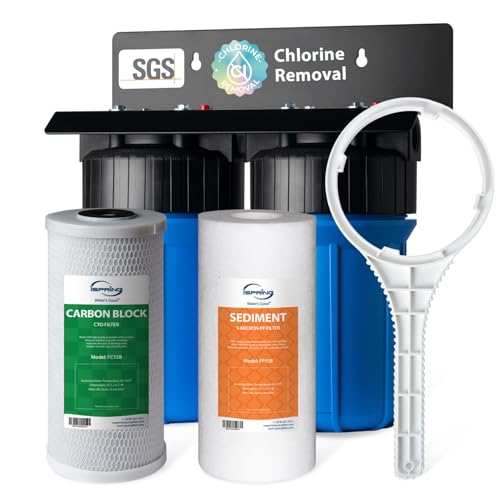
When You Need Both
This is common on well water specifically, where it’s routine to have hardness, sediment, and chlorine/iron concerns simultaneously, and on municipal water in areas with both hard water and heavily chlorinated supply. The typical setup is a sediment/carbon filter installed upstream of the softener — this protects the softener’s resin bed from sediment fouling and removes chlorine before it can degrade the resin over time — followed by the softener itself. If you don’t want the brine tank/salt commitment of a true softener but still want to reduce scale, a salt-free scale control unit like the A.O. Smith Whole House Salt-Free Scale Control (AO-WH-DSCLR) (about $340) paired with a separate carbon filter is a lower-maintenance combination — with the caveat that it changes mineral crystal structure rather than removing hardness minerals outright, so it won’t produce the same “soft” water feel as ion exchange.
A.O. Smith Salt-Free Scale Control — check current price
Cost Comparison Over Time
Softener and filter costs break down differently over the life of the system:
- Softener ongoing costs: salt (commonly $60-$300/year depending on household size and hardness level), optional professional servicing ($150-$300/year), and eventual resin replacement (resin beds are typically rated 10-15 years).
- Filter ongoing costs: cartridge replacement, which varies by system and micron rating but commonly runs from a few dollars per cartridge for basic sediment filters (replaced every 3-6 months) up to more for combined carbon/KDF cartridges on a similar schedule. There’s no salt or drain line involved. Filter performance also degrades gradually between cartridge changes — expect some drop in flow rate/pressure as a cartridge nears the end of its rated capacity, more noticeable on finer micron ratings.
- Installation: both categories are typically installed at the point where the main water line enters the house, and both commonly run $150-$1,000+ in professional labor depending on whether your plumbing is already set up for it. Running both systems in sequence adds plumbing complexity (and cost) versus installing just one.
Installation Note
Both softeners and whole-house filters tie into your home’s main water line, and in most jurisdictions that kind of plumbing work is covered by code and may require a permit, particularly if a drain line or backflow prevention is involved (relevant for softeners). We’re intentionally not providing DIY installation steps here — get a quote from a licensed plumber, who can also confirm local permit requirements and correctly size any bypass or drain connections.
Decision Cheat Sheet
| Your situation | Likely answer |
|---|---|
| Water tests hard (10+ GPG), no reported contaminant issues | Softener |
| Water tests soft/moderate, but tastes/smells like chlorine | Whole-house filter |
| Well water with hardness + sediment + chlorine or iron | Both, filter installed upstream of softener |
| Want less scale, don’t want a brine tank or added sodium | Salt-free scale control (not a true softener) + separate filter if needed |
| Unsure | Test your water first — don’t guess |
Bottom Line
These aren’t competing products solving the same problem — they’re solving two different problems that happen to both show up as “something’s off with my water.” A softener is the right answer to hardness and scale; a whole-house filter is the right answer to chlorine taste/odor and sediment; and a meaningful share of households, especially on well water, end up needing both installed in sequence. The one step that actually resolves the “which do I need” question is testing your water rather than guessing from symptoms alone — everything downstream of that (sizing, tier, budget) follows from the test results.
Pingback: iSpring Water Treatment Systems: A 2026 Buyer's Guide for Homeowners - HomeMechanicals