HomeMechanicals.com is an Amazon Associate and earns from qualifying purchases. Product details come from manufacturer listings; see our research process.
iSpring is a U.S. water treatment brand Atlanta-based, that has been engineering reverse osmosis systems since 2007. Its catalog covers the three jobs most households ask of a water system: softening hard water, filtering the whole house at the main line, and polishing drinking water at the point of use. Several of its products are marketed as DIY-installable (the whole-house cartridge filters, for example, list 1-inch NPT connections and 20-inch x 4.5-inch cartridges, with published installation videos), and the listings describe support handled from its Atlanta base. Local plumbing code still applies to any main-line work.
This guide explains how the iSpring lineup is structured in 2026, what each of the six models below actually does, and how to match one to your household. It draws on the product details shown in each model’s Amazon listing plus general category knowledge. It does not substitute for a water test, and it is an independent buyer’s guide, not a product test or review.
How the iSpring lineup is organized
Four product families account for nearly everything iSpring sells to homeowners, and the six systems covered here span all of them.
- Salt-based softeners — ion exchange systems that reduce hardness minerals. The WCS50KG is the compact one-tank entry here, rated at 50,000 grains with automatic backwash and regeneration.
- Whole-house cartridge filters (WGB series) — multi-stage housings installed at the main water line, using replaceable 20-inch x 4.5-inch cartridges. The WGB32B-KDS bundle and the WGB32BM iron and manganese system are both in this family.
- Tank-style media filters with smart valves — the WF150K uses a media bed that the digital control valve back-flushes and regenerates on a schedule, rather than cartridges you swap out.
- Reverse osmosis — split between under-sink household units such as the tankless RO1200AK and larger freestanding commercial-grade systems such as the CRO1000.
The important structural point: softeners, whole-house filters and RO systems solve different problems and are frequently installed together rather than instead of one another. A softener addresses hardness. A whole-house filter addresses sediment, chlorine, taste and odor across every tap. RO addresses dissolved solids at one faucet. The Amazon listings for the WGB-series filters state that a whole-house cartridge filter will not reduce total dissolved solids the way an RO system does. If you are still deciding which category you need, our water treatment decision matrix walks through the comparison, and softener vs. whole-house filter covers the most common point of confusion.
The models worth knowing
iSpring WCS50KG 50,000 Grains Whole House Water Softener
This is iSpring’s compact salt-based softener, described in its Amazon listing as a compact one-tank design. It arrives pre-filled with ion exchange resin in a corrosion-resistant fiberglass tank, and the automatic control valve handles backwash and media regeneration without manual intervention. Hardness settings can be adjusted for your water’s measured hardness and the number of people in the household, and a low-salt alarm flags when the brine needs topping up.
The 50,000-grain capacity and single-cabinet footprint make this a fit for homes where the mechanical room, garage corner or utility closet cannot accommodate a full two-tank system. The Amazon listing says it is designed for indoor installation on a cold water supply only, with a 1-inch or 3/4-inch NPT inlet/outlet, and lists it for commercial and residential use. Like any salt-based softener it needs a code-compliant drain for regeneration and periodic salt refills. Before buying any softener, get a hardness number in grains per gallon from a lab or utility report — capacity sizing is a function of hardness multiplied by daily water use, not square footage.

- Compact design for space-saving installation: The one-tank compact design of the iSpring WCS50KG whole house water softener helps …
- Hassle-free maintenance with automatic backwash and media regeneration: The water softener's automatic backwash and media regenera…
- High-quality components for reliable performance: Equipped with pre-filled, high-quality ion exchange resin, a corrosion-resistant…
iSpring WF150K Whole House Central Water Filtration System
The WF150K is a tank-style central filter rather than a cartridge system. Installed at the main water entry, it uses a patented filtration media formula that the digital smart control valve automatically back-flushes and regenerates, so there are no cartridges to buy and change on a schedule. The Amazon listing says it is lab-tested to meet NSF/ANSI 42 and 53 standards and names chlorine, lead, heavy metals, pesticides, herbicides and VOCs among the targeted contaminants. It also says the system is designed to last 10 years for homes with 2-3 bathrooms or 5 years for homes with 4-5 bathrooms. The listing makes no hardness-removal claim, so this is a filter, not a softener alternative.
This suits homeowners who want whole-house filtration with the lowest possible ongoing maintenance and are willing to trade cartridge flexibility for a set-and-forget media bed. The digital screen lets you set auto-flush intervals to match your water quality and usage. iSpring backs it with a 30-day money-back guarantee and a 10-year extended manufacturer warranty that must be activated online after installation — registration requirements are a common coverage pitfall, which we cover in water treatment warranties explained.
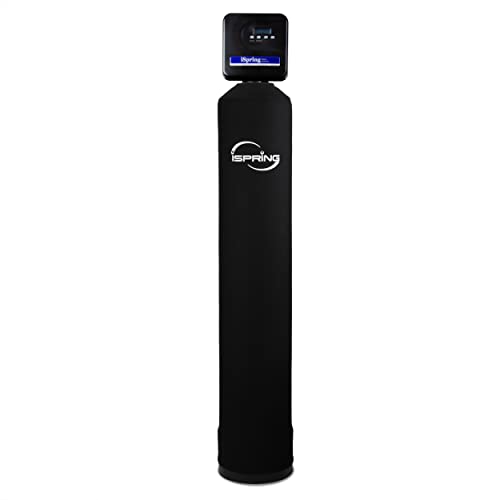
- ENJOY CLEAR WATER FROM EVERY FAUCET – Installed at the main water entry, this whole house water filter system removes chlorine, le…
- HIGH CAPACITY – The patented filtration media formula is automatically back-flushed and regenerated by the digital smart control v…
- PROTECT YOUR HOUSEHOLD APPLIANCES – The WF150K whole house central water filtration system helps extend the lifespan of your plumb…
iSpring CRO1000 4-Stage Tankless Commercial Reverse Osmosis System
The CRO1000 is a commercial-grade RO system with a 1,000 GPD output and a tankless, on-demand design. Four stages do the work: a 20-inch x 4.5-inch polypropylene sediment filter in a transparent housing for visual monitoring, two 20-inch x 4.5-inch carbon block filters, and a commercial-size 1,000 GPD RO membrane that the Amazon listing says removes up to 99% of over 1,000 contaminants including lead, chlorine, fluoride, arsenic, asbestos, calcium and sodium. The listing text does not cite a specific NSF/ANSI certification for this claim, and actual results depend on your water and operating conditions. The whole assembly sits on a freestanding metal frame with wheels and locking brakes.
This is not a typical under-sink purchase. It fits households with unusually high treated-water demand, home-based food operations, hydroponics, or anyone feeding multiple dispensers, ice makers and espresso machines from one source. The listing gives a staged filter schedule: first stage every 3-6 months, second and third stages every 6-12 months, and the RO membrane every 2-3 years, depending on water quality. It needs floor space, a drain and plumbing runs to each point of use. The listing cites a 0.7 GPM flow rate and an 80-130 psi working water-pressure range, and says the optional PMP1000 booster pump is recommended below 80 psi, so check your household pressure before buying. As with any RO system, a portion of the water goes to drain as wastewater.

- COMMERCIAL RO SYSTEM WITH RELIABLE FEATURES – The iSpring CRO1000 is a true commercial-grade reverse osmosis system with a high ou…
- HIGH-EFFICIENCY COMMERCIAL-SIZE RO MEMBRANE – Removes up to 99% of over 1,000 contaminants, including lead, chlorine, fluoride, ar…
- 4-STAGE WATER FILTRATION – Equipped with commercial-grade filters: a 20” x 4.5” PP Sediment Filter with a transparent housing for …
iSpring WGB32B-KDS + WSP50ARB Ultimate Whole House Water Filter
This bundle pairs iSpring’s three-stage WGB housing with a WSP50ARB reusable spin-down sediment prefilter that has a touch-screen auto-flushing module, so coarse sediment is captured and purged before it reaches the cartridges. The listing describes an FWDS150K patented scale inhibitor that sequesters calcium and magnesium and inhibits corrosion, an FG25B-KS compound filter stage designed to reduce chlorine, lead, mercury, hydrogen sulfide and other contaminants, and an FC25B coconut shell carbon block stage that further reduces chlorine and improves taste. Connections are 1-inch NPT with 20-inch x 4.5-inch cartridges, and the system is rated up to 250,000 gallons with flow up to 15 GPM, per the listing.
It fits homeowners who want scale and chlorine control without adding salt to the house — note that scale sequestration is a different mechanism from ion exchange softening and does not remove hardness minerals from the water. The listing positions it as DIY-installable with manual and video support (main-line work should still follow local code; see the installation section below), and includes a 1-year manufacturer warranty activated by online registration plus lifetime tech support. As the listing states, it will not reduce total dissolved solids. The listing also says the filters were tested by an independent third party to meet NSF/ANSI standards but does not name the standards, so confirm the specific certification before relying on it for a particular contaminant such as lead.

- An anti-scale water filter system that protects your pipes and household appliance from scale, corrosion, and more – The FWDS150K …
- A water filtration system with top-notch quality – WSP50ARB reusable spin down sediment filter with touch-screen auto flushing mod…
- The third stage FC25B carbon block filter is made of high-quality coconut shell carbon for maximum filtration efficiency and filte…
iSpring RO1200AK Dual-Flow Alkaline Reverse Osmosis System
The RO1200AK is the flagship under-sink unit in this group: a 1,200 GPD tankless system that the Amazon listing rates at 0.83 GPM and describes as filling an 8-ounce cup in roughly five seconds. The listing says the tankless design saves about 70% of under-sink space, but the system requires an electrical outlet. Its signature feature is a dual-flow faucet — the left handle delivers fast carbon-filtered water for rinsing and washing, the right delivers full RO water for drinking, so RO water is not used for tasks such as washing produce, which the listing says helps extend membrane life.
Four stages cover PP sediment, activated carbon, a 0.0001-micron RO membrane and an alkaline mineral filter that restores minerals after the membrane, with the Amazon listing citing reduction of up to 1,000-plus contaminants including rust, chlorine, lead, PFAS and TDS. The listing text does not cite a specific NSF/ANSI certification for those claims, so check the current documentation if lead or PFAS reduction matters to you. It lists replacement filters at 12 months (FPCA1200) and 24 months (MRO1200). A TDS monitor on the faucet shows real-time inlet and outlet readings in RO mode, auto flush protects the membrane, and filter reminders handle service timing. The listing states a 3:1 pure-to-drain ratio and says it produces about 50% less wastewater than 1.5:1 systems; actual drain volume varies with water pressure, temperature and TDS, and the drain line must be code-compliant. For the broader tank-versus-tankless trade-off, see our under-sink RO comparison.

- Dual‑Flow Faucet – One Faucet with Left and Right: Most RO systems waste RO water on everyday rinsing, shortening membrane life. T…
- 1200 GPD Tankless – 8 oz in ~5 Seconds: Tired of waiting for a trickle? This tankless system delivers a true 0.83 GPM – fill a cup…
- 4‑Stage High‑Efficiency Filtration + Alkaline Boost: PP sediment + activated carbon + 0.0001μm RO membrane + AK mineral filter – r…
iSpring WGB32BM Iron and Manganese Whole House Water Filter
The WGB32BM is the well-water variant of the WGB platform. Stage one is a high-capacity polypropylene sediment filter rated to 5 microns, stage two is a coconut shell carbon block, and stage three is the FM25B media specifically designed to reduce iron and manganese along with associated taste and odor problems. Connections are 1-inch NPT with the same 20-inch x 4.5-inch cartridge format, and the system is rated to last up to 12 months or 100,000 gallons.
It fits households on private wells dealing with rust staining on fixtures and laundry, metallic taste, or the black streaking associated with manganese. The Amazon listing states reduction of iron up to 3.0 ppm and manganese up to 1.0 ppm, so a water test showing your actual iron concentration matters more here than with any other system on this list — levels above the rated range, or iron present in bacterial or complexed forms, call for a different treatment approach. Like the other WGB systems, it does not reduce TDS. The listing says its sediment and carbon filters were tested by an independent third party to meet NSF/ANSI standards without naming which, so confirm the specific certification if it matters to you.

- Whole house water filter that protect your family and household appliance from iron, manganese and more: Our 3rd stage iron water …
- DIY installation and maintenance – refer to our manual and our helpful YouTube videos for easy DIY installation. With 1 in. NPT in…
- Top-notch quality – the first stage high capacity polypropylene sediment filter achieves filtration down to 5 microns. The second …
iSpring model comparison
| Model | Type | Key capacity / output | Power & connection | Best fit |
|---|---|---|---|---|
| WCS50KG | Salt-based softener, one-tank | 50,000 grains | Powered control valve; main line | Hard water in a tight installation space |
| WF150K | Central media filter, smart valve | Listed life: 10 years (2-3 bath homes) or 5 years (4-5 bath homes) | Digital control valve; main line | Whole-house filtration with minimal upkeep |
| CRO1000 | Tankless commercial RO, 4-stage | 1,000 GPD | Freestanding wheeled frame; 80-130 psi working range (optional booster pump) | High-volume treated water, multiple dispensers |
| WGB32B-KDS + WSP50ARB | 3-stage cartridge filter + auto-flush spin-down | Up to 250,000 gallons | Touch-screen auto-flush module; 1 in. NPT main line | Scale, chlorine and sediment control without salt |
| RO1200AK | Tankless under-sink RO, 4-stage + alkaline | 1,200 GPD / 0.83 GPM, 3:1 pure to drain | Requires electrical outlet; under sink | Fast drinking water from a compact cabinet |
| WGB32BM | 3-stage cartridge filter, iron/manganese | Up to 12 months or 100,000 gallons | Cartridge system (no powered parts listed); 1 in. NPT main line | Private wells with iron and manganese |
How to choose
Start with a water test, not a product page. A certified lab test or a current municipal water quality report tells you hardness in grains per gallon, iron and manganese levels, TDS and whether chlorine or chloramine is used. Every sizing decision below depends on those numbers.
If the problem is scale, spotting and soap that will not lather, that is hardness, and ion exchange softening is the whole-house method that removes hardness minerals (salt-free scale inhibitors only reduce scale formation, and RO reduces hardness at a single tap) — the WCS50KG is the softener in this lineup. Size by hardness multiplied by daily household water use, not by house size. The control valve is a major factor in long-term reliability on many softeners; our control valve comparison explains what to look for.
If the problem is taste, odor, chlorine or sediment at every tap, you want whole-house filtration. Choose between the cartridge approach (WGB32B-KDS bundle or WGB32BM) and the media-bed approach (WF150K) based on how you prefer to maintain it: cartridges give you targeted, swappable stages; the media bed gives you a long service interval with no cartridge inventory. Our whole-house filtration comparison covers that trade-off across brands.
If the problem is dissolved solids, PFAS or drinking-water taste, RO is the approach in this lineup that addresses dissolved solids, and it is a point-of-use fix; check the certification documentation before relying on any PFAS or lead reduction claim. The RO1200AK is aimed at one kitchen; the CRO1000 is aimed at high-demand point-of-use applications (it is not a whole-house system). Running RO downstream of a softener or sediment filter generally extends membrane life, which is a common reason homeowners end up with two systems rather than one.
If you are on a private well, sequence matters: sediment and iron removal first, then softening, then point-of-use RO. Iron reaching a softener’s resin can foul it, which is why iron is usually treated first; a water treatment professional can advise on sequencing for your water.
Installation and safety
Water treatment is a plumbing modification, and the main-line systems here — the softener, both WGB filters and the WF150K — cut into your home’s incoming supply. Even where iSpring describes installation as DIY-friendly with 1-inch NPT fittings and published videos, the work must meet local plumbing code. Many jurisdictions require a permit for main-line work, a backflow prevention device, and an approved drain connection with a proper air gap for backwashing and regenerating equipment. Where local code requires a licensed plumber, or if you are not confident shutting down, cutting and reconnecting the main, hire one; a failed connection behind a wall or above a finished ceiling is an expensive mistake.
A few category-specific points:
- Test your water first. Buying treatment equipment before you know what is in the water is the single most common way homeowners end up with a system that does not fix their complaint.
- Treat certifications as whatever the listing actually states. Manufacturer claims of lab testing and contaminant reduction are not the same as third-party certification to a specific NSF/ANSI standard. If a particular certification matters to you — for lead, PFAS or arsenic, for example — confirm it in the current product documentation or NSF’s public certified-products listings before purchase. For example, the WF150K listing says it was lab-tested to meet NSF/ANSI 42 and 53, and the WGB listings say their filters were independently tested to NSF/ANSI standards without naming which; ‘tested to meet’ wording is not the same as a confirmed certification.
- Electrical requirements. The RO1200AK listing states it requires an electrical outlet, and powered control valves need one too; check each listing for the power needs of any pump or module. Under-sink outlets should be properly installed, and nothing about an RO system should involve extension cords in a cabinet that can get wet.
- Drain and discharge. Softener regeneration brine and RO concentrate both need a code-compliant drain. Some municipalities and septic systems have rules about brine discharge — check locally before installing a salt-based softener.
- Sodium and septic considerations. If you have a septic system, ask your installer or local authority about softener regeneration discharge. Ion exchange softening adds sodium to treated water in proportion to hardness removed. If anyone in the household is on a sodium-restricted diet, discuss it with a physician and consider a potassium chloride alternative or an unsoftened cold tap at the kitchen.
- Warranty registration. Several iSpring systems require online registration after installation to activate coverage. Do it promptly, keep the installation date and receipt, and read the warranty terms for conditions such as maintenance, replacement-part and installation requirements that can affect coverage.
No water treatment system should be bought on a promise of utility savings, appliance longevity in specific dollar terms, or health outcomes. Filtration and softening solve defined water quality problems; judge them on that.
Frequently asked questions
Does an iSpring whole-house filter reduce total dissolved solids?
No. iSpring states directly in its product information that the WGB-series whole-house filters are installed at the main supply line to treat all the water in the home, but unlike an RO system they will not reduce total dissolved solids. If your water test shows high TDS and that is what you want addressed, you need reverse osmosis at the point of use — the RO1200AK or CRO1000 in this lineup — not a whole-house cartridge filter.
How often do iSpring filters need to be replaced?
It depends on the system. The WGB32BM is rated for up to 12 months or 100,000 gallons. The WGB32B-KDS bundle is rated up to 250,000 gallons, and its spin-down prefilter is reusable with an auto-flush module. The CRO1000 runs on a staged schedule: first stage every 3-6 months, second and third stages every 6-12 months. The WF150K uses a regenerating media bed that the listing says is designed to last 10 years in 2-3 bath homes or 5 years in 4-5 bath homes, rather than replaceable cartridges, and the RO1200AK includes filter life alerts. Actual intervals shift with incoming water quality and household volume.
What is the practical difference between tankless and tank-based reverse osmosis?
A tank-based RO system produces water slowly into a pressurized storage tank, so flow at the faucet is limited by what is in the tank. A tankless system such as the RO1200AK filters on demand at a higher rated throughput — 0.83 GPM in this case — which removes the refill wait and frees under-sink space, at the cost of requiring an electrical outlet. The RO1200AK listing cites a 3:1 pure-to-drain ratio, compared with the 1.5:1 it attributes to conventional systems; ratios vary by design and operating conditions.
Which iSpring system suits a private well with rust staining?
Rust staining on fixtures and laundry can indicate iron (a lab test confirms the cause), and the WGB32BM is the system in this lineup built for it, with a dedicated third-stage FM25B media for iron and manganese reduction following the sediment and carbon stages. The critical step is confirming your iron concentration against the listing’s stated maximums (3.0 ppm iron, 1.0 ppm manganese) with a lab test. Wells with iron above that range, or with iron bacteria, need a different treatment approach — often oxidation and filtration — and should be assessed by a water treatment professional.