HomeMechanicals.com is an Amazon Associate and earns from qualifying purchases. Product details come from manufacturer listings; see our research process.
Rheem is a major water heating brand with a residential catalog that spans gas and electric storage tanks, gas tankless units, electric tankless units, and HVAC equipment. For a homeowner replacing a water heater, that breadth is both helpful and confusing: the same brand will sell you a 50-gallon electric tank, a wall-hung gas unit that fires at nearly 200,000 BTU/hr, and an electric tankless unit that needs more amperage than many whole houses have to spare. This guide covers five Rheem water heaters, what the published specifications actually say about each one, and how to match them to the way your house is plumbed and powered. Everything below is based on supplied manufacturer listing information and well-established general knowledge about these categories — not on first-hand use.
How the Rheem lineup is organized
The models in this guide fall into three distinct families, and the differences between them matter far more than the differences within them.
- RTG gas tankless. Wall-mounted, natural-gas-fired units that heat water only when a tap opens. Both RTG models here are described as non-condensing, meaning they do not extract heat from flue gases a second time the way condensing units do. In practice, non-condensing gas tankless heaters typically use metal venting rather than PVC (confirm approved vent materials in the installation manual), and condensing designs generally list higher efficiency; both units here list a UEF of 0.82. They are split by install location: one indoor (direct vent), one outdoor (no venting required).
- Professional Classic electric storage tanks. Conventional tank water heaters with a thermostat, an anode rod and a drain valve. The PROE50 M2 is the 50-gallon medium-height version. Storage tanks keep a reservoir of hot water ready, so flow rate is not the limiting factor — tank volume and recovery rate are.
- RTEX / RETEX electric tankless. Compact, vent-free units that heat water with electric elements. Both 36 kW models here are large-output units, and their delivered flow depends heavily on inlet water temperature, so they tend to suit warmer-inlet conditions best. No gas line, no flue — but a very large electrical demand.
Model numbers, configurations and warranty terms can differ by seller, so confirm the exact model and coverage terms on the listing before purchase.
The models worth knowing
Rheem RTG Series 9.5 GPM Natural Gas Tankless — Indoor
This is the largest-output unit in the group: 199,900 BTU/hr and a rated 9.5 GPM at a 35°F temperature rise, with a 0.82 UEF. That rise figure is the key to reading the spec. A 35°F rise means raising, say, 70°F groundwater to 105°F — realistic in the South. In a northern winter, where inlet water can arrive in the 40s, the same unit delivers meaningfully fewer gallons per minute because it has to work harder on every gallon. The listing describes it as suited to 3–4 simultaneous showers, a shorthand that depends on inlet temperature and fixture flow rates; with colder incoming water, fewer fixtures may be supported.
It is an indoor, direct-vent unit with a digital LED control panel offering ±1°F adjustments, built-in freeze protection, and CSA certification per the listing. The listing cites a 15-year heat exchanger and 5-year parts warranty and states that professional installation is required; warranty terms typically depend on professional installation, registration and maintenance, so read the actual warranty document before relying on them. The listing positions it for multi-bathroom homes with an existing natural gas supply and a wall where code-compliant venting can be run to the exterior. This listing is for natural gas; propane use would depend on manufacturer-approved conversion, which the listing does not address, and gas tankless units also generally need a standard 120V electrical connection, so confirm requirements with a licensed gas fitter.

- High Performance Natural Gas Tankless Water Heater delivers endless instant hot water on demand for whole house residential use | …
- Energy Efficient Non-Condensing Gas Tankless Water Heater with 0.82 Uniform Energy Factor (UEF) saves up to 34% on energy costs vs…
- Ideal Whole House Tankless Gas Water Heater for large families and multi-bathroom homes with 3-4 water points running simultaneous…
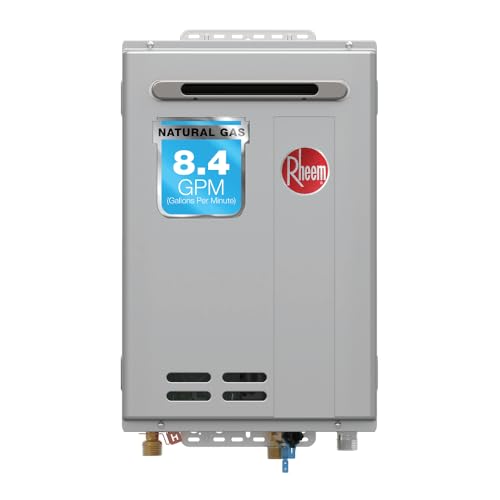
Rheem RTG Series 8.4 GPM Natural Gas Tankless — Outdoor
Mechanically this is the same concept one step down in output: 180,000 BTU/hr, a rated 8.4 GPM at a 35°F rise, the same 0.82 UEF, the same digital LED control with ±1°F adjustment, freeze protection and CSA certification, and the same 15-year heat exchanger / 5-year parts warranty language. The difference is the cabinet. It is built for outdoor wall mounting in a metal enclosure, which, per the listing, eliminates the indoor venting run, though code clearances from windows, doors and gas meters still apply — venting can be a major cost and complexity factor in a tankless retrofit.
The trade-off is climate. Outdoor units rely on built-in freeze protection that requires continuous electrical power, so they generally suit milder winter regions better than deep-freeze climates, and powered freeze protection typically cannot help during an outage; confirm outdoor suitability with the manual and a licensed installer. If you are weighing an exterior install in a cold region, read our guide to winterizing a water heater before you commit to the location.
- High Performance Natural Gas Tankless Water Heater delivers endless instant hot water on demand for whole house residential use | …
- Energy Efficient Non-Condensing Gas Tankless Water Heater with 0.82 Uniform Energy Factor (UEF) saves up to 34% on energy costs vs…
- Ideal Whole House Tankless Gas Water Heater for large families and multi-bathroom homes designed for outdoor installation, this hi…
Rheem PROE50 M2 RH95 50-Gallon Professional Classic Electric
The conventional option, and for many homes still the right one. This is a 50-gallon electric storage tank in a medium-height cabinet, rated at 18.75 amps, with an automatic thermostat, an anode rod for tank protection and an enhanced-flow brass drain valve. Rheem positions it for households of three to five people or homes with three or more bathrooms.
Two things can make it a simpler replacement than tankless. First, electric tanks of this size typically land on a dedicated 240V circuit sized per the nameplate and local code — a far smaller electrical ask than any 36 kW tankless unit. Second, the listing notes a smaller footprint than comparable models, which helps in closets and tight mechanical rooms. Where a tank gives ground is sustained output: once the reservoir is drawn down, you wait for recovery. The brass drain valve and replaceable anode rod are the maintenance-relevant details here — periodic flushing and anode inspection, on the interval in the manufacturer’s manual, are typical tank maintenance, particularly on hard water.

- Provides ample hot water for households with 3-5 people or homes with 3+ bathrooms
- This water heater takes up less space than competitive models making it a great choice for replacing an existing water heater
- Reliable hot water solution from Rheem, the global leader in water heating
Rheem RTEX-36 36kW Electric Tankless
The RTEX-36 is a 240V electric tankless unit rated at 36 kW, with external adjustable temperature control and bottom-mounted 3/4-inch NPT connections. No gas line, no flue, no combustion air requirement, and a cabinet small enough to free up the space a tank occupies. For homes without natural gas — or where running a new gas line and vent is impractical — this is the whole-home electric path.
The electrical reality has to be respected. Thirty-six kilowatts at 240 volts is on the order of 150 amps of demand, which is normally distributed across multiple double-pole breakers and often exceeds what a 100- or 150-amp service can support alongside an HVAC system, range and dryer. A licensed electrician must verify service capacity, breaker configuration and wire sizing against your actual panel and local code before purchase, not after. Output also tracks inlet temperature closely: electric tankless units deliver their best gallons-per-minute figures where groundwater is warm. Our tankless water heater size calculator is the right place to test that math for your region.

Rheem RETEX-36 Performance 36 kW Self-Modulating
This listing is a refurbished 36 kW self-modulating electric tankless unit listed at 6 GPM (the listing does not state the temperature rise behind that figure, so real-world flow will vary with inlet temperature). Per the listing, refurbished products are tested and certified to look and work like new, with functionality testing, cleaning, inspection and repackaging, and ship with relevant accessories. “Self-modulating” means the unit adjusts element power to the actual flow and temperature demand rather than switching fully on and off, which generally produces steadier outlet temperatures at partial flow.
The electrical requirements are the same as any 36 kW unit — a substantial, electrician-verified multi-circuit 240V feed. Because this is a refurbished listing, confirm the exact coverage terms shown at checkout before buying; refurbished warranty terms are typically different from new-product terms, and installation quality can affect coverage on any brand. Our overview of what actually voids equipment coverage explains the usual mechanisms.

- This refurbished product is tested and certified to look and work like new. The refurbishing process includes functionality testin…
Specification comparison
| Model | Type | Key output | Power / fuel | Best fit |
|---|---|---|---|---|
| RTG 9.5 GPM Indoor | Non-condensing gas tankless, indoor direct vent | 9.5 GPM at 35°F rise; 199,900 BTU/hr; 0.82 UEF | Natural gas | Multi-bathroom homes with gas service and a vent path |
| RTG 8.4 GPM Outdoor | Non-condensing gas tankless, outdoor | 8.4 GPM at 35°F rise; 180,000 BTU/hr; 0.82 UEF | Natural gas | Mild-winter homes where exterior mounting avoids venting |
| PROE50 M2 RH95 | Electric storage tank, 50 gallon, medium height | 50-gallon capacity; automatic thermostat; anode rod | Electric, 18.75 amps | 3–5 person households; straightforward tank swap |
| RTEX-36 | Electric tankless | 36 kW; external adjustable temperature control; 3/4″ NPT bottom connections | Electric, 240V | No-gas homes with ample electrical service capacity |
| RETEX-36 Performance (refurbished) | Electric tankless, self-modulating | 36 kW; 6 GPM | Electric, 240V | Buyers comfortable with refurbished stock and large electrical loads |
How to choose
Work through four questions in order, because each one eliminates options.
- What fuel is already at the house? If you have natural gas at adequate line capacity, the RTG units are in play. If you are all-electric, the choice is between the 50-gallon tank and a 36 kW tankless unit.
- How cold is your incoming water? The gas tankless ratings in this guide assume a 35°F temperature rise, and any tankless flow rating depends on the rise behind it. In northern climates, the same unit delivers fewer simultaneous fixtures than its headline number suggests. Run your own numbers with the size calculator rather than relying on the listing’s “3–4 showers” shorthand.
- What will the installation actually involve? Gas tankless retrofits often require gas line upsizing and new venting; electric tankless retrofits often require panel and service work. A tank-for-tank replacement usually requires the least. Our comparison of tankless versus traditional water heaters breaks down where those costs land.
- Do you need simultaneous demand or total daily volume? Tankless is designed for continuous hot water within its rated flow; a tank can cover a short, heavy burst from a smaller electrical or gas supply until its reserve is drawn down. For a wider category view, see our gas versus electric tankless roundup.
Installation and safety
Water heater work touches gas, venting, electrical and pressurized plumbing at once, which is why this category is permit-controlled nearly everywhere.
- Use licensed trades. Gas models require a licensed plumber or gas fitter; the indoor RTG listing explicitly states that professional installation is required. Electric models require a licensed electrician for circuit work. Permits and inspections are typically required by local code and are normally handled by the licensed contractor; inspections exist to catch venting and gas sizing errors. Manufacturer warranties commonly require professional installation, so unlicensed work can put coverage at risk.
- Gas line sizing is not optional. A 199,900 or 180,000 BTU/hr tankless unit can demand far more gas than the tank it replaces. The existing line and meter must be evaluated and often upsized; undersized supply can cause poor performance and unsafe operating conditions, so a licensed gas fitter should size it to code.
- Venting must match the appliance. Non-condensing indoor units require the manufacturer-specified direct-vent materials and clearances. Never reuse an old atmospheric flue for a tankless unit without a code-compliant vent design.
- Electrical circuits must be sized to the nameplate. A 36 kW tankless unit is a major load spread across multiple 240V circuits; an electrician must confirm service capacity, conductor sizing and breaker configuration before installation. The 50-gallon electric tank needs its own properly sized dedicated circuit.
- Verify the T&P valve and discharge. Every storage tank needs a working temperature-and-pressure relief valve with a correctly routed discharge pipe, plus expansion control where required by code.
- Protect against freezing. Outdoor gas units rely on powered freeze protection; keep them energized and protect exposed piping. Set thermostats with scald risk in mind, particularly with children or older adults in the home.
Frequently asked questions
Does a 9.5 GPM rating mean I always get 9.5 gallons per minute?
No. That figure is tied to a 35°F temperature rise. If your incoming water is colder, the unit has to add more heat per gallon, so the deliverable flow drops. Always size against your local winter inlet temperature and the fixtures you expect to run at the same time.
Should I pick the indoor or the outdoor RTG unit?
It is mostly a climate-and-wall-space decision. The outdoor model removes the venting run, which simplifies many retrofits, but it depends on built-in freeze protection and continuous power, so it suits milder winters. The indoor model needs a code-compliant direct vent but sits in conditioned space.
Is electric tankless a drop-in replacement for an electric tank?
Rarely. A 50-gallon electric tank draws a fraction of what a 36 kW tankless unit does. Moving from one to the other usually means new circuits and may mean a service upgrade. Have an electrician evaluate your panel before ordering.
What maintenance do these units need?
Gas tankless units should be descaled on the interval the manual specifies, especially on hard water, and their inlet filters kept clean. Electric tankless units also need scale management on the heating elements. Storage tanks benefit from periodic flushing and anode rod inspection. Follow the manufacturer’s documentation, since warranty terms commonly tie coverage to proper installation and maintenance.
Nothing here is a prediction of performance, operating cost or results in your home. Final equipment selection and sizing should be confirmed by the licensed contractor who will be responsible for the installation and the permit.