HomeMechanicals.com is an Amazon Associate and earns from qualifying purchases. Product details come from manufacturer listings; see our research process.
DuroMax Power Equipment is a portable power brand that built its name on engine-driven portable generators designed to run on more than one fuel. If you have shopped portable backup power in the last few years, you have probably seen the pattern: large-frame units with wheel kits, a wide outlet panel, a front-facing fuel selector, and a model number that starts with XP. The brand’s current focus is clear from its own product titles — tri-fuel capability, transfer-switch-ready outlets, and remote electric start.
This guide covers five DuroMax models that homeowners shopping for storm and outage backup are most likely to be comparing in 2026: the XP28000iHT, XP16000iHT, XP15000HXT+, XP11000iHT and XP15000HX. Everything below is based on the published product specs and listing features for those models, plus general, well-established knowledge about how portable generators are sized, connected and operated safely. Where a figure is not published for a given model, this guide says so rather than filling the gap.
How the DuroMax lineup is organized
The five models here fall into three recognizable families, and the model numbers themselves are the fastest way to read the lineup. The number after “XP” is the headline wattage, and the suffix tells you the technology.
- iHT — tri-fuel digital inverter. The XP28000iHT, XP16000iHT and XP11000iHT are described as portable digital inverter generators that run on gasoline, propane or natural gas. Inverter output is specified as clean sine wave power, and the XP11000iHT listing specifically calls out low THD. All three are listed with remote electric start and transfer-switch-ready capability.
- HXT+ — tri-fuel with electronic fuel injection. The XP15000HXT+ is a tri-fuel portable generator with EFI instead of a carburetor, published as 50-state approved, and shipped with an AGM gel battery.
- HX — dual fuel. The XP15000HX runs on gasoline or propane only, uses a 670cc OHV DuroMax engine, and is the most conventional design in this group.
Two features recur across the family and are worth understanding as a set rather than per model. The first is the fuel selector: DuroMax publishes a front-facing interface that lets you change fuel type in seconds, and the tri-fuel models include quick-connect fittings (the XP28000iHT listing includes a 3/4-inch natural gas hose with quick-connect fittings). The second is CO Alert, a carbon monoxide detection system that shuts the generator down when dangerous CO levels are detected. CO Alert is listed on the XP16000iHT, XP11000iHT and XP15000HX. It is a safety backstop, not permission to run a generator anywhere near an enclosed space.
One more practical note on reading these specs: for the XP15000HXT+ and XP11000iHT, DuroMax publishes both a starting and a running figure (15,000/12,000 and 11,000/9,000 watts respectively). For the XP28000iHT, XP16000iHT and XP15000HX, the supplied listing features give a single headline wattage. Size your loads against published running watts whenever that number is available for the model you are actually buying, and confirm it on the spec sheet before you commit. Also keep in mind that a generator’s headline wattage is usually its gasoline rating; output on propane and especially natural gas is typically lower. DuroMax’s own product pages list separate peak and running figures per fuel (for the XP28000iHT, 28,000 appears to be the gasoline peak rating), so check the per-fuel numbers for the fuel you actually plan to use.
The models worth knowing
DuroMax XP28000iHT
This is the largest unit in the group: a tri-fuel portable digital inverter generator published at 28,000 watts (a peak figure on gasoline; running watts and per-fuel ratings are lower) of clean sine wave output, running on gasoline, propane or natural gas. It is equipped with two 50-amp outlets intended for use with a generator interlock or transfer switch, includes a 3/4-inch natural gas hose with quick-connect fittings, and uses 100% copper windings. Remote electric start is listed.
The fit here is a larger home where the goal is running most of the house at once rather than rationing circuits — well pump, central air, electric range, multiple refrigeration loads. The trade-off is physical: output at this level means weight, footprint, fuel consumption and a serious conversation with an electrician about whether your panel and transfer equipment can actually accept it. The dual 50-amp configuration only pays off if your installed equipment is designed to use it.
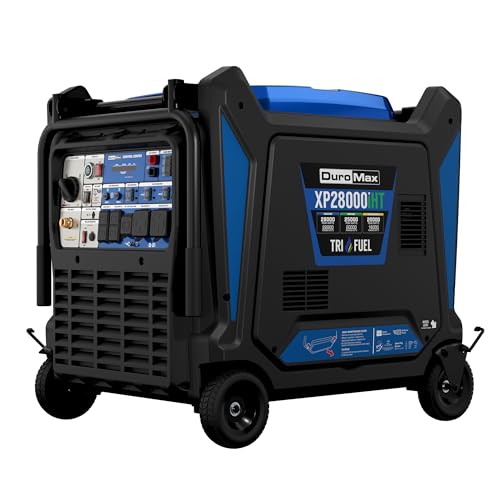
- 28,000 Watts of Quiet, Clean, Sine Wave Power — Powers your whole home quietly and with ease.
- Tri Fuel Technology— Runs on gasoline, propane, or natural gas for ultimate fuel flexibility
- Home Backup Ready — Equipped with 2 50 Amp outlets for use with generator interlocks or transfer switches
DuroMax XP16000iHT
The XP16000iHT is the mid-upper tri-fuel inverter: 16,000 watts of clean sine wave power on gasoline, propane or natural gas, with dual 50-amp outlets for connection to a transfer switch or generator interlock. It adds the convenience and safety features DuroMax emphasizes most — remote start so you can start and stop the unit from inside during a storm, CO Alert shutdown, and a quick-connect fuel system with a front-facing selector for switching fuels.
This is the model to look at if you want whole-home ambitions with a more manageable machine than the XP28000iHT, or if you also expect to use it for an RV or a job site. The listing positions it for all three roles, and inverter output is the reason it is comfortable with sensitive electronics.

- 16,000 Watts of Reliable Tri-Fuel Power – Power your whole home, RV, or job site with clean sine wave energy. Runs on gasoline, pr…
- Dual 50-Amp Outlets for Whole-Home Backup – Equipped with TWO 50A plugs, allowing seamless connection to a transfer switch or gene…
- Remote Start for Ultimate Convenience – Start and stop your generator remotely from inside your home, providing effortless operati…
DuroMax XP15000HXT+
The XP15000HXT+ is the tri-fuel EFI model: 15,000 starting watts and 12,000 running watts, published as capable of running a whole home including large appliances and central A/C. The headline difference is electronic fuel injection, which DuroMax describes as improving fuel efficiency, improving cold starts and reducing maintenance. It ships with an AGM gel battery for cold-weather performance, and the power panel includes GFCI 120V household outlets plus 30A and 50A transfer-switch-ready receptacles. It is listed as 50-state approved.
Two groups should pay attention. First, buyers in cold climates, where starting behavior in January is the thing that actually determines whether a generator is useful — see our guide to running a portable generator through a winter outage. Second, anyone in a state with stricter emissions rules, where the 50-state approval listing may matter for what you can buy; confirm your state’s rules. The trade-off versus the iHT models is that this is not described as an inverter unit, so if ultra-clean output for sensitive electronics is your priority, compare carefully.

- 15,000 Starting Watts / 12,000 Running Watts – Powerful enough to run a whole home, including large appliances and central A/C
- Tri-Fuel Technology – Runs on gasoline, propane, or natural gas for unmatched fuel flexibility
- Electronic Fuel Injection (EFI) – Enhances fuel efficiency, improves cold starts, and reduces maintenance
DuroMax XP11000iHT
The XP11000iHT is the entry point into the tri-fuel inverter family: 11,000 peak watts and 9,000 running watts, gas/propane/natural gas, with inverter power and low THD that DuroMax lists as suitable for sensitive electronics such as TVs and laptops (for medical equipment, confirm requirements with the device maker). It includes CO Alert shutdown, electric start with a remote key fob, and a battery maintainer to keep the starting battery ready between uses.
For a typical single-family home that wants the essentials covered — refrigeration, furnace blower, well pump, lights, internet, device charging — this is often the more honest size than the biggest unit on the page. Nine thousand running watts is a real amount of power, and the smaller the engine, the less fuel you burn per hour of outage. Run the math on your own loads before you assume you need more.
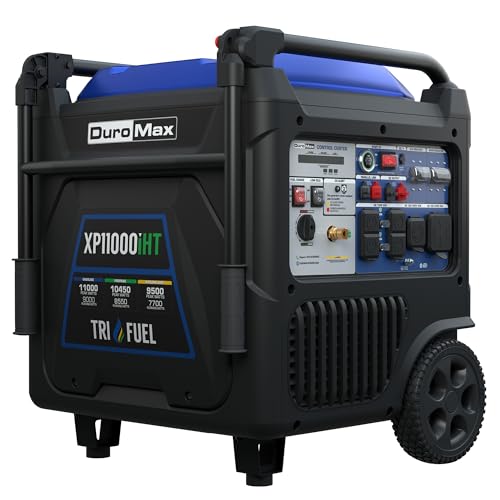
- 11,000 Peak Watts / 9,000 Running Watts – Power your entire home, RV, or jobsite with clean, reliable energy. Delivers high output…
- Tri-Fuel Technology – Gas, Propane, or Natural Gas – Choose your fuel source based on availability or preference. Get ultimate fle…
- Inverter Power with Low THD – Safe for sensitive electronics like TVs, laptops, and medical devices. Clean sine wave power ensures…
DuroMax XP15000HX
The XP15000HX is the dual fuel option: 15,000 watts on gasoline or propane (the listing gives a single headline figure, so confirm running watts on the spec sheet), built on a 670cc OHV DuroMax engine with all copper windings. It carries CO Alert, push-button start (the listing title also says remote electric start, but the feature bullets describe push-button start, so confirm before buying), a digital multimeter in the control center, and the front-facing fuel interface for changing fuel type in seconds. The power panel is the most explicitly detailed of the group: five 120V GFCI household outlets, one 120V 30A outlet, one 120/240V 30A twist-lock, and a heavy-duty 120/240V 50A outlet that makes it transfer switch ready.
This one fits homeowners who have no natural gas service at the house, or no interest in a permanent gas connection, and who are happy with gasoline plus stored propane cylinders. Propane also stores far longer than gasoline without stabilizer, which is why many owners keep it as the standby fuel. The trade-off versus the tri-fuel models is simply fewer options during a long event.

- With 15,000 watts of power, the XP15000HX Dual Fuel generator will keep your whole home running during a storm or power outage, wh…
- Enjoy the freedom and flexibility of running your generator on either gasoline or propane. Propane is cost effective, clean-burnin…
- Built using a powerful 670cc OHV DuroMax engine and features ALL COPPER WINDINGS designed to make your generator last for years.
Model comparison
| Model | Type | Published output | Fuels | Transfer-switch outlets (as listed) | Best fit |
|---|---|---|---|---|---|
| XP28000iHT | Tri-fuel digital inverter | 28,000 watts (gasoline peak), clean sine wave | Gasoline, propane, natural gas | Two 50A outlets; 3/4″ NG hose with quick connect included | Large homes aiming to run nearly everything at once |
| XP16000iHT | Tri-fuel digital inverter | 16,000 watts, clean sine wave | Gasoline, propane, natural gas | Two 50A outlets | Whole-home backup that also serves RV or job site duty |
| XP15000HXT+ | Tri-fuel, EFI | 15,000 starting / 12,000 running watts | Gasoline, propane, natural gas | 30A and 50A transfer-switch-ready receptacles, plus GFCI 120V | Cold climates and 50-state-approval buyers |
| XP11000iHT | Tri-fuel digital inverter | 11,000 peak / 9,000 running watts, low THD | Gasoline, propane, natural gas | Transfer switch ready (per listing) | Essential-circuit backup with electronics-friendly output |
| XP15000HX | Dual fuel, 670cc OHV | 15,000 watts (single headline figure) | Gasoline, propane | 120/240V 50A, plus 120/240V 30A twist-lock and 120V 30A | Homes without gas service that want a big, simple portable |
How to choose
Start with your actual load list, not the biggest number. Add up the running watts of what you genuinely need during an outage, then account for the surge draw of the largest motor you will start — typically a well pump, air conditioner or furnace blower. Our generator size calculator walks through that math. Oversizing costs you fuel every hour of every outage; undersizing shows up the first time the compressor tries to start.
Decide your fuel strategy before the model. Tri-fuel only pays for itself if you can realistically use the third fuel. Natural gas can mean no refueling at 3 a.m. while gas service stays up (supply can still be disrupted in a regional emergency), which is why the XP28000iHT ships with a natural gas hose and quick-connect fittings — but it also means a gas connection that a licensed professional has to make and size correctly. If you have no gas service, the dual-fuel XP15000HX covers the same ground with one fewer option and one fewer installation step.
Weigh inverter output against engine simplicity. The iHT models publish clean sine wave output and, on the XP11000iHT, low THD — a better match if you are running computers or modern televisions; for medical equipment, confirm power requirements with the device maker and keep a backup plan. The XP15000HXT+ answers a different question with EFI and an AGM gel battery: starting reliability and fuel metering in cold weather.
Confirm what your state and your panel allow. Emissions approval varies by state, which is why the XP15000HXT+ listing calls out 50-state approval. Separately, a transfer-switch-ready outlet on the generator is only half the system; the other half lives at your service panel.
Cross-shop the category, not just the brand. Portable tri-fuel units compete with other portables and, increasingly, with battery systems that run silently and indoors. If you are still deciding on an approach, compare with our Westinghouse generator guide and the broader Power & Backup complete guide.
Installation and safety
A portable generator that only powers extension cords needs no permits. The moment you want it feeding your home’s circuits, the rules change and professional work is required.
- Connecting to house circuits requires properly installed transfer equipment. A manual or automatic transfer switch, a generator interlock kit, or a smart panel must be installed by a licensed electrician, with permits and inspection as your local code requires. This is what the “transfer switch ready” language on these listings assumes.
- Never backfeed. Do not attempt to energize your home through a dryer outlet, a range outlet, or any double-male cord. Backfeeding bypasses every protection in the system and endangers you, your family and utility line workers.
- Carbon monoxide: outdoors only. Run the generator outside, well away from doors, windows, vents and any attached garage, with exhaust directed away from the structure. CO Alert shutdown on the XP16000iHT, XP11000iHT and XP15000HX is a last-resort backstop, not a substitute for placement. Keep working CO alarms inside the house.
- Natural gas and propane hookups are licensed work. A natural gas connection — including the 3/4-inch quick-connect setup supplied with the XP28000iHT — should be made by a licensed plumber or gas fitter who can confirm gas line sizing and supply pressure for the added load, per local code. Propane connections need the correct regulator and hose, inspected for leaks before every use.
- Electrical details matter. Have your electrician confirm grounding and bonding, neutral configuration for your transfer equipment, and correct circuit and conductor sizing. Use outdoor-rated cords of adequate gauge for the load and distance, and keep GFCI outlets in service.
- Fuel and maintenance. Store gasoline in approved containers away from the house and never refuel a hot or running engine. Follow the manufacturer’s manual for oil, break-in and service intervals, and exercise the unit periodically so you learn its behavior before an outage, not during one.
Nothing here is a substitute for your local code official or a qualified contractor; see our disclaimer.
Frequently asked questions
Can a DuroMax portable really back up a whole house?
Several of these models are published as whole-home capable — the XP15000HXT+ listing specifically mentions large appliances and central A/C. Whether that holds for your house depends on your load list, your largest motor’s starting draw, and how your transfer equipment is configured. Many homes do best with a managed approach: a transfer switch or interlock that covers the circuits that matter, rather than attempting every circuit simultaneously.
What does tri-fuel actually get me over dual fuel?
A third option during a long event. Gasoline is easy to obtain until a regional outage empties the stations; propane stores well and sits ready in cylinders; natural gas, where you have service, can keep running without refueling for as long as service continues. The tri-fuel iHT models and the XP15000HXT+ let you pick based on what is available that week. The cost is the natural gas connection, which has to be installed and sized by a licensed professional.
Do I need an electrician if the generator is already “transfer switch ready”?
Yes. That phrase describes the generator’s outlet — a 50-amp or 30-amp receptacle ready to feed transfer equipment. The transfer switch, interlock or smart panel at your service panel is separate hardware that a licensed electrician installs, with permits per local code. Plan for that work as part of the project from the start.
Is an inverter model worth it over a conventional portable?
If you are running computers or modern televisions, the clean sine wave output and low THD specified on the iHT models is generally the better match (anyone relying on medical equipment should confirm its requirements with the device maker), and inverter units are generally quieter at partial load. If your priorities are cold starting, fuel metering and straightforward mechanicals, the EFI-equipped XP15000HXT+ addresses those instead. Both are legitimate; they answer different questions.