Prices shown were verified on Amazon on September 15, 2026 and change frequently — always check the current price before buying.
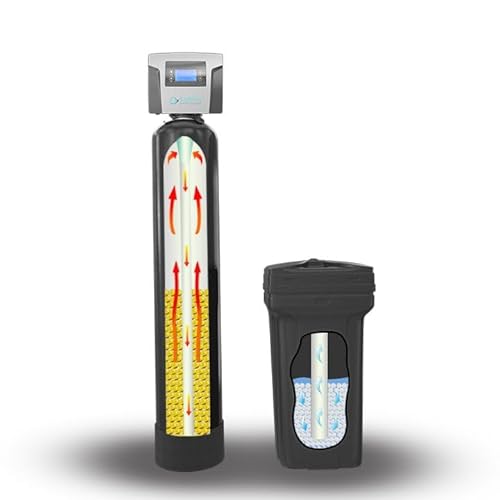
Hard water — water carrying dissolved calcium and magnesium — is one of the most common reasons a house develops scale on fixtures, spotty dishes, dry skin and hair after showering, and a water heater that fails years ahead of schedule. A water softener uses ion exchange to swap those hardness minerals for sodium (or potassium) ions, which stops new scale from forming. It will not dissolve scale that has already built up in pipes or on a water heater element, and it does not remove chlorine, lead, bacteria, or other contaminants — that’s a separate filtration system’s job (we cover that trade-off in a companion post).
We pulled current pricing, ASINs, and specs for the products below directly through Amazon’s Creators API rather than relying on manufacturer marketing pages, so the prices reflect what was listed at the time of writing (re-verified September 15, 2026) and will drift over time — check the live price before you buy. As an Amazon Associate we earn from qualifying purchases.
What Actually Matters When You’re Comparing Softeners
- Grain capacity — how many grains of hardness the resin bed can remove before it needs to regenerate. Undersized units regenerate too often, which wastes salt and water; oversized units cost more up front than most homes need. See the sizing formula below.
- Control valve type — a metered (“demand-initiated”) valve regenerates based on actual water use, which is typically more salt- and water-efficient than a timer-based valve that regenerates on a fixed schedule regardless of how much water you actually ran.
- Resin type — 8% vs. 10% cross-linked resin affects resistance to chlorine and oxidative breakdown; a higher cross-link percentage is generally rated for a longer service life, particularly on chlorinated municipal water.
- Warranty structure — the mineral tank, resin bed, brine tank, and control valve are usually warrantied separately and for different lengths. A “lifetime warranty” headline often applies only to the tank, not the valve — read the actual terms on the listing or manufacturer site before assuming full coverage.
- Install requirements — every softener needs a bypass valve, a drain line (for the regeneration wastewater), and usually a nearby electrical outlet. A home with a pre-plumbed softener loop is a much cheaper install than one where a plumber has to cut into the main line.
Quick Comparison
| Product | Best For | Grain Capacity | Price (at time of writing) |
|---|---|---|---|
| Aquasure Harmony Series | Budget, salt-based | 40,000 grains | about $520 |
| A.O. Smith AO-WH-DSCLR | Budget, salt-free alternative | Rated to 600,000 gal. throughput | about $340 |
| AFWFilters Fleck 5600 SXT | Mid-range, widely serviceable | 48,000 grains | about $790 |
| SoftPro Elite Basic HE | Premium, city water | 48,000 grains | about $1,300 |
| SoftPro Elite HE (Well Water) | Premium, well water / higher iron | 64,000 grains | about $1,550 |
Budget Pick: Aquasure Harmony Series 40,000 Grain
The Aquasure Harmony line shows up repeatedly in the sub-$700 salt-based softener category, and the 40,000-grain version is sized reasonably for a 3-4 bathroom household on moderately hard municipal water. It uses a digital metered control head, meaning regeneration is triggered by actual water use rather than a fixed timer.
- Grain capacity: 40,000
- Control valve: High-performance automatic digital metered head
- Typical price: about $580 (listed as reduced from $579.99)
This is a reasonable starting point if your household is small-to-medium and your water isn’t extremely hard or high in iron — at higher hardness or with well water iron, you’ll cycle through the resin’s capacity faster and may be better served by a larger unit like the ones further down this list.

Budget Alternative (No Salt): A.O. Smith Whole House Salt-Free Scale Control
Worth flagging up front: this is not a water softener in the ion-exchange sense, and A.O. Smith doesn’t market it as one — it’s a template-assisted crystallization (TAC) scale control system. It changes the crystal structure of hardness minerals so they’re less likely to adhere to pipe walls and fixtures, but it doesn’t remove the minerals from the water and won’t produce the “slippery” feel of true soft water. It also needs no salt, no drain line, and no electricity, which simplifies installation.
- Rated capacity: approximately 600,000 gallons before media replacement
- No salt, no backwash, no electrical connection required
- Operating range: rated for incoming hardness under roughly 15 GPG and iron under 0.3 ppm — harder or higher-iron water falls outside its tested range and won’t get the same scale-reduction result
- Typical price: about $400 (listed as reduced from $399.99)
This is a reasonable option for households that want to reduce scale buildup without maintaining a brine tank or adding sodium to their wastewater — but if your goal is actually soft, lather-friendly water (not just less scale), a true ion-exchange softener is the product category that does that.

Mid-Range Pick: AFWFilters 48K Grain Fleck 5600 SXT
The Fleck 5600 SXT valve is one of the most common control valves in the water treatment industry — it’s been in production for years and independent plumbers/water treatment techs in most regions have parts and familiarity with it, which matters for a component you’re expecting to run for over a decade. AFWFilters builds this unit with 10% cross-linked resin, which is a step up in chlorine/oxidation resistance over the 8% resin used in many entry-level units.
- Grain capacity: 48,000
- Control valve: Fleck 5600 SXT, digital metered
- Resin: 10% cross-linked
- Typical price: about $790
Because the Fleck 5600 SXT is so widely used, this is also a reasonable pick if you want a system that’s realistically serviceable by a range of local techs rather than tied to one manufacturer’s proprietary parts.

Premium Pick: SoftPro Elite Basic HE 48,000 Grain
SoftPro (a brand under Quality Water Treatment) positions its Elite line at the higher end of the direct-to-consumer softener market, with high-efficiency (HE) resin and control settings intended to use less salt and water per regeneration cycle than a standard-efficiency unit at the same grain capacity. The listing includes a larger brine tank, bypass valve, and a protective tank jacket.
- Grain capacity: 48,000
- High-efficiency (HE) resin and regeneration settings
- Includes bypass valve and tank jacket
- Control valve: backed by a limited lifetime warranty (excluding wear parts like the circuit board and piston) — longer than the 1-5 year valve coverage typical of budget units
- Typical price: about $1,300
The premium price here is buying you the HE efficiency claims and SoftPro’s lifetime valve warranty rather than a fundamentally different softening mechanism — check SoftPro’s published warranty terms directly before assuming a specific coverage length, since exact terms can change.

Premium Pick for Well Water: SoftPro Elite HE 64,000 Grain
Well water households typically deal with higher hardness and often measurable iron content, both of which eat into a softener’s effective capacity faster than municipal water does. The 64,000-grain version of SoftPro’s Elite HE line is built for that higher-demand scenario, and SoftPro markets a well-water-specific configuration separately from its standard city-water Elite units — worth confirming which configuration you’re ordering if iron removal matters to your water profile.
- Grain capacity: 64,000
- Marketed specifically for well water applications
- Resin warranty note: SoftPro’s resin warranty applies to the city-water Elite configuration — the well-water version does not carry the same resin warranty; confirm current terms on SoftPro’s site before purchase
- Typical price: about $1,550
If your well water test shows iron above roughly 1-2 ppm, or hardness well above 15 gpg, a dedicated iron filter ahead of the softener is often recommended in addition to (not instead of) a larger-capacity softener — iron fouls resin over time if it isn’t addressed separately.
How to Size a Water Softener: The Grain Capacity Math
Buying too small a unit means it regenerates constantly (wasting salt and water and shortening resin life); buying too large wastes money up front. The standard sizing approach:
- Get your water hardness in grains per gallon (GPG). A home test kit, your municipal water quality report, or a lab test will usually report hardness in either GPG or parts per million (ppm)/mg per liter. If you have ppm, divide by 17.1 to convert to GPG.
- Estimate daily household water use. A common planning figure is about 75 gallons per person per day. Multiply by the number of people in the household.
- Multiply people × gallons/day × hardness (GPG) to get your daily grain removal requirement.
- Add for iron, if on well water. A common rule of thumb is to add roughly 5 GPG of “equivalent hardness” for every 1 ppm of dissolved iron, since iron consumes resin capacity similarly to calcium/magnesium.
- Multiply the daily figure by 7 to get a weekly grain requirement, since most systems are set to regenerate roughly once a week rather than daily.
Worked example: A family of four, on municipal water tested at 12 GPG hardness, no significant iron: 4 people × 75 gallons × 12 GPG = 3,600 grains/day. × 7 days = 25,200 grains/week. That household would be reasonably matched to a 32,000-40,000 grain unit, which gives some buffer above the bare minimum rather than running the resin bed to full exhaustion every cycle.
If your water test shows both high hardness and elevated iron, size up rather than down — running a softener at the edge of its rated capacity means more frequent regeneration cycles and faster resin wear.
Total Cost of Ownership
The sticker price on the unit is not the full cost. Budget for:
- Professional installation: commonly $150-$1,000 in labor if your home already has a pre-plumbed softener loop; costs run higher — sometimes into the low thousands — if a plumber has to cut into the main water line, add a bypass, and run a new drain line from scratch.
- Salt (for salt-based units): a 40-lb bag typically runs $5-$10 and commonly lasts about a month for a family of four, putting most households in the $60-$300/year range depending on hardness level and household size.
- Periodic professional servicing: optional but commonly recommended once or twice a year, in the range of $150-$300/year, to check the brine tank for salt bridging, inspect the injector/venturi, and confirm the valve is cycling correctly.
- Resin replacement: resin beds are typically rated for 10-15 years of service before they need replacing, which is a separate cost from routine salt refills.
Warranty Terms to Check
Softener warranties are typically broken into three separate components, and it’s worth reading all three rather than the single headline number in a listing title:
- Mineral/resin tank: often 10 years to lifetime on the tank shell itself.
- Resin bed: commonly 5-10 years, with some premium brands offering longer coverage on the resin specifically.
- Control valve: usually the shortest coverage, often 1-5 years, since it’s the most mechanically complex part with moving components (motor, piston, seals). In practice, well-maintained Fleck-style valves are widely reported to run well beyond their warranty period, but the warranty itself is still the shorter number.
Common Failure Points
If a softener stops working correctly, the most frequent causes reported by installers and service techs are:
- Salt bridging — a hardened crust forms in the brine tank above the water line, preventing salt from dissolving into brine even though the tank looks full.
- Control valve motor or piston wear — the mechanical part that shifts the valve between service and regeneration cycles is the component most likely to need eventual replacement.
- Injector/venturi clogging — sediment or precipitated iron can block the small nozzle that draws brine into the resin tank during regeneration.
- Resin fouling — iron, sediment, or chlorine damage can degrade resin beads faster than expected, especially on well water without a pre-filter.
Installation: Get a Licensed Plumber Involved
Water softener installation typically involves modifying your home’s main water line, adding a bypass valve, and running a drain line for regeneration wastewater — work that is regulated by plumbing code in most jurisdictions and, depending on your municipality, may require a permit. We’re not going to walk through DIY installation steps here; if you’re not already a licensed plumber, get a quote from one before you buy. A pre-plumbed softener loop (common in newer construction in hard-water regions) makes for a substantially simpler and cheaper install than retrofitting one from scratch.
Frequently Asked Questions
Does a water softener remove chlorine or improve drinking water taste?
Not on its own. A standard ion-exchange softener is built to remove hardness minerals, not chlorine, chloramine, or other taste/odor compounds. If drinking water quality is your concern, that’s a separate whole-house or under-sink filter, which we cover in our companion comparison post.
Salt or potassium chloride?
Potassium chloride pellets work in the same brine tank and avoid adding sodium to your wastewater, but they typically cost several times more per pound than sodium chloride and require adjusting the unit’s settings, since potassium is somewhat less efficient at regeneration than sodium. Check your unit’s manual before switching media types.
How long do water softeners actually last?
Most sources put average service life at 8-12 years, with well-maintained premium units sometimes reaching 15-20 years. Actual lifespan depends heavily on incoming water quality, maintenance habits, and whether iron/sediment is addressed with pre-filtration where needed.
Bottom Line
If you’re on typical municipal water with moderate hardness, the Aquasure Harmony 40,000-grain unit is a reasonable entry point. If you specifically want to avoid a brine tank and don’t need true soft water, the A.O. Smith salt-free scale control is a lower-maintenance alternative worth understanding the limits of. For a system built around a widely serviceable, well-supported valve, the AFWFilters Fleck 5600 SXT is a solid mid-range choice. And if you want higher-efficiency resin and a manufacturer support structure built around residential water treatment specifically — especially on well water — the SoftPro Elite line is the premium option here. Whichever tier you land on, get your water tested for hardness (and iron, if you’re on a well) before you commit to a grain capacity, and budget for professional installation rather than treating it as a DIY plumbing project.