HomeMechanicals.com is an Amazon Associate and earns from qualifying purchases. Product details come from manufacturer listings; see our research process.
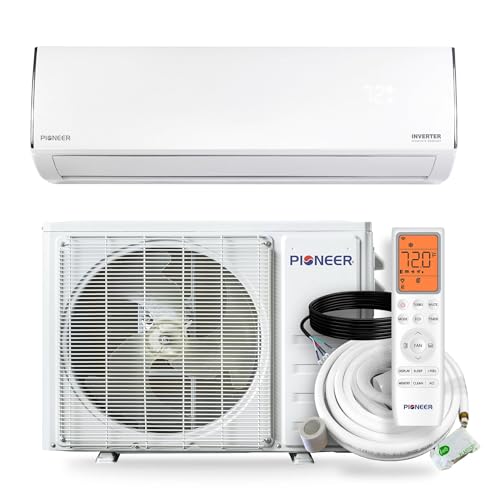
Pioneer is a ductless mini-split brand that sells its systems as complete sets rather than loose components. A typical Pioneer package includes the indoor air handler, a factory-charged outdoor condenser, a remote control, and an insulated line set with basic installation accessories. A complete set simplifies shopping, but the system still has to be installed by licensed trades. This guide walks through the Pioneer families represented in the models below, explains how the single-zone and multi-zone options differ, and covers the sizing and licensing questions that matter before you buy.
How the Pioneer Mini-Split lineup is organized
The models covered here fall into two naming families, and understanding the split makes the rest of the lineup much easier to read.
- Quantum Ultra is the high-efficiency inverter line. Pioneer describes these systems as “inverter++” and the published efficiency figures are the highest in this group, with Energy Star certification and Wi-Fi control listed on the multi-zone models. Quantum Ultra appears here in two forms: single-zone wall-mount systems (one indoor head, one outdoor unit) and multi-zone systems where a single outdoor condenser feeds three or four indoor heads.
- Diamante is the single-zone wall-mount family, offered at more than one tier. Diamante Pro sits above Diamante Essenza on published efficiency, and the Pro model listed here specifies R-454B refrigerant along with dual-axis motorized louvers and a Mute fan mode. Essenza is the simpler, lower-SEER2 entry point, still built around a variable-speed inverter compressor rather than a single-speed on/off design.
Two practical distinctions cut across both families. The first is single-zone versus multi-zone. A single-zone system conditions one room or one open area and is the simplest thing to install and service. A multi-zone system puts one condenser outside and runs separate refrigerant lines to each indoor head, which means more line set routing, more penetrations, and a system where all zones depend on one outdoor unit. The second is voltage. Most of these models run on 208–230V single-phase power, which generally means a new dedicated circuit and disconnect. The 12,000 BTU Quantum Ultra is listed at 115V, which can sometimes be served by a more common branch circuit — still a dedicated one, sized and installed to local code.
If you are still deciding whether ductless is the right architecture at all, our overview of central AC vs. heat pump vs. mini-split vs. geothermal is a useful first stop.
The models worth knowing
Quantum Ultra Quad Split 36,000 BTU (4 Zone), 230V
This is the largest system in the group: a four-zone inverter++ heat pump with four 9,000 BTU/H nominal indoor heads on one outdoor unit. Pioneer lists the condensing system at 35,000 BTU/H cooling (modulating from a 5,500 BTU/H minimum up to 41,000 BTU/H maximum) at 22.5 SEER2 and 12.0 EER2, with 36,000 BTU/H nominal heating in the same modulation range at 9.5 HSPF2 and 3.5 COP2. Power is 208–230V, 60 Hz, single phase. It is Energy Star certified and Wi-Fi enabled, and ships as a complete set with indoor and outdoor sections, a wireless remote with Wi-Fi, and an insulated flared line set with accessories.
The fit here is a whole-floor or whole-small-home retrofit where four comparably sized rooms each need their own thermostat — bedrooms plus an office, or a finished basement plus an addition. The listed modulation range is meant to let a system this large turn down when only one zone is calling.

- Ultra-high efficiency inverter++ ductless multi split quad (4) zone heat pump system
- (x4) inside unit cooling capacity: 9,000 BTU/H nominal capacity, condensing system 35,000 BTU/H (range: 5,500 minimum – 41,000 max…
- Heating capacity: 36,000 BTU/H nominal (range 5,500 minimum – 41,000 maximum) with 9.5 HSPF2/3.5 COP2 efficiency
Quantum Ultra Triple Split 27,000 BTU (3 Zone), 230V
The three-zone version of the same concept, with three 9,000 BTU/H nominal indoor heads. Pioneer lists the condensing system at 27,000 BTU/H cooling (4,500 BTU/H minimum to 31,000 BTU/H maximum) at 24 SEER and 12.0 EER, and 28,000 BTU/H nominal heating (4,500 to 33,000 BTU/H) at 10 HSPF and 3.5 COP. The listing is inconsistent: its title says 24 SEER2, while its feature list says 24 SEER and 10 HSPF. Confirm the rating basis (SEER versus SEER2) with Pioneer or the AHRI certificate before comparing it with the other models. Voltage is 208–230V, 60 Hz, single phase, and it is Energy Star certified and Wi-Fi enabled with the same complete-set packaging.
This suits a three-room zoning plan: a primary bedroom, a second bedroom, and a living area, for example. Compared with the quad, you give up one zone but the lower listed minimum output (4,500 versus 5,500 BTU/H) may suit homes where the zones are modest and often idle. The efficiency figures are not directly comparable because the listings may use different rating bases.

- Ultra-high efficiency inverter++ ductless multi split triple (3) zone heat pump system
- x3 inside unit cooling capacity: 9,000 BTU/H nominal capacity, condensing system 27,000 BTU/H (range: 4,500 minimum – 31,000 maxim…
- Heating capacity: 28,000 BTU/H nominal (range 4,500 minimum – 33,000 maximum) with 10 HSPF/3.5 COP efficiency
Quantum Ultra 24,000 BTU, 23 SEER2, 230V (Single Zone)
A single-zone, high-wall ductless inverter heat pump rated at 24,000 BTU/H and 23 SEER2, running on 230V, and sold as a full set with Energy Star certification. Two tons of capacity in one indoor head is a lot of air moving through a single location, so this model makes the most sense in genuinely large open spaces: a great room, a combined kitchen-and-living area, a large shop or a converted garage with an open floor plan.
Choose it over a multi-zone system when you want one well-mixed space handled by one head rather than several smaller heads with separate controls — it is a simpler installation and there is only one indoor filter and drain to maintain.

Quantum Ultra 12,000 BTU, 23 SEER2, 115V (Single Zone)
The same Quantum Ultra single-zone platform at 12,000 BTU/H and 23 SEER2, but specified for 115V power. That voltage is the headline feature for retrofits: 115V equipment is often easier to serve in an older panel than a new 230V double-pole circuit, though it still needs a properly sized dedicated circuit and disconnect installed to code.
One ton is a common fit for a single bedroom, a home office, a sunroom or a small addition in a moderate climate. It is also the natural pick when the electrical work, not the equipment, is the hard part of the project.

Diamante Pro 18,000 BTU, 21 SEER2, 230V
Pioneer lists this single-zone 230V system at 18,000 BTU/H cooling and 18,000 BTU/H heating, 21.0 SEER2, 9.5 HSPF2, and R-454B refrigerant, with a 16-foot installation kit included. It runs cooling, heating, Dry and Fan modes, and uses motorized up-down and left-right louvers to sweep air across the room. Variable fan speeds plus a Mute mode are called out for bedroom use, and the remote includes a local sensing feature so the setpoint can be read at the handset rather than only at the wall unit. The package covers the indoor air handler, factory-charged outdoor condenser, remote, and an insulated line set.
The R-454B charge is worth noting: it is an A2L refrigerant adopted as part of the industry’s move away from higher-GWP blends, and it is classified as mildly flammable, which affects who should be opening the refrigerant circuit and how the equipment is sited. This model fits a 1.5-ton room or zone — a large bedroom, a bonus room, or a garage within its capacity — where quiet operation matters.

- CAPACITY AND EFFICIENCY: This 18,000 BTU mini split is a 230V AC/heating system with 18,000 BTU/H cooling capacity, 21.0 SEER2 eff…
- DUCTLESS ALL-SEASON COMFORT: Built as a mini split heat pump, this single zone mini split air conditioner provides cooling, heatin…
- DUAL-AXIS AIRFLOW AND LOCAL SENSING: The slim wall mounted air conditioner uses motorized up-down and left-right louvers to sweep …
Diamante Essenza 17,000 BTU, 17 SEER2, 230V
The entry point in this group: a 17,000 BTU/H single-zone 230V high-wall system listed at 17 SEER2 and 9.5 EER2, with up to 16 feet of included line set and a factory charge. Pioneer positions it around quiet operation for sleeping areas, nurseries and home offices, with a compact, minimalist indoor unit. The variable-speed compressor ramps up and down to hold the setpoint instead of cycling on and off at full output.
It fits homeowners who want inverter comfort and ductless simplicity in one room without paying for the top efficiency tier — a reasonable trade-off in a mild climate or in a space that is only conditioned part of the year. In a hot or cold climate with long run hours, the higher SEER2 and HSPF2 models deserve a closer look.
- 17 SEER2 Efficiency with 9.5 EER2
- Engineered for silent operation, the indoor unit runs so quietly it’s ideal for sleeping areas, nurseries, and home offices.
- Maintains your set temperature more efficiently by ramping the compressor speed up or down, avoiding the energy waste of frequent …
Model comparison
| Model | Type | Capacity (as listed) | Efficiency (as listed) | Power | Best fit |
|---|---|---|---|---|---|
| Quantum Ultra Quad Split 36,000 BTU | Multi-zone heat pump, 4 indoor heads | 4 × 9,000 BTU/H heads; 35,000 BTU/H cooling (5,500–41,000), 36,000 BTU/H heating nominal | 22.5 SEER2 / 12.0 EER2; 9.5 HSPF2 / 3.5 COP2; Energy Star | 208–230V, 60 Hz, 1 phase | Four separately controlled rooms on one condenser |
| Quantum Ultra Triple Split 27,000 BTU | Multi-zone heat pump, 3 indoor heads | 3 × 9,000 BTU/H heads; 27,000 BTU/H cooling (4,500–31,000), 28,000 BTU/H heating nominal | 24 SEER / 12.0 EER; 10 HSPF / 3.5 COP; Energy Star (listing title says 24 SEER2; confirm) | 208–230V, 60 Hz, 1 phase | Three-zone retrofit with modest room loads |
| Quantum Ultra 24,000 BTU | Single-zone high-wall heat pump | 24,000 BTU/H | 23 SEER2; Energy Star | 230V | Large open space handled by one head |
| Quantum Ultra 12,000 BTU | Single-zone high-wall heat pump | 12,000 BTU/H | 23 SEER2; Energy Star | 115V | One room where 230V service is difficult |
| Diamante Pro 18,000 BTU | Single-zone high-wall heat pump, R-454B | 18,000 BTU/H cooling and heating | 21.0 SEER2; 9.5 HSPF2 | 230V | 1.5-ton room needing quiet, directional airflow |
| Diamante Essenza 17,000 BTU | Single-zone high-wall inverter heat pump | 17,000 BTU/H | 17 SEER2 / 9.5 EER2 | 230V | Entry-tier single room or seasonal space |
How to choose
Start with zones, not capacity. Count the spaces that genuinely need independent temperature control. One space means a single-zone system, full stop — it is simpler to install, simpler to service, and a failure takes out one room instead of the whole house. Three or four spaces with different schedules and solar exposure is where the triple and quad systems earn their complexity.
Then size the load, not the square footage. Insulation, window area, ceiling height, air sealing and climate drive the number far more than floor area does. Oversizing a mini-split causes short run cycles, poor humidity removal and more compressor starts; undersizing leaves you running flat out on design days. A Manual J-style load calculation from your installer is the right basis, and the published modulation ranges on the multi-zone units tell you how low each system can turn down when only one zone is calling.
Weigh efficiency against run hours. A 23–24 SEER2 class system has more to offer in a climate where it runs most of the year than in a room you condition six weeks a summer. Check HSPF2 and COP figures if heating is a real job for the unit, not an afterthought.
Check the electrical path early. The 230V models need a dedicated double-pole circuit and an outdoor disconnect; panel capacity is often the hidden constraint in older homes, which is exactly where the 115V option can simplify things.
For broader cross-brand context, see our roundup of the best mini-split heat pump systems. For another brand’s system packages, see our MRCOOL buyer’s guide. Line set types and installation requirements differ between systems, and all of them call for licensed installation. And before you buy anything, read HVAC warranties explained, because installation documentation and registration requirements are where ductless coverage most often goes sideways.
Installation and safety
Mini-splits sit at the intersection of two licensed trades, and both matter here.
- Refrigerant work. These systems ship factory-charged with flared line sets, which generally means the refrigerant circuit has to be opened, evacuated, pressure-tested and charge-verified during installation. That work calls for a qualified HVAC technician with the correct recovery and evacuation equipment — and refrigerant handling is federally regulated in the United States under EPA Section 608, which limits it to certified technicians. Owners should never open the refrigerant circuit or add refrigerant. The Diamante Pro’s R-454B charge is an A2L, mildly flammable refrigerant, which brings additional handling, leak-detection and siting considerations.
- Electrical work. Every model here needs a dedicated branch circuit, correct conductor and breaker sizing, and a service disconnect at the outdoor unit, all per local code. Use a licensed electrician.
- Permits and inspections. Mechanical and electrical permits are commonly required for a ductless install. Check with your local authority before work starts, not after.
- Warranty conditions. Many manufacturers condition coverage on professional installation, proper evacuation, and timely registration. Confirm the current requirements in the documentation that ships with your unit.
- Mounting and condensate. The outdoor unit needs a level pad or wall bracket with clearance for airflow and service, and the indoor unit needs a properly pitched condensate drain — a sagging or clogged drain line is one of the most common ductless callbacks.
More background on system types, sizing and seasonal planning lives in our complete heating and cooling guide.
Frequently asked questions
Can I install a Pioneer mini-split myself?
These systems use flared line-set connections rather than pre-charged quick-connect couplers, so the refrigerant circuit normally has to be evacuated and verified at installation. Installation, including the refrigerant circuit, the electrical hookup and the wall penetration, should be done by a licensed HVAC technician and a licensed electrician, with permits as your local code requires. The warranty may also require professional installation.
Do the multi-zone systems let every head run at full capacity at once?
A multi-zone condenser has a finite total output, and on the quad system Pioneer lists four 9,000 BTU/H heads against a 35,000 BTU/H cooling condenser. In practice the outdoor unit modulates and distributes capacity across whichever zones are calling, so individual heads can be limited when every zone demands maximum output simultaneously. Size each room’s head to its actual load and treat the condenser rating as the ceiling for the whole system.
Will a Pioneer heat pump heat my home in winter?
All of these models are heat pumps, so they heat as well as cool, and the published HSPF2 and COP figures indicate heating performance. Like any air-source heat pump, output declines as outdoor temperatures drop, and no manufacturer’s nominal rating describes performance at your design temperature. In a cold climate, ask your installer for capacity at your local design temperature and plan for a backup heat source if the numbers fall short.
What is the real difference between Quantum Ultra and Diamante?
Quantum Ultra is the higher-efficiency tier in this group, with the top published SEER2 figures, Energy Star certification, and Wi-Fi control listed on the multi-zone systems. Diamante Pro and Essenza are single-zone wall-mount systems at lower published efficiency tiers, with Essenza the simplest of the three. The trade-off is straightforward: more efficiency and connectivity at the top of the range, fewer features and a narrower spec sheet lower down. Which one makes sense depends on your run hours and how much control you actually want.
This guide is informational and is not a substitute for a load calculation, a licensed contractor’s assessment, or your local code requirements. See our disclaimer for details.