HomeMechanicals.com is an Amazon Associate and earns from qualifying purchases. Product details come from manufacturer listings; see our research process.
Generac is a Wisconsin-based power equipment manufacturer and one of the most widely distributed generator brands in North America. Most homeowners encounter it in one of three places: a permanently installed home standby unit sitting on a pad beside the house, a large wheeled portable rolled out when the lights go off, or a compact inverter generator used for camping and light backup. This guide covers six current Generac models spanning all three categories, explains how the lineup is organized, and walks through the decisions that actually determine which one fits a given house. It uses only the manufacturer-supplied product details plus general, well-established knowledge about how backup power works. Nothing here is a substitute for a load calculation and a conversation with a licensed installer.
How the Generac lineup is organized
The models below fall into three distinct families, and the differences between them matter more than the differences within them.
Home standby generators are permanently installed, fueled by a natural gas line or an on-site propane tank, and paired with an automatic transfer switch. When utility power drops, the unit starts and transfers load without anyone being home. The 22kW Guardian and the 26kW unit in this guide both are listed with a 200-amp automatic transfer switch and remote monitoring, and Generac markets them as whole-house solutions. The switch rating is not the generator’s capacity, though: a 22 or 26kW unit generally cannot run every load on a 200-amp service at once, so what it actually covers depends on a load calculation by the installer.
Tri-fuel portable generators sit in the middle. They are large-frame, wheeled, open-frame machines in the 12,500 starting watt class that can run on gasoline, liquid propane, or a natural gas connection. They are manually started and manually connected, but their output is high enough to carry a meaningful portion of a house through an outage when wired to an inlet and transfer switch by an electrician.
Inverter generators are the smallest and quietest group. Instead of producing power directly at engine speed, they generate and then electronically condition the output, which yields cleaner power for sensitive electronics and allows the engine to throttle down under light load. The iQ3500 and the dual-fuel iQ3800 DF are built for recreational use, RV service and light emergency backup rather than whole-house coverage.
The models worth knowing
Generac Guardian 22kW Home Generator with Transfer Switch and WiFi Monitoring
This is an air-cooled Guardian standby configuration aimed at typical single-family homes. It delivers 22,000 watts on natural gas or propane and ships with a 200-amp NEMA 3R smart transfer switch in an aluminum outdoor enclosure, so the package covers both generation and automatic switching. Generac’s True Power Technology is specified at under 5% total harmonic distortion, which matters for variable-speed HVAC equipment, well pump controls and home electronics. Generac describes the purpose-built G-Force engine as low-maintenance and states the unit is engineered and assembled in the USA.
Mobile Link Wi-Fi connectivity reports status and maintenance alerts remotely, which is the practical value of a standby unit for anyone who travels: the generator exercises and runs whether or not a person is present. The listing cites a 5-year limited warranty on the transfer switch; warranty terms, registration and installation requirements vary, so read the warranty before buying. Generac recommends installation by a certified, licensed electrician. This is one option for a household that wants outage coverage to be automatic.
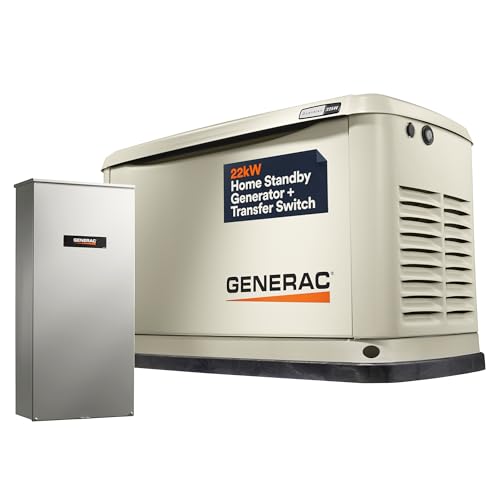
- Remote Monitoring Anywhere: With Generac 7043 22kW Mobile Link Wi-Fi connectivity, effortlessly track generator performance from a…
- Whole House Protection: Enjoy comprehensive coverage with Generac's 200 Amp NEMA 3R smart switch, designed for outdoor use with an…
- Long-Term Assurance: Backed by a 5-Year Limited Warranty, this automatic transfer switch delivers lasting performance and peace of…
Generac 26kW Whole Home Generator with Transfer Switch and Cellular Capability
The 26kW unit is the larger of the two standby models, also listed with a 200-amp automatic transfer switch. Two differences stand out against the 22kW. First, the listing describes built-in cellular connectivity rather than Wi-Fi, so monitoring through the Mobile Link app does not rely on the home’s router; the listing notes this requires a Mobile Link premium subscription. Second, the specification sheet emphasizes cold-climate and weather hardening: oil level sensors that monitor readiness, improved cold start performance, and a sloped roof with rear air intake to reduce the risk of ice or snow intrusion.
Generac describes its electronic fuel and ignition control as optimizing fuel use, with lower emissions and lower cost of ownership on average than Guardian Series units; actual results vary with use and fuel cost. The listing also cites a 5-year limited warranty and 24/7/365 customer support; confirm current terms with Generac. Buyers with larger homes, multiple air conditioning systems or electric-heavy mechanical loads, or cold-climate outages may want to compare this model, with sizing confirmed by a licensed installer.

- Whole House Protection: Keep your family comfortable and connected during power outages. Avoid the disruption of losing refrigerat…
- Lowest Total Cost Of Ownership: Electronic fuel & ignition control optimizes fuel use for a more cost-efficient and lower emission…
- Remote Monitoring & Control: Built-in Cellular Connectivity allows you to monitor performance and control your generator with Mobi…
Generac 12,500 Watt Tri-Fuel Generator with EFI and Electric Start
This is the electronically fuel-injected member of the tri-fuel portable family, and EFI is its defining feature: fuel delivery is managed electronically rather than by a carburetor, which Generac says optimizes fuel efficiency and reduces maintenance requirements. A single dial switches fuel sources without shutting the unit down. Generac specifies 8,550 running watts on liquid propane and 7,000 running watts on natural gas, so output steps down as you move away from gasoline — normal behavior for multi-fuel engines and important to account for when sizing.
Runtime on the 7.5-gallon tank is listed at up to 14 hours at 25% load and 10.5 hours at 50% load on gasoline, with a 20-pound LP cylinder good for up to 6 hours at 25% load. Starting is by rocker-switch electric start with a recoil backup and included battery. The control panel carries one 120V 20A GFCI duplex, one 120/240V 30A L14-30R twist-lock and one 120/240V 50A NEMA 14-50R outlet, and COsense technology is designed to monitor carbon monoxide, sound an alert and shut the engine down automatically; it is a backup safeguard, not a substitute for running the generator outdoors and away from the home. It is listed as 50-state compliant, which matters for California buyers.
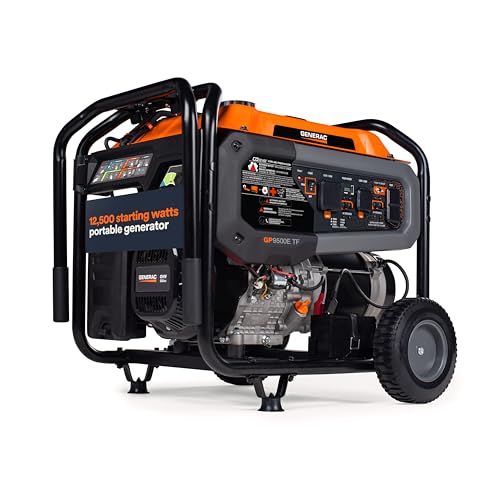
- ELECTRONIC FUEL INJECTION (EFI): Optimizes fuel efficiency and reduces maintenance requirements
- RUNS ON GAS, LIQUID PROPANE, OR NATURAL GAS: A single dial switches fuel sources without shutting the unit down; propane delivers …
- ELECTRIC START WITH RECOIL BACKUP AND BATTERY INCLUDED: Rocker-switch electric start eliminates pull-cord effort for routine start…
Generac 12,500 Starting Watt Tri-Fuel Portable Generator with Electric Start
This tri-fuel portable covers the same output class — 12,500 starting watts and 9,500 running watts from a 500cc Generac OHV engine — with a carbureted, automatic-voltage-regulated design. The 32% gap between surge and running output is the headroom that lets motor-driven loads like air conditioner compressors and sump pumps start without stalling the engine, and the built-in AVR stabilizes voltage for tools, pumps and appliances.
Runtime is listed at 9.5 hours at 50% load and 14 hours at 25% on the 7.5-gallon tank, and a natural gas connection can remove the need to refuel (the gas hookup should be made by a licensed gas fitter or plumber in line with local code). The outlet panel is slightly broader than the EFI model’s: two 120V 20A GFCI duplex outlets plus the L14-30R and 14-50R twist-lock and receptacle, with a digital hour meter for tracking service intervals. COsense and push-button electric start are included. Note that this unit is listed as 49-state compliant, so it is not sold for use in California. It is aimed at buyers who want large-frame tri-fuel capability with a conventional carbureted engine.

- TRI-FUEL FLEXIBILITY FOR ANY SITUATION: Run on gasoline, liquid propane, or natural gas with a simple dial turn, delivering 9,500 …
- STABLE POWER WITH AUTOMATIC VOLTAGE REGULATION: Built-in AVR continuously stabilizes output voltage, protecting connected equipmen…
- 12,500 STARTING WATTS FOR HIGH-SURGE LOADS: The 500cc Generac OHV engine delivers 12,500 starting watts on gas — 32% more surge ca…
Generac iQ3500 3,500 Watt Portable Inverter Generator
The iQ3500 is Generac’s quieter, clean-power option, rated at 3,500 starting watts (3,000 running watts per Generac’s spec sheet). Generac says the inverter technology and enclosure design deliver quiet operation, which suits campgrounds and tailgates; check local noise ordinances and the published decibel rating. PowerRush Advance Technology provides over 50% more starting capacity, which is what allows a 3,500-watt class machine to start motor-driven tools and appliances rather than just run resistive loads.
Operation is simplified through the PowerDial, which combines start, run and stop into a single control, and electric start with an included battery removes the pull cord from routine use. COsense carbon monoxide protection is integrated. It is 49-state compliant. It is commonly used for RV and recreation, and some owners use units of this size for a refrigerator, lights and device charging during shorter outages, depending on the loads and starting surges involved.

- Portable Power Solution: The 7723 iQ3500 inverter generator is your portable power station for all outdoor adventures, including c…
- Easy Start-Up: The generator features Electric Start with a battery included and an intuitive PowerDial that integrates start, run…
- Advanced Power Technology – PowerRush Advance Technology offers over 50 percent more starting capacity, making this portable inver…
Generac iQ3800 DF 3,800 Watt Dual-Fuel Portable Inverter Generator
The iQ3800 DF takes the inverter formula and adds fuel flexibility. On gasoline it produces 3,000 running watts and 3,800 peak; on liquid propane, 2,700 running and 3,400 peak. Output is specified at less than 3% total harmonic distortion, which is the figure usually checked for laptops and other sensitive electronics. Anyone planning to power medical equipment such as a CPAP should confirm compatibility with the device maker and a physician or supplier. The 212cc OHV engine uses push-button electric start with a recoil backup and included battery, and Economy Mode extends gas runtime to 20 hours at 25% load while reducing noise. Dual COsense sensors are designed to shut the unit down if carbon monoxide reaches hazardous levels.
Connectivity is the most generous in this group: four 20A GFCI outlets, one 120V 30A locking outlet, and USB-A and USB-C ports. The unit is parallel-ready, so a second iQ3800 DF can be linked for up to 6,000 watts combined using a parallel kit (sold separately). The listing gives a weight of 107 pounds and describes never-flat wheels and a fold-down telescoping handle for repositioning. A built-in spark arrestor supports campsite use, and it is EPA-compliant for 49 states.

- DUAL-FUEL PORTABLE INVERTER GENERATOR: Runs on gasoline (3,000W / 3,800W peak) or liquid propane (2,700W / 3,400W peak), giving yo…
- CLEAN POWER WITH LESS THAN 3% THD: Inverter technology produces stable sine-wave output safe for laptops, tablets, CPAP machines, …
- ELECTRIC PUSH-BUTTON START WITH BACKUP RECOIL: Battery-included push-button ignition fires up the 212cc OHV engine reliably; 3,800…
Generac model comparison
| Model | Type | Key output | Fuel | Best fit |
|---|---|---|---|---|
| Guardian 22kW with 200A switch | Home standby, automatic | 22 kW, under 5% THD | Natural gas or propane | Whole-house automatic backup with Wi-Fi monitoring |
| 26kW with 200A switch | Home standby, automatic | 26 kW | Natural gas or propane | Larger-load homes and cold climates; cellular monitoring (subscription) |
| 12,500 W Tri-Fuel EFI | Large-frame portable | 8,550 W running on LP; 7,000 W on natural gas | Gasoline, liquid propane or natural gas | High-output manual backup, 50-state compliant |
| 12,500 Starting Watt Tri-Fuel | Large-frame portable | 12,500 starting / 9,500 running W | Gasoline, liquid propane or natural gas | Surge-heavy loads, jobsite and home backup |
| iQ3500 | Portable inverter | 3,500 starting W (3,000 running W) with PowerRush Advance | Gasoline | Quiet recreational use and light backup |
| iQ3800 DF | Portable inverter, dual fuel | 3,000 W running / 3,800 W peak on gas | Gasoline or liquid propane | Sensitive electronics, RV use, parallel expansion |
How to choose
Start with the load, not the model. Add up what must run simultaneously, and pay attention to starting watts for anything with a motor — well pumps, air conditioning compressors, sump pumps and refrigeration all draw a surge well above their running draw. Our generator size calculator walks through that math. If the list includes central air conditioning, electric water heating or a deep well, you are generally in standby territory; if it is a refrigerator, lights, a furnace blower and devices, an inverter or mid-size portable may be able to cover it, depending on exact starting and running loads.
Decide whether coverage must be automatic. A standby unit with an automatic transfer switch starts on its own, which matters for sump pumps, medical equipment, freezers and homes left empty during storm season. A portable requires someone present, awake and willing to go outside in bad weather to start and connect it.
Match fuel to what your property already has. A natural gas meter makes standby operation effectively unlimited in runtime. Propane requires tank capacity sized for multi-day operation. Gasoline-only portables depend on stations having power. Tri-fuel units hedge against all three failing, at the cost of reduced output on gas and propane.
Consider climate and outage pattern. Long winter outages, ice storms and multi-day events push toward standby or high-output tri-fuel; brief summer flickers rarely justify permanent installation. For a region-by-region view, see our breakdowns on backup strategy by climate and on running a portable generator safely in winter outages.
Plan the purchase and installation window. Standby installation involves scheduling, permits and sometimes utility coordination, and lead times lengthen ahead of storm season. Our guide on when to buy a whole-house generator covers that timing, and our standby brand comparison puts Generac alongside other major manufacturers if you are still deciding at the brand level.
Installation and safety
Carbon monoxide is the primary hazard with portable units. Run the tri-fuel and inverter models outdoors only, well away from doors, windows, vents and attached garages, and never inside a garage, basement, crawlspace, shed or under a deck — opening a door or window does not make an enclosed space safe. Install working CO alarms with battery backup on every level of the home and near sleeping areas, per the alarm maker’s and local code guidance. COsense is a valuable backup layer that detects rising CO and shuts the engine down, but it does not change where a generator may be operated.
Never connect a portable generator to house wiring with a cord or by backfeeding a receptacle. Powering home circuits requires a properly sized transfer switch or a panel interlock kit, installed by a licensed electrician in accordance with local code, typically with a permit and inspection. Backfeeding endangers utility line workers and anyone in the home. Use the generator’s outlets and rated extension cords for anything short of a permanent inlet installation.
Standby generators are permanent mechanical and electrical installations. Generac itself recommends installation by a certified, licensed electrician, and the gas piping should be done by a licensed plumber or gas fitter where local rules require it. This is not a DIY project. Expect permits, inspection, a code-compliant pad and clearances, correctly sized gas piping with adequate supply pressure and volume, and exhaust routing and placement per local code and the installation manual. Gas supply sizing is commonly cited as an important factor in natural gas performance, so the fuel side deserves as much attention as the electrical side. Installed cost typically includes the pad, permits, gas and electrical labor and the transfer switch, and often adds substantially to the unit price, so get multiple written quotes from licensed contractors.
Other basics. Let engines cool before refueling, store gasoline outside living spaces in approved containers, keep propane connections leak-checked, and follow the manufacturer’s maintenance and exercise schedule. Grounding, cord condition and wet-weather protection all follow manufacturer instructions. Whether a generator reduces outage disruption depends on correct sizing, installation and maintenance, and no generator should be assumed to cover medical-critical equipment without a dedicated plan and professional review. This guide is general information, not professional electrical, plumbing or gas advice. Specifications come from Amazon listings and manufacturer materials and can change, so confirm current details with Generac and your installer.
Frequently asked questions
What size standby generator does a whole house actually need?
It depends on simultaneous load, not square footage. Both standby units here ship with a 200-amp automatic transfer switch, which is sized to a typical residential service, but the generator’s kilowatt rating determines how much can run at once. Generally, homes with lighter electric loads fit smaller units while homes with multiple air conditioners, electric water heating or large well pumps need more capacity; these are rough patterns, not sizing advice. A load calculation by a licensed installer is the deciding step.
What does tri-fuel capability change in practice?
It changes what happens when one fuel runs out. A tri-fuel portable switches between gasoline, liquid propane and natural gas by dial, so a closed gas station or an empty propane cylinder does not end the outage plan. The trade-off is output: Generac specifies 8,550 running watts on propane and 7,000 on natural gas for the EFI model, below its gasoline rating. Size against the fuel you expect to use most, not the highest number on the box.
Why choose an inverter generator over a conventional portable?
Two reasons: power quality and noise. The iQ3800 DF is specified at less than 3% total harmonic distortion, output suitable for laptops, tablets and CPAP machines, and inverter generators such as the iQ3500 are generally quieter than open-frame equipment, though actual noise varies by model and load. The limitation is capacity — these are a few thousand watts, not whole-house machines, though the iQ3800 DF can be paralleled with a second identical unit for up to 6,000 watts combined.
How much maintenance does a home standby generator require?
Standby units run periodic self-exercise cycles and need scheduled service on the engine side, including oil and filter changes, air filter and spark plug attention, and battery checks, per the owner’s manual intervals. The 26kW listing highlights oil level sensors that monitor readiness, and both units report status and maintenance alerts through the Mobile Link app — Wi-Fi on the 22kW, built-in cellular on the 26kW. Most owners keep a service agreement with the installing dealer so the unit is verified before storm season rather than during it.