HomeMechanicals.com is an Amazon Associate and earns from qualifying purchases. Product details come from manufacturer listings; see our research process.
The glasses come out of the dishwasher spotted again. Soap won’t lather in the shower, the laundry feels stiff, and there’s a chalky film creeping back onto the faucets. The softener is sitting right there in the basement, plugged in, apparently doing nothing. If you’ve been searching “water softener not softening” or “water softener not using salt,” you’re in the right place.
Quick answer: most softeners that stop softening fail for one of three reasons. First, a salt problem in the brine tank — either it’s genuinely low, or the salt has formed a hard crust (a “salt bridge”) or a sludgy layer at the bottom (“mushing”) that keeps brine from forming. Second, the bypass valve is still in bypass after a plumbing repair, a filter change, or a vacation. Third, the control valve lost its settings or its clock after a power outage, so it either never regenerates or regenerates at the wrong time with the wrong hardness number. Work through those before you assume the resin is shot or the valve needs a rebuild.
Before you start
A softener is a plumbing appliance with a powered control head, so treat it like both.
- Unplug the control valve, or switch off the circuit at the breaker, before you touch anything other than the lid of the brine tank, the bypass lever, and the front-panel buttons your manual tells you to use.
- Never open electrical enclosures, pry into the control head’s circuit board, or splice a damaged power cord. If the unit has no display, trips a breaker, shows scorch marks, or smells hot, stop and call a licensed electrician for the wiring or breaker side and the manufacturer for the unit itself.
- Anything beyond the owner’s manual is not a DIY job. Repiping, moving the bypass, rebuilding a control valve, replacing a piston or seal kit, or opening a pressurized mineral tank should go to a licensed plumber or the manufacturer’s service network. In many areas plumbing changes also need a permit and must meet local code.
- Check your paperwork before you take anything apart. Self-service on some components can affect coverage — our overview of what actually voids water treatment warranties is worth five minutes first.
- If you’re on a private well, remember a softener does not disinfect or make water microbiologically safe. Keep up routine well testing, and treat any separate disinfection equipment (such as UV or chlorination) as its own service question.
Check these in order
These are ordered cheapest-and-easiest first. Resist the urge to jump to step 7.
1. Salt level in the brine tank
What it looks like: hardness returns gradually over a week or two. The brine tank looks like it still has salt, or you genuinely can’t remember the last refill.
Why it happens: ion exchange works by swapping calcium and magnesium onto resin beads, then flushing them off with a strong brine solution. No salt means no brine, which means the resin never gets recharged — even though the valve keeps running its cycles on schedule.
What you can safely check: open the lid and look. Most manuals want the salt kept above the water line — check yours for the exact fill target, and use the salt type it specifies. Overfilling can make bridging more likely.
Call for service if: the tank is full of standing water well above the salt with no sign of it drawing down — that points to steps 2 and 6.
2. A salt bridge or salt mushing
What it looks like: the tank looks full, but the softener isn’t using salt. Tap the surface and it’s a solid crust with an air gap underneath. Or the opposite: a dense, slushy layer of fine salt and sediment at the bottom.
Why it happens: humidity, high indoor temperature swings, long gaps between regenerations, or lower-purity salt. A bridge leaves the water below it in contact with almost no salt, so the brine is too weak to recharge the resin. Mushing packs the bottom of the tank and blocks the draw.
What you can safely check: with the unit unplugged, gently probe the surface with a broom handle to break a bridge into pieces — carefully, so you don’t crack the tank or damage the brine well and float assembly. For mushing, the usual fix is scooping the tank out, cleaning it per the manual, and refilling with fresh salt.
Call for service if: the mush is cemented around the brine well or you’d have to disconnect plumbing to clear it.
3. The bypass valve is still in bypass
What it looks like: hard water came back suddenly and completely — often the day after a plumbing repair, a water heater swap, or a return from vacation.
Why it happens: bypass gets used any time someone needs to isolate the softener, and it’s easy to forget to put it back. Some installations also have a separate hard-water line for outside spigots, which is normal.
What you can safely check: find the bypass on the back of the control valve (on many systems it’s a plastic bypass on a 1-inch yoke) or the three-valve loop in the plumbing, and compare its position to the diagram in your manual. Return it to service slowly to avoid a pressure surge.
Call for service if: the bypass is stiff, leaking, or won’t seat. Don’t force it — that’s a plumber’s job.
4. Wrong hardness setting, or your water changed
What it looks like: the system regenerates, uses salt, and still leaves spots. Often this shows up after a utility switches sources or a well pump is serviced.
Why it happens: a metered softener calculates capacity from the hardness number you programmed. If it’s set lower than your actual hardness, it waits too long between regenerations and you run out of soft water near the end of each cycle. Iron makes this worse: iron consumes capacity and, in general terms, many manufacturers ask you to add an allowance per part per million of iron on top of your hardness setting, or to pre-treat the iron separately; the exact allowance and iron limits are in your valve and softener manuals.
What you can safely check: your current hardness setting versus a fresh test of the untreated water (step 9). Municipal customers can also look up the latest water quality report. If you’re on a well and the water now smells of sulfur or stains fixtures, the softener alone may no longer be the right tool — our water treatment decision matrix walks through where each one fits.
5. Regeneration schedule and the control clock after a power outage
What it looks like: the display is blinking, flashing a default time, or blank. You hear the unit running mid-afternoon instead of overnight, or you never hear it at all.
Why it happens: many control valves keep programmed settings through an outage but lose the time of day once any backup runs out. For example, Pentair’s Fleck SXT manual describes a power backup that holds the clock for at least 48 hours; after a longer outage expect to reset the time of day, and don’t assume the valve tracked water use while the power was out. A wrong clock means regeneration lands while the family is showering, and the hard water that reaches your taps during a cycle gets blamed on the softener. In other cases the regeneration day override or cycle times got erased or changed.
What you can safely check: reset the time of day, confirm the regeneration start time (overnight is typical), and verify the hardness and day-override values against the manual. You can usually start a manual regeneration from the front panel and listen for the drain line flow — a good way to confirm the valve is cycling at all. Control platforms behave differently here; our Fleck vs. Clack vs. Autotrol comparison explains how these valve families differ.
Call for service if: the display is dead, the motor hums without the valve advancing, or it regenerates constantly.
6. A clogged injector, venturi, or restricted brine line
What it looks like: the classic water softener not using salt pattern — salt level never drops, the brine tank slowly fills with water, and soft water never returns even though the valve cycles.
Why it happens: the valve draws brine using a small injector (venturi). Sediment, iron, or salt fines can restrict that passage or the screen in front of it, and a kinked, pinched, or air-leaking brine line does the same thing. No draw, no recharge.
What you can safely check: with the power off and the unit in bypass, look for obvious kinks or crushed sections in the brine tubing and confirm the fittings are seated and not visibly leaking. Some manuals cover cleaning the injector screen; if yours does, follow it exactly.
Call for service if: your manual doesn’t document the procedure, or clearing it means depressurizing and opening the valve body. That’s a licensed plumber or manufacturer repair, not a weekend project.
7. Resin age and fouling
What it looks like: everything checks out — salt is fine, settings are right, the unit draws brine — but soft water runs out faster every month. Often on older systems, or wells with iron or organics.
Why it happens: resin beads lose exchange capacity over years of service, and chlorine, iron, or sediment can foul or break them down faster. Fouled resin can sometimes be helped with a manufacturer-approved resin cleaner used per the label; oxidized, broken-down resin generally has to be replaced.
What you can safely check: the age of the unit, whether a sediment prefilter or carbon stage ahead of it was ever maintained, and whether you’re seeing resin beads in aerators or toilet tanks (which suggests a failed distributor or screen).
Call for service if: you’re at the point of replacing media. Opening a mineral tank and replacing resin is a service job.
8. The unit is undersized for how the house actually uses water
What it looks like: soft water in the morning, hard water by evening. Or it worked fine for two people and stopped keeping up when the household grew, a teenager started taking long showers, or you added a soaking tub.
Why it happens: capacity is a function of grains per gallon of hardness times gallons used per day. Push past that and the resin exhausts before the next regeneration. Flow rate matters too — running several fixtures at once on a system with a lower recommended service flow can mean pressure drop and water slipping through less effectively treated.
What you can safely check: your hardness, number of occupants, bathroom count, and whether hardness correlates with heavy-use days. If it does, see the sizing section below.
9. Confirm it with a test strip
Before and after any repair, test. Inexpensive hardness test strips give you an approximate grains-per-gallon or ppm reading in seconds (a lab test or your utility’s report gives firmer numbers). Take two samples: one from an untreated tap (an outside spigot is often plumbed ahead of the softener) and one from a treated indoor cold tap, after running the line for a minute. If both read hard, the softener isn’t exchanging — back to steps 1 through 7. If the untreated sample reads much harder than before, your water source changed and your hardness setting needs to change with it. If the treated sample is soft but you still see spots, you may be chasing a dishwasher detergent or rinse-aid issue instead.
Symptom → likely cause → safe next step
| Symptom | Likely cause | Safe next step |
|---|---|---|
| Hard water returned suddenly and completely | Bypass valve left in bypass | Compare the bypass position to the manual and return it to service slowly |
| Salt level never drops; tank holds standing water | Salt bridge, mushing, or a restricted injector / brine line | Break a bridge gently with power off; inspect the brine line for kinks; otherwise call for service |
| Tank looks full but water is hard | Salt bridge with an air gap underneath | Probe the crust carefully, clear it, refill with the salt type your manual specifies |
| Display blinking or showing a default time | Clock lost after a power outage | Reset time of day, regeneration time, hardness and day override per the manual |
| Regenerates on schedule but water still spots | Hardness setting too low, or new iron / source change | Test untreated water with a strip and reprogram hardness (add an iron allowance per the manual) |
| Soft in the morning, hard by evening | Capacity or flow rate too small for the household | Recalculate hardness × daily usage; consider a higher-capacity system |
| Soft water period shrinking year over year | Aging or fouled resin | Ask the manufacturer about approved resin cleaner or media replacement |
| Resin beads in aerators; leaks; valve won’t advance | Internal component failure | Stop. Licensed plumber or manufacturer service |
When it’s a sizing problem, not a fault
A softener that’s simply too small for the house will look broken forever. Nothing in the maintenance checklist fixes it, because the system is doing exactly what it was built to do — just not for as many gallons as you’re using. The math is hardness in grains per gallon multiplied by daily gallons used; compare that against the unit’s grain capacity and how often it’s allowed to regenerate. High hardness, iron in the water, a large household, multiple bathrooms running at once, or a big soaking tub all push the number up fast. Unconditioned mechanical rooms matter too: a damp basement or a garage install that swings between hot and freezing makes salt bridging and mushing more likely, so pick a location your manual approves of. If you’re weighing a replacement, our guide to softeners for hard water and the broader Water Systems guide cover how the pieces fit together. Also note that listed grain capacities are generally maximum figures at a high salt dose; the capacity a unit delivers at efficient salt settings is typically lower, so check the manufacturer’s capacity-versus-salt-dose table. The three systems below are examples of configurations homeowners look at when they outgrow a small unit or have a well-water complication.
The PRO+AQUA Elite 5-Stage Whole House Water Softener and Filter Bundle is built around well water specifically, pairing softening with stages aimed at iron, sulfur, sediment and chlorine, plus an RO system for drinking water. Per the listing it’s described as suited to small-to-medium households and ideal for 3–4 bathrooms, with the softener and well filter stages regenerating automatically. That multi-stage approach matters if your softening problem was really an iron problem, since iron eats softening capacity and fouls resin; handling it upstream is the usual strategy. None of the stages the listing describes is a disinfection step, so private wells still need routine bacteriological testing, and iron and sulfur removal has limits that depend on your water chemistry.
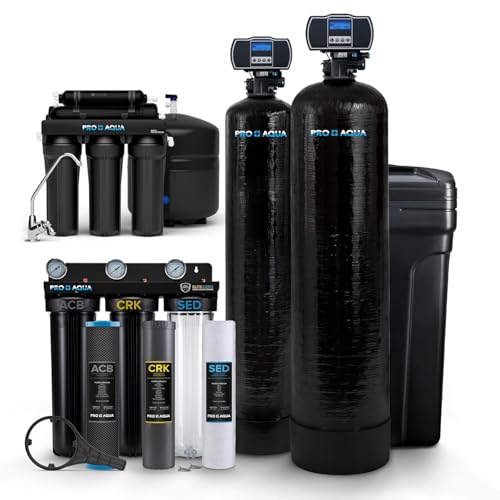
- 5 STAGE ULTIMATE PROTECTION: Specifically designed to provide unmatched filtration performance for well water. This whole house fi…
- UNMATCHED PERFORMANCE: From small to medium size households on well water. The specially engineered filters are designed to work t…
- PRO-GRADE MATERIALS: Designed for commercial demand but made for your home – With commercial grade parts, the PRO+AQUA systems wil…
The AFW Filters Fleck 5600SXT 48,000 Grain Water Softener with Upflow Carbon Filter is a package built around the Fleck 5600SXT digital metered valve with upgraded 10% resin, listed at 48,000 grain capacity and a recommended service flow up to 12 GPM. The upflow carbon stage is listed as needing no backwash — no drain line, no electricity, no wastewater for that tank — and targets chlorine and chloramines plus a range of chemicals, tastes and odors. The listing states a 5-year valve warranty and a 10-year tank warranty. It ships with an installation manual and technical support, though the actual plumbing tie-in and any electrical work should follow local code and go to licensed trades where required.
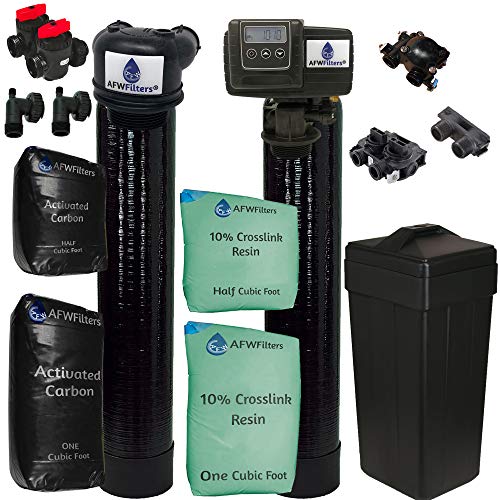
- COMPLETE PACKAGE – Complete package that includes a whole house Water Softener w/ UPGRADED 10% resin & Upflow Carbon Filtration Sy…
- WATER SOFTENER – Complete whole house system. Controlled by the Fleck 5600sxt digital meter valve. 48,000 grain high capacity soft…
- UPFLOW CARBON FILTRATION – Eco-friendly upflow design provides outstanding filtration without the need to backwash. No backwash me…
The DURAWATER Fleck 5600 SXT Whole House Water Softener is the more straightforward softener-only option: 48,000 grains, 1.5 cubic feet of high-capacity resin pre-loaded in the tank, the same on-demand metered 5600 SXT control, a plastic bypass with a 1-inch yoke, and a 14 × 36-inch brine tank with a safety float for overflow protection. On-demand metering is the relevant feature for the troubleshooting above — it triggers regeneration from measured water use rather than a fixed calendar day, which can reduce the odds of running out of soft water on a heavy-use evening, assuming the hardness setting is programmed correctly.
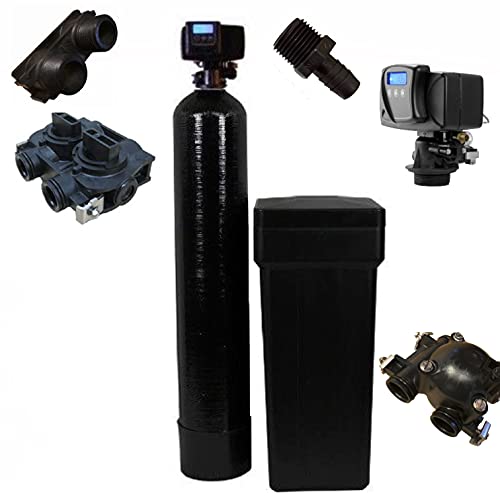
- Digital Metered Control System: Fleck 5600 SXT On Demand Digital Metered Water Softener with advanced meter-based regeneration tec…
- High Capacity Resin: 48,000 Grain capacity with 1.5 cubic ft of High Capacity Resin Pre Loaded in the tank for efficient water sof…
- Complete System: Black Mineral tank, 1.5 cu ft High Capacity Resin, plastic bypass and 1" yoke, and a standard 14"x36" Brine Tank …
Whichever direction you go, have a licensed plumber handle the installation and confirm permit requirements in your area — bypass placement, drain line air gaps and discharge rules are all local-code items.
Frequently asked questions
Why is my water softener not using salt?
The salt level staying put is the signature of either a salt bridge (a hard crust with an air pocket beneath it, so the water below never contacts enough salt) or a brine draw problem — a restricted injector or venturi, a plugged screen, or a kinked brine line. Start by probing the salt surface gently with the power off, then check the brine tubing for kinks and loose fittings. If the valve runs its cycles but the tank still fills with water instead of drawing it down, that’s a service call to a licensed plumber or the manufacturer.
My water softener is not softening but it regenerates — what now?
That combination usually points to a hardness setting that’s too low for your actual water, iron consuming capacity that was never accounted for, or resin that has lost exchange capacity with age. Test an untreated tap with a hardness strip, compare it against what’s programmed in the valve, and add whatever iron allowance your manual calls for. If the numbers are right and soft water still runs out early, ask the manufacturer about approved resin cleaning or media replacement.
How long should a water softener take to regenerate?
Most residential units run a multi-stage cycle lasting on the order of an hour or two, which is why manufacturers suggest scheduling it overnight. Water drawn during regeneration may be hard, so a wrong clock after a power outage can make a perfectly healthy softener look broken in the middle of the day. Your manual lists the cycle times for your specific valve — use those numbers, not a general figure.
Do I need a plumber to fix a water softener?
Often not for the basic checks your manual describes, such as checking and breaking up salt, cleaning and refilling the brine tank, operating the bypass valve as the manual shows, reprogramming hardness and the clock, and testing with strips. If you are unsure or anything leaks, call a pro. Anything structural — repiping, moving or replacing the bypass, rebuilding the control valve, replacing a piston or seal kit, opening the mineral tank, or replacing resin — belongs to a licensed plumber or the manufacturer’s service network, with permits where local code requires them. Electrical problems like a tripping breaker or damaged wiring go to a licensed electrician, not to you and not to the plumber.