This post contains Amazon affiliate links. As an Amazon Associate, HomeMechanicals.com earns from qualifying purchases — see our affiliate disclosure for details. Prices shown were verified on Amazon on September 15, 2026 and change frequently — always check the current price before buying.
A whole-house water filtration system treats every drop entering your home at the main line, rather than just the water at one faucet. That makes it a bigger decision than a countertop pitcher or an under-sink filter: you’re typically looking at a few hundred to over a thousand dollars for the unit alone, plus professional plumbing work to tie it into your main line. This guide compares five real systems currently available on Amazon, spanning entry-level sediment/carbon setups to premium systems built around specialty filtration media like KDF and catalytic carbon.
Disclosure: HomeMechanicals.com is a participant in the Amazon Associates program. We may earn a commission on qualifying purchases made through links in this article, at no added cost to you. Full policy on our affiliate disclosure page.
What Whole-House Filtration Actually Removes
Most whole-house filters on the market are built around one or more of these media types, often stacked in stages:
- Sediment filtration — a mechanical pre-filter (typically rated 5–20 micron) that catches dirt, rust particles, and sand before they reach the rest of the system or your fixtures.
- Standard activated carbon (GAC or carbon block) — adsorbs chlorine, some VOCs, and improves taste and odor. It handles free chlorine reasonably well but is only modestly effective against chloramine, a secondary disinfectant a growing number of municipalities use instead of (or alongside) chlorine.
- Catalytic carbon — activated carbon that’s been processed at high temperature to boost its catalytic activity. Independent testing generally shows catalytic carbon meaningfully outperforms standard carbon on chloramine breakdown, though exact reduction percentages vary widely across studies and testing conditions. If your water utility uses chloramine (check your local water quality report), this distinction matters.
- KDF (Kinetic Degradation Fluxion) media — a copper-zinc alloy that uses a redox reaction to reduce chlorine and certain heavy metals, and also helps inhibit bacterial growth on the filter media itself. It’s frequently paired with catalytic carbon rather than used alone, since each handles a different part of the job.
None of these whole-house filtration systems soften water or remove hardness minerals (calcium and magnesium). If scale buildup on fixtures and appliances is your primary concern rather than chlorine/sediment/taste, see our companion post, Water Softener vs. Whole-House Filter, for that distinction, and our Best Water Softeners for Hard Water roundup for true softening options.
How We Picked These Systems
We pulled current, real listings and pricing via Amazon’s product catalog rather than estimating. Prices below reflect what was live at the time of writing and will drift with normal Amazon pricing fluctuations — check the current listing before you buy. We grouped systems into rough budget/mid/premium tiers based on price and media sophistication, not marketing claims.
Budget Tier: Basic Sediment + Carbon
iSpring WGB21B — 2-Stage Whole House Filtration System
The WGB21B is a straightforward two-stage setup: a sediment pre-filter followed by a carbon block stage, rated by the manufacturer’s listing for roughly 50,000 gallons before the carbon stage needs replacing. It’s a reasonable entry point if your water is municipal, relatively clean, and your main concerns are chlorine taste/odor and basic sediment — not heavy metals or chloramine.
- Typical price: about $155
- View on Amazon
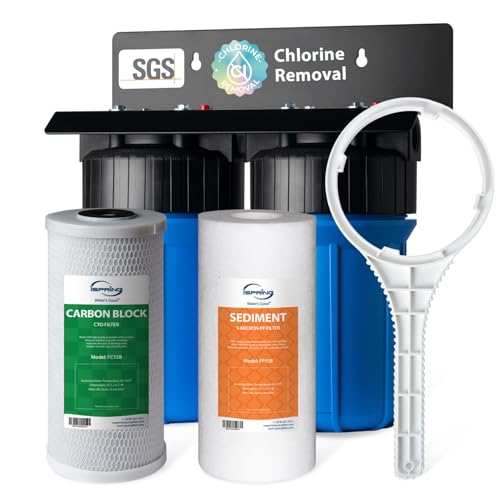
iSpring WGB32B — Commercial-Grade 3-Stage System
Steps up from the WGB21B with a third stage, giving more contact time and typically better reduction of taste/odor issues and a broader range of sediment sizes. Still a carbon-based system without KDF or catalytic media, so treat it as a step up in capacity and redundancy rather than a change in what contaminant categories it targets.
- Typical price: about $420
- View on Amazon

Mid Tier: Bigger Housings, Broader Reduction Claims
Express Water Whole House Water Filter System (3-Stage, "Ultimate Protection")
A 3-stage sediment/carbon/carbon system with larger 4.5″ x 20″ filter housings than the entry-level iSpring units, which generally means longer filter life between changes and lower pressure drop. Positioned as a mid-tier all-rounder for households wanting more filtration capacity without moving up to KDF-based media.
- Typical price: about $490 (was around $550)
- View on Amazon

SpringWell Whole House Water Filter Cartridge System (Carbon + Sediment)
SpringWell’s cartridge-based whole house system pairs sediment and carbon filtration in a more compact, cartridge-style housing (as opposed to the tank-style backwashing systems SpringWell also sells). It sits at the upper end of carbon-only systems before you get into specialty media territory.
- Typical price: about $620
- View on Amazon

Premium Tier: Specialty Media (KDF + Catalytic Carbon)
Aquasana Rhino WH-1000 — Carbon & KDF Media, 1,000,000 Gallons
The Rhino WH-1000 is Aquasana’s flagship whole-house system and is the one system in this roundup built around KDF media combined with carbon, rather than carbon alone. The listing cites a 1,000,000-gallon /up-to-10-year rated capacity on the main tank (pre- and post-filters are replaced far more frequently, typically every 3–6 months, and are a genuine ongoing cost worth budgeting for). Because it combines KDF with carbon, it’s the pick in this list best suited to well water or municipal water with elevated chlorine, chloramine, or trace heavy metal concerns — assuming your water testing supports that need in the first place.
- Typical price: about $1,000
- View on Amazon

At a Glance
| System | Tier | Media | Price |
|---|---|---|---|
| iSpring WGB21B | Budget | Sediment + Carbon (2-stage) | about $155 |
| iSpring WGB32B | Budget/Mid | Sediment + Carbon (3-stage) | about $380 |
| Express Water 3-Stage | Mid | Sediment + Carbon (3-stage, larger housings) | about $490 |
| SpringWell Cartridge System | Mid/Premium | Sediment + Carbon | about $620 |
| Aquasana Rhino WH-1000 | Premium | Carbon + KDF | about $1,000 |
Installation Notes
Whole-house filters tie into your main water line, typically right after the meter or pressure tank, and often require cutting into copper or PEX, adding shutoff valves, and in many jurisdictions a permit or at least code-compliant materials and backflow considerations. This is not a DIY plumbing project we’d recommend attempting without experience — we’d point you to a licensed plumber for the install itself, both for code compliance and so any warranty on the unit stays valid. Most manufacturer warranties on these systems require using OEM replacement cartridges (a generic substitute can void coverage), don’t cover freeze damage to the housing, and in some cases require documented professional installation — check the specific warranty terms before you buy, not after something goes wrong. Expect the plumbing labor for a whole-house filter to be a smaller job than a full water softener install (no drain line, no electrical, no brine tank), but pricing varies a lot by region and existing plumbing layout, so get a local quote rather than relying on a national average.
Frequently Asked Questions
Do I need to test my water before choosing a system?
Yes, and this is the step most homeowners skip. A basic municipal water quality report (available from your utility, usually online) will tell you whether chloramine is used as a secondary disinfectant, and whether there are any reported issues with iron, manganese, or other metals. Well water owners should get an independent lab test rather than relying on assumptions, since well water quality can vary significantly even between neighboring properties. Buying a KDF/catalytic-carbon system when a basic carbon filter would have covered your actual water profile is money spent on a problem you don’t have; the reverse mistake — under-filtering water with a real chloramine or metals issue — means the system underperforms regardless of price.
How often do filter cartridges need to be replaced?
This varies by system and by your water’s sediment load, but as a general rule sediment pre-filters need the most frequent attention (often every 2–6 months), while the main carbon or KDF/carbon media stage is rated for a much longer service life — sometimes measured in gallons treated (as with the Aquasana Rhino’s 1,000,000-gallon rating) rather than a fixed calendar interval. Whatever the marketed capacity, budget for replacement filters as a genuine recurring cost on top of the sticker price, not an afterthought.
Will a whole-house filter reduce my water pressure?
Any filter media adds some resistance to flow, and pressure drop tends to increase as filters load up with sediment between changes. Systems with larger filter housings and multiple parallel filters (rather than a single small cartridge) generally show less pressure drop under typical household demand, which is one practical reason the mid-tier and premium systems above use bigger housings than the entry-level two-stage units.
Does a whole-house filter protect my water heater and appliances from scale?
No. Sediment and carbon filtration protects against particulates, chlorine/chloramine taste and odor, and (with KDF) some metals and bacterial growth on the media — but it does nothing about dissolved calcium and magnesium, which are what cause scale. If scale on your water heater, dishwasher, or fixtures is your primary concern, you want a water softener or a salt-free TAC conditioner, not a filtration system. See our Water Softener vs. Whole-House Filter post for the full breakdown, and our Best Water Softeners for Hard Water roundup if hardness is the issue you’re actually solving for.
Bottom Line
If your water utility report doesn’t show chloramine or heavy metals, one of the carbon-only budget or mid-tier systems above is probably sufficient and considerably cheaper. If you’re on well water, have tested for iron or hydrogen sulfide, or your utility uses chloramine, the KDF/catalytic-carbon route (like the Aquasana Rhino) is worth the added cost — but test your water first rather than guessing. And remember: none of these systems address hardness. If scale is your actual problem, you’re looking at a softener or a salt-free conditioner, not a filter.