This post contains Amazon affiliate links. As an Amazon Associate, HomeMechanicals.com earns from qualifying purchases — see our affiliate disclosure for details. Prices shown were verified on Amazon on September 15, 2026 and change frequently — always check the current price before buying.
This post contains Amazon affiliate links. HomeMechanicals.com may earn a commission on qualifying purchases at no extra cost to you — see our affiliate disclosure page for details.
A quick note before we get into it: the BLUETTI AC500 — the model many buyers still search for by name — no longer turns up as an active listing through Amazon’s product catalog, and BLUETTI has moved its flagship modular lineup to the Apex 300 system, which now plays the same role (a base unit designed to be expanded with add-on battery packs). We’re comparing that current model instead of the discontinued one, since a comparison built around a product you can no longer actually buy wouldn’t be useful. Similarly, “Jackery Explorer” now spans several generations — we’re using the current Explorer 2000 v2, which sits closest in market position to the other two.
These three represent three different approaches to the same problem — a large-capacity, high-output portable power station in the $900-2,000 range — and they’re not identical in capacity or price, which matters for a fair read of the table below.
At a Glance
| Spec | EcoFlow DELTA Pro | BLUETTI Apex 300 | Jackery Explorer 2000 v2 |
|---|---|---|---|
| Battery capacity | 3,600Wh | 2,764.8Wh (expandable to 5,529.6Wh or 7,884.8Wh with add-on packs) | 2,042Wh (a separate, higher-spec Explorer 2000 Plus bundle reaches 4,084Wh — see note below; that is a different product tier, not an accessory for this unit) |
| Continuous AC output | 3,600W | 3,840W | 2,200W |
| Surge/peak output | 7,200W | 7,680W | 4,400W |
| Battery chemistry | LiFePO4 | LiFePO4 (EV-grade) | LiFePO4 |
| Weight (base unit) | ~99-100 lbs | ~84-85 lbs | ~39.5 lbs |
| AC wall recharge | ~2.7h (120V/1,800W circuit) / ~1.8h (240V/3,000W circuit) | ~2h in standard mode; BLUETTI cites 80% in ~45 min via Turbo Charging (max 3,840W input) | ~2h to full (single figure published) |
| Solar recharge (best case) | ~10-11h with 400-440W panels; max solar input 1,600W | ~40 min to 80% / ~80 min to full with 2,400W of solar input (two 1,200W arrays) | ~7h with the unit’s maximum supported 400W solar input (no larger array is supported) |
| Warranty | 5 years (3+2) | 5 years | 5 years (3+2, requires registration) |
| Cycle life | 3,500 cycles to 80% capacity | 6,000 cycles to 80% capacity (~17-year estimated lifespan per BLUETTI) | 4,000 cycles to ≥70% capacity (different threshold than the other two — not directly comparable) |
| AC outlets | ~5 total (4x 20A NEMA 5-20R + 1x 30A) | 6 total (4x 120V NEMA 5-20R + 1x 240V NEMA 14-50R + 1x TT-30R) | 5 total |
| Price (base unit, at time of writing) | about $1,900 | about $1,700 | about $900 |
Prices and current promotions change frequently — the figures above reflect what Amazon’s Creators API returned at the time this was written; check the live listing for current pricing.
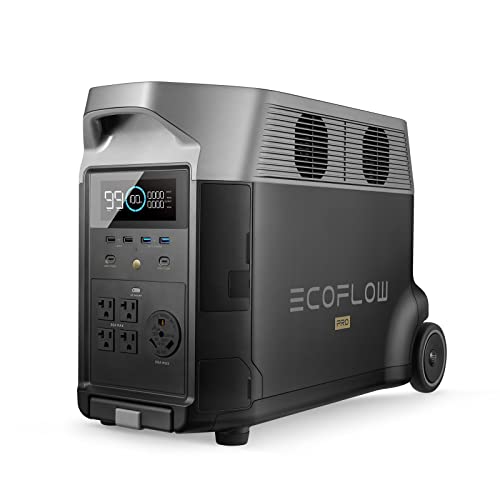
- EcoFlow DELTA Pro (3,600Wh): Check current price on Amazon
- BLUETTI Apex 300 (2,764.8Wh): Check current price on Amazon

- Jackery Explorer 2000 v2 (2,042Wh): Check current price on Amazon

Capacity and Output: Not an Apples-to-Apples Fight
The DELTA Pro carries the most capacity of the three at its base price, and BLUETTI’s Apex 300 actually edges it out on continuous and surge watts despite having less raw capacity — meaning it can push more power at once, even if it runs out of stored energy sooner under a heavy load. Jackery’s Explorer 2000 v2 is the smallest and least powerful of the three by a clear margin at its base configuration, but it’s also less than half the price of the other two. Jackery separately sells a distinct, higher-spec Explorer 2000 Plus line (3,000W continuous, a different product tier from the v2 compared here) bundled with an extra battery for more capacity, discussed just below.
BLUETTI’s Apex 300 takes this expansion idea furthest: it’s designed from the ground up as a modular system, with add-on battery packs pushing it to 5,529.6Wh (around $2,999 combined) or 7,884.8Wh (around $3,699 combined) — well beyond either of the other two’s maximum practical capacity. If you expect your power needs to grow — more appliances, a longer typical outage duration, or a future move toward broader home backup — the Apex 300’s expansion path is the most built-out of the three.


If you want more capacity than the base 2000 v2 offers, note that Jackery also sells a separate, higher-output Explorer 2000 Plus line — a different product from the v2 used in the main comparison, not an add-on for it. The Plus takes a 2,042Wh add-on battery (about $800), so one unit plus one battery reaches 4,084Wh, and Jackery lists the line as expandable to 24kWh in total. The catch as of this writing is how the base unit is sold: the Plus is currently listed mainly in solar bundles rather than on its own, with the cheapest in-stock option being the unit paired with two 100W panels at around $2,600. That makes the real combined cost of the Plus expansion path meaningfully higher than it looks on capacity alone, and higher than the v2 route. Confirm the exact model and spec sheet before buying, since v2 and Plus are easy to mix up when shopping.

Recharge Speed
All three publish genuinely fast recharge times under best-case conditions, but the fine print differs. BLUETTI’s Apex 300 posts the most aggressive numbers (45 minutes to 80% via AC, and as little as 40 minutes to 80% via a large 2,400W solar array) — but those figures assume high-current charging setups (a 3,840W-capable AC circuit, or two 1,200W solar arrays) that not every household or campsite will have on hand. On a standard single wall outlet, expect noticeably longer than the headline number for any of these three. The DELTA Pro’s recharge times are the most conservatively documented of the three — EcoFlow publishes separate figures for a standard 120V circuit versus a 240V circuit, which is a more transparent way to present it, even if the standard-outlet number isn’t as flashy.
For solar, all three scale recharge speed directly with how much panel wattage you actually connect — the manufacturer’s “headline” solar recharge time typically assumes near-maximum rated solar input, which for most residential solar panel setups (rather than the manufacturer’s own bundled panels in full sun) will take longer in practice.
Weight and Portability
This is one of the clearest differentiators. The Jackery Explorer 2000 v2, at roughly 39.5 lbs, is comfortably a one-person carry. The BLUETTI Apex 300 at roughly 84-85 lbs and the EcoFlow DELTA Pro at roughly 99-100 lbs both cross into two-person-lift territory for most people, and neither is something you’ll want to move around the house or in and out of a vehicle solo on a regular basis. If portability matters as much as capacity — say, you want to move the unit between a garage, a vehicle, and the house — that pushes toward the Jackery, or toward buying a smaller unit than any of these three flagships.
Warranty and Long-Term Ownership
All three carry a 5-year warranty, though EcoFlow’s and Jackery’s are both structured as a 3-year standard term plus a 2-year extension (Jackery’s extension requires product registration; check EcoFlow’s current registration terms as well, since these policies can change). BLUETTI’s Apex 300 carries the strongest published cycle-life figure of the three — 6,000 cycles to 80% capacity, versus EcoFlow’s 3,500 cycles to 80% and Jackery’s 4,000 cycles, though Jackery’s figure is measured to a different (lower, ≥70%) capacity threshold, so it’s not a direct like-for-like comparison. On paper, that gives the Apex 300 the longest expected useful life before capacity noticeably degrades, assuming normal use and storage conditions — though real-world battery life depends heavily on charge/discharge habits, storage temperature, and how often the unit is cycled versus left topped-up.
Which One Should You Buy
- Budget-conscious, don’t need maximum output: the Jackery Explorer 2000 v2 is less than half the price of the other two and still covers a meaningful set of household loads. Add the extra battery later if you find you need more runtime.
- Want the most headroom to grow capacity over time: the BLUETTI Apex 300’s modular battery system scales further than either competitor, which matters if you think your backup needs will expand.
- Want the most capacity in a single box today, with the most third-party track record: the EcoFlow DELTA Pro remains a well-reviewed, established flagship with the largest base-configuration capacity of the three.
- Weight/portability is a real constraint (apartment, no dedicated storage spot, need to move it often): the Jackery is meaningfully lighter than the other two.
Safety and Installation Notes
All three of these are portable, plug-in devices — none of them require an electrician or a permit to use as intended, which is charging the unit and plugging your own devices or a short extension cord into it. If your actual goal is wiring backup power into your home’s electrical panel (a true whole-home setup that keeps hardwired circuits running automatically), that requires a transfer switch and a licensed electrician, along with local permitting in most jurisdictions — we won’t walk through that wiring here, since it isn’t something to attempt without a licensed professional. Also follow each manufacturer’s ventilation guidance; these units generate heat under heavy load and during fast charging, and none of them are designed to run in a fully enclosed, unventilated space.
Bottom Line
There isn’t a single winner here — the three occupy genuinely different positions once you account for price, weight, and expansion path, not just raw specs. The Apex 300 is BLUETTI’s answer to buyers who want to start smaller and scale up; the DELTA Pro is the most capacity you can get in one box without needing a second purchase; and the Explorer 2000 v2 is the value play for buyers who don’t need flagship-tier output. Match the pick to your actual expected load and how much you expect your needs to grow, rather than defaulting to the biggest number on the spec sheet.