This post contains Amazon affiliate links. As an Amazon Associate, HomeMechanicals.com earns from qualifying purchases — see our affiliate disclosure for details. Prices shown were verified on Amazon on September 15, 2026 and change frequently — always check the current price before buying.
This post contains Amazon affiliate links. HomeMechanicals.com may earn a commission on qualifying purchases at no extra cost to you — see our affiliate disclosure page for details.
A “solar generator” is really a portable power station: a large lithium battery pack with a built-in inverter, charge controller, and a set of AC outlets, USB ports, and a 12V output. None of the models below require a permit or an electrician to use as a portable, plug-in backup source — you charge them from a wall outlet or solar panels ahead of time, then plug your devices directly into the unit during an outage. If your goal is whole-home backup wired into your electrical panel through a transfer switch, that’s a separate project that requires a licensed electrician and local permitting; we cover where that line sits later in this guide.
How to Size a Solar Generator for Your Home
Two numbers matter, and they’re not the same thing:
- Capacity (watt-hours, Wh): how much total energy the battery holds — think of it as the size of the fuel tank. A 1,000Wh unit running a 100W load will last roughly 8-9 hours in practice (there’s always some conversion loss, typically 10-15%).
- Output (watts, W): how much power the unit can deliver at once. Manufacturers publish both a continuous rating (what it can sustain) and a surge/peak rating (a short burst, usually a few seconds, for motor start-up). A well pump or a refrigerator compressor can draw 2-3x its running wattage for a second or two when it kicks on — if your unit’s surge rating can’t cover that spike, it will trip or shut off even though its continuous rating looked fine on paper.
As a rough starting point for typical household loads (always check the nameplate wattage on your own appliances — these vary by model and age):
- Refrigerator: roughly 100-250W running, with a surge that can briefly hit 800-1,200W on compressor start
- Sump or well pump: often 750-1,500W running, with surge commonly 2-3x that
- CPAP machine: typically 30-60W
- Window AC unit (small): roughly 500-1,200W running, higher surge
- Wi-Fi router/modem: usually under 30W combined
- Laptop charging: roughly 45-90W
Add up what you actually want to keep running during an outage, check that figure against the continuous watt rating of any unit you’re considering, and make sure the surge rating has headroom for whatever has a compressor or motor. Then look at watt-hours to figure out how many hours of runtime that gives you before you need to recharge (from a wall outlet, a car, solar panels, or a generator, depending on the model).
The Picks
These five span roughly $500 to $2,300 and cover a genuinely different capacity/output tier each, so the “best” one depends entirely on what you’re trying to run and for how long. All five list current prices at the time of writing pulled via Amazon’s Creators API — check the listing for the live price, since these move often.
Budget Entry Point: Jackery Explorer 1000 v2
- Capacity: 1,070Wh (LiFePO4)
- Output: 1,500W continuous / 3,000W surge, pure sine wave
- Recharge: under ~1.7 hours via wall outlet to full; roughly 3.5-4.5 hours with a 400W solar array
- Weight: 24.4 lbs
- Warranty: 5 years; rated for 4,000 cycles down to roughly 70% of original capacity
- Price: about $560
This is the realistic entry point for keeping a router, a few lamps, phone charging, and a CPAP running through a shorter outage. It won’t run a fridge and a well pump at the same time, but it’s light enough to move around the house and cheap enough to be a sensible first purchase if you’ve never owned one.

Mid-Capacity: BLUETTI Elite 200 V2
- Capacity: 2,073.6Wh (LiFePO4)
- Output: 2,600W continuous, with a 3,900W “power lifting” mode BLUETTI describes for high-demand appliances — treat 2,600W as the number to plan continuous loads around, pure sine wave
- Recharge: BLUETTI lists three charging modes: Turbo at 1,800W AC input (0–80% in about 1 hour), Standard at up to 1,440W (full in about 1.6 hours), and Silent at 800W (full in about 3 hours). Solar full charge is given as 2.4 hours with 1,000W of panels. As always, those assume a suitable circuit and ideal conditions.
- Weight: 53.35 lbs
- Cycle life: BLUETTI’s marketing copy claims over 6,000 cycles and a 17-year service life; as with all such figures, the capacity-retention threshold behind the number is not specified in the listing
- Price: about $900 (verified September 21, 2026)
This tier is where you can realistically start covering a fridge plus a handful of small loads for a good stretch of a multi-hour outage. At just over 53 lbs it is genuinely portable for one person in a way the older 60 lb-plus units in this class were not, though it is still not something you will want to move daily.

Mid-Upper: Anker SOLIX F3000
- Capacity: 3,072Wh (LiFePO4)
- Output: 3,600W continuous / 7,200W surge, pure sine wave. Note: Anker also lists a 7,200W figure for two F3000 units linked together running continuous 240V output — that is a different, continuous spec for a two-unit setup, not the single-unit surge rating, and it’s easy to confuse the two. The single-unit 7,200W surge rating itself is real and documented on Anker’s own product page.
- Recharge: under 2 hours to full with a 1,600W solar array; wall-outlet recharge time wasn’t published in the sources we checked
- Weight: 91.5 lbs
- Warranty: 5 years; cycle-life figures were inconsistent across Anker’s own materials (3,000 vs. 4,000 cycles cited in different places), both describing a roughly 10-year design life
- Price: about $1,400 (list around $1,700)
A solid step up in both capacity and continuous wattage for households that want to run a fridge, a sump pump, and general electronics together. It’s a two-person lift at over 90 lbs — factor that into where you plan to store and use it.

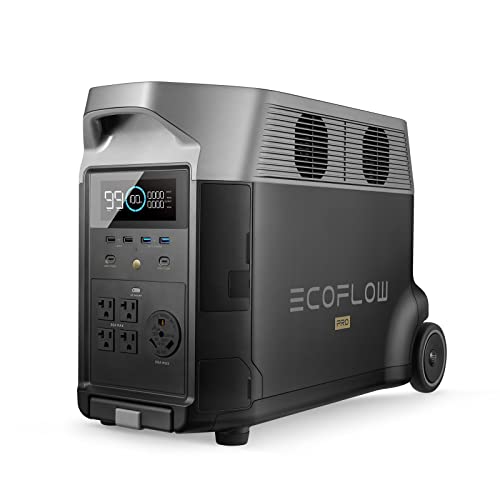
Premium Flagship: EcoFlow DELTA Pro
- Capacity: 3,600Wh (LiFePO4)
- Output: 3,600W continuous / 7,200W surge, pure sine wave. (EcoFlow’s “X-Boost” feature allows running certain devices up to 4,500W by tolerating a voltage drop — that’s a software accommodation, not extra continuous capacity, so don’t count on it for sensitive electronics.)
- Recharge: roughly 2.7 hours to full on a standard 120V/1,800W circuit, or about 1.8 hours on a 240V/3,000W circuit; solar recharge is roughly 10-11 hours with a 400-440W panel setup (max rated solar input is 1,600W, which shortens this considerably with a bigger array)
- Weight: approximately 99-100 lbs
- Warranty: 5 years (3-year standard plus 2-year extended); rated for 3,500 cycles to 80% capacity
- Price: about $1,900 (list around $2,600)
This is EcoFlow’s established whole-home-adjacent flagship, and the specs back up running a fridge, well pump, and several other circuits simultaneously for a genuinely useful stretch of an outage. It’s also EcoFlow’s line with the most third-party review coverage and track record at this point, which counts for something when you’re spending close to $2,000.
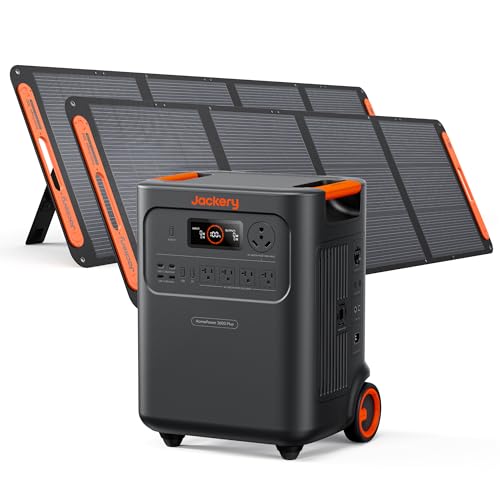
Whole-Home Expandable: Jackery HomePower 3600 Plus (with solar panels)
- Capacity: 3,584Wh base, expandable up to 21kWh with add-on battery packs (LiFePO4)
- Output: 3,600W continuous / roughly 7,200W rated surge (one independent load test reached about 5,900W under real-world surge conditions, short of the rated figure — worth keeping in mind if you’re sizing around a specific high-draw motor)
- Recharge: roughly 2.5 hours via wall outlet; roughly 4 hours with about 1,000W of solar input (this listing bundles two solar panels)
- Weight: 77 lbs (base unit)
- Warranty: 5 years (3-year standard plus 2-year extended); 6,000 cycles cited, though Jackery doesn’t publish the capacity-retention threshold for that figure
- Price: about $2,730 (list around $3,700, includes two 200W solar panels)
The expandability is the real story here — Jackery markets this line specifically as a whole-home backup foundation you can scale by adding battery packs over time rather than buying your final capacity on day one. That flexibility comes at a premium price, and stacking multiple battery packs is a meaningful additional spend beyond the base unit.
Solar Recharging: What to Actually Expect
Every manufacturer publishes a best-case solar recharge time assuming full-rated panel wattage, direct sun, an ideal panel angle, and moderate temperatures. Real-world recharging is typically slower — cloud cover, morning/evening sun angles, panel positioning, and heat all reduce the effective wattage reaching the battery. Treat published solar recharge times as a floor, not a guarantee, and if solar is your primary recharge plan for a multi-day outage, it’s worth erring toward more panel wattage than the “recommended” bundle suggests.
Warranty and Battery Degradation
All five picks above use LiFePO4 (lithium iron phosphate) chemistry, which is the current standard for this category because it degrades more slowly and handles more charge cycles than older lithium-ion chemistries before capacity noticeably drops. That said, cycle-life numbers aren’t directly comparable across brands: some manufacturers publish cycles to 80% remaining capacity, while others (notably some Jackery models) publish cycles to a 70% threshold — a “4,000 cycle” rating isn’t apples-to-apples between brands unless you check what capacity floor that number assumes. Warranty length (5 years is standard across all five picks here) is a reasonable proxy for how confident a manufacturer is in long-term reliability, but it’s not a substitute for checking the actual cycle-life spec against your expected usage pattern.
Safety Notes
- These units generate some heat under load and during charging. Follow the manufacturer’s ventilation clearance guidance and don’t operate them in an enclosed space without airflow.
- None of the units above are a substitute for a properly installed transfer switch if your goal is backing up hardwired circuits in your home. Running an extension cord from a portable power station to power specific devices is fine; back-feeding a home’s electrical panel without a transfer switch is a genuine safety hazard (to you and to utility workers) and, in most jurisdictions, illegal without a permit.
- If you want true whole-home backup wired into your panel, that’s a job for a licensed electrician, and it will typically involve a transfer switch and local permitting — we’re not going to walk through DIY panel wiring here, because it isn’t a DIY job.
- Keep these units away from open flame and out of direct sun/high heat for extended periods, per standard lithium battery storage guidance.
Bottom Line
If you’re new to this category and mainly worried about a shorter outage, the Jackery Explorer 1000 v2 is a sensible, inexpensive starting point. If you want to reliably keep a fridge running through a longer outage, the BLUETTI Elite 200 V2 or Anker SOLIX F3000 are where the math starts working in your favor. And if you’re thinking about this as the foundation of an actual whole-home backup strategy — with the intention to expand capacity over time — the EcoFlow DELTA Pro and Jackery HomePower 3600 Plus are built for that job, with the HomePower 3600 Plus specifically designed to scale further than the others. None of them replace a licensed electrician if hardwired backup is the end goal, but as a portable, no-permit-required first step, all five are reasonable purchases at their respective price points.
Pingback: Building a Whole-Home Resilience System: How Water, Power, and HVAC Work Together - HomeMechanicals