Prices shown were verified on Amazon on September 15, 2026 and change frequently — always check the current price before buying.
Whole-house reverse osmosis (RO) is a step up from a standard carbon/sediment filter in what it removes, and a step up in cost, complexity, and ongoing maintenance to get there. It’s a real category with real products, not a marketing repackaging of the filters we’ve covered elsewhere on this site — but it’s also frequently oversold as a default upgrade when a standard whole-house filter would solve the actual problem for a lot less money. This post is about figuring out which situation you’re in. As an Amazon Associate we earn from qualifying purchases; full policy on our affiliate disclosure page.
How It’s Mechanically Different From a Standard Filter
A standard whole-house filter — the kind covered in our Whole-House Water Filtration Systems Compared post — uses sediment media to trap particulates and activated carbon to adsorb chlorine, chloramine, and some organic taste/odor compounds. Water flows through relatively coarse media; nothing forces it through a barrier fine enough to block dissolved, ionic-level material.
Reverse osmosis works differently. Water is pushed under pressure through a semi-permeable membrane with pores small enough to reject dissolved solids, not just particulates. That’s the mechanical distinction that matters: carbon filtration is very good at chlorine and taste/odor and largely blind to dissolved minerals and ionic contaminants, while RO is built specifically to reject what carbon can’t touch. Because the membrane needs applied pressure and a place for the rejected material to go, whole-house RO systems are also structurally more involved — commonly requiring a storage tank, a booster pump, and a drain connection, none of which a standard cartridge filter needs.
What Whole-House RO Actually Removes That a Standard Filter Doesn’t
Based on general industry data on RO membrane performance (not any single manufacturer’s marketing claims), reverse osmosis membranes are commonly cited as reducing 95-99% of the following, none of which standard carbon/sediment filtration is built to address at meaningful levels:
- Total dissolved solids (TDS) — carbon media isn’t designed to remove dissolved ionic TDS (calcium, magnesium, sodium, chloride, etc.) at all; it adsorbs organics and chlorine, and any TDS-meter change from carbon filtration is typically minimal and inconsistent. RO is the technology actually built to reject dissolved solids.
- Fluoride — standard carbon media does not meaningfully reduce fluoride; RO is one of the few residential-scale technologies that does.
- Nitrates — relevant mainly for well water near agricultural land; carbon filters pass nitrates through largely unaffected.
- Arsenic — neither carbon filters nor water softeners remove arsenic; RO (and a few specialty adsorptive media not covered in this post) do, though RO’s arsenic rejection depends on oxidation state — pentavalent As(V) rejects well, while trivalent As(III) needs pre-oxidation to reject as effectively, which matters if your lab report specifies which form is present.
- Lead and PFAS — RO membranes reduce both substantially; carbon can reduce some PFAS compounds depending on the specific media and contact time, but RO is the more consistent whole-house solution across a broader range of PFAS chain lengths.
If a municipal water quality report or a private well lab test doesn’t flag any of the above, whole-house RO is solving a problem you don’t have, and a standard filter (or, for hardness specifically, a softener — see our softener vs. filter comparison) is the better-matched, cheaper tool.
The Real Tradeoffs
Wastewater Ratio and the Drain Requirement
RO membranes reject concentrate along with the contaminants they filter out, and that concentrate has to go somewhere — down a drain. Older/less efficient systems commonly ran 3:1 to as high as 7-8:1 waste-to-product ratios; modern systems with recirculation can do meaningfully better, with some claiming close to 1:1 under the right conditions. Even at a favorable 3:1 ratio, a household using 400 gallons of treated water a day is sending roughly 1,200 additional gallons down the drain in the process. This is the single biggest practical difference from a standard filter, which doesn’t waste water at all, and it’s worth confirming the specific ratio a system is rated for before buying, not assuming the best-case number applies.
The Remineralization Debate
RO strips dissolved minerals so thoroughly that the output water is typically mildly acidic (commonly cited in the pH 5-6 range) and can taste flat, and there’s a legitimate concern about it being more corrosive to copper plumbing over time. The common fix is a remineralization stage — usually a calcite or calcite/magnesium cartridge added after the membrane — that adds back calcium, magnesium, and trace minerals to bring pH up toward a neutral 7-8 range and restore a more natural taste. Not every whole-house RO system includes this stage by default; it’s worth checking whether a given product does, or budgeting for it as an add-on, particularly if the house has copper supply lines.
Higher Cost and Maintenance
Whole-house RO equipment runs meaningfully higher than a comparable carbon/sediment filter — commonly starting around $1,100-$1,200 for compact tankless commercial-style units and climbing well past $5,000 for true whole-house systems with a large storage tank and booster pump (see product comparison below). Ongoing maintenance is also more involved: membranes typically need replacement on a roughly 1-3 year cycle depending on incoming water quality and usage, pre-filter cartridges need their own separate replacement schedule to protect the membrane, and systems with a storage tank and booster pump have more mechanical components that can eventually need service, compared to a filter’s single cartridge swap.
Pressure Requirements
RO membranes need adequate incoming water pressure to function efficiently — low municipal or well pressure is a common reason whole-house RO systems ship with, or need to be paired with, a booster pump. This is a detail worth confirming against your home’s actual measured pressure before buying rather than assuming a system will perform at its rated flow/recovery numbers out of the box.
Four Real Whole-House RO Systems Across Price Tiers
All four below were sourced fresh via Amazon’s Creators API for this post, with current listed pricing at time of writing.
| System | Tier | Capacity | Configuration | Price |
|---|---|---|---|---|
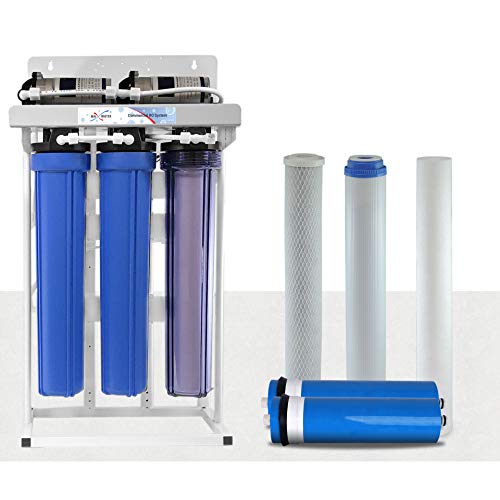
| Max Water 600 GPD Commercial RO | Budget | 600 GPD | Tankless, chlorine reduction pre-stage | about $1,150 |
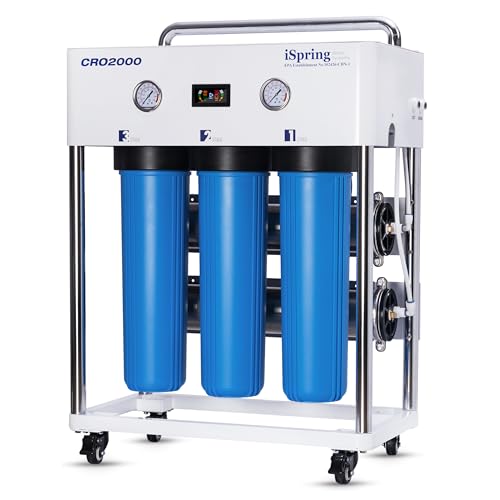
| iSpring CRO2000 4-Stage Dual Pump | Mid | 2000 GPD | Tankless, dual pumps, pressure gauges, freestanding steel bracket | about $3,400 (was about $3,800) |
| Crystal Quest Compact 3-Stage | High | 1000 GPD | Tankless, space-saving, made in USA | about $3,750 |
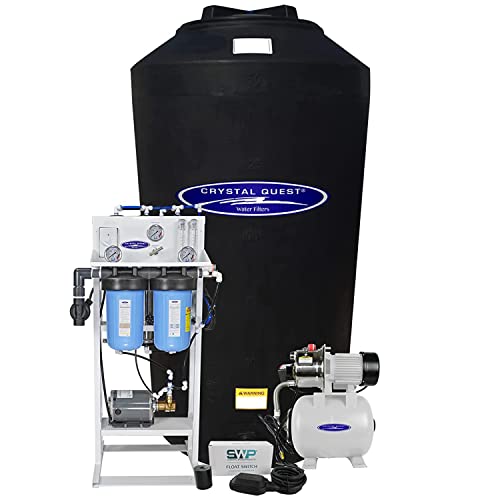
| Crystal Quest Whole House RO, 165-Gallon Tank | Premium | 1000 GPD | Storage tank + water pump + sediment/carbon pre-filter | about $5,450 |
Budget: Max Water 600 GPD Commercial Reverse Osmosis System
The lowest-priced true whole-house-capable RO system we found with current live pricing, explicitly marketed as a whole-house filter system and built with a chlorine-reduction pre-stage ahead of the membrane. As a tankless system, it doesn’t include the large storage tank of the premium options below, which keeps both price and footprint down but also means it’s producing filtered water on demand rather than drawing from a pressurized reserve.
- Typical price: about $1,150
- View on Amazon
Mid: iSpring CRO2000 4-Stage Tankless Commercial RO, 2000 GPD
A meaningful step up in throughput (2000 gallons/day rated) with dual pumps and pressure gauges, aimed at higher household demand or larger properties where a single-pump 600-1000 GPD system might not keep pace. Also tankless, so like the Max Water unit above, it produces on demand rather than storing pre-treated water.
- Typical price: about $3,500 (was around $3,800)
- View on Amazon
High: Crystal Quest Whole House RO, Compact 3-Stage, 1000 GPD
Crystal Quest markets this specifically as a space-saving whole-house configuration, made in the USA, at 1000 GPD. It sits at a higher price point than the two tankless systems above despite comparable throughput to the Max Water unit, reflecting brand and build differences rather than a straightforward capacity upgrade — worth comparing specs directly against the CRO2000 above if throughput, not brand, is your deciding factor.

- Typical price: about $3,750
- View on Amazon
Premium: Crystal Quest Whole House RO, 165-Gallon Tank + Pump, 1000 GPD
This is the configuration that most closely matches the “true” whole-house RO architecture described earlier in this post: a 165-gallon atmospheric storage tank plus a dedicated water pump to deliver pressurized output on demand, with sediment and carbon pre-filtration ahead of the RO stage. The storage tank means the system can meet peak simultaneous demand (multiple fixtures running at once) without waiting on the membrane’s real-time production rate, which is the main practical advantage over the tankless options above — at a real cost and footprint tradeoff, since a 165-gallon tank needs dedicated mechanical space.
- Typical price: about $5,450
- View on Amazon
Who Should (and Shouldn’t) Get One
Whole-house RO is a reasonable investment if a water test has specifically flagged elevated TDS, fluoride, nitrates, arsenic, or PFAS, and you want that addressed at every tap rather than just the kitchen sink via an under-sink RO unit. It’s a poor fit if your only documented issue is hardness (that’s a softener’s job) or chlorine taste/odor (that’s a standard filter’s job) — in both of those cases you’d be paying substantially more, wasting more water, and taking on more maintenance for a capability you don’t need. It’s also worth factoring in whether your plumbing has adequate incoming pressure and whether a storage tank and drain connection are physically feasible in your mechanical space before committing to a tank-based premium system.
Installation Note
Whole-house RO installation involves tying into the main water line, adding a drain connection for reject water, and in many configurations plumbing in a storage tank and booster pump — all work governed by local plumbing code, and drain connections in particular commonly require a permit and backflow prevention. We’re not providing DIY installation steps here; get a quote from a licensed plumber who can also verify your home’s incoming pressure is adequate for the specific system you’re considering.
Bottom Line
Whole-house RO is the right answer to a specific, testable problem — dissolved contaminants a standard filter can’t remove — and the wrong answer if you’re chasing scale or chlorine odor, where cheaper, lower-maintenance categories already do the job. If you land on RO being the right call, tankless systems like the Max Water and iSpring options above are the lower-cost, lower-footprint entry point; a tank-based system like the Crystal Quest 165-gallon unit is worth the added cost mainly if your household regularly hits peak simultaneous demand that a tankless system’s real-time production rate can’t keep up with. Either way, get your water tested first, and don’t buy RO capacity for a problem your test results don’t actually show.
Pingback: Best Under-Sink Reverse Osmosis Systems: Tank vs. Tankless Compared - HomeMechanicals