This post contains Amazon affiliate links. As an Amazon Associate, HomeMechanicals.com earns from qualifying purchases — see our affiliate disclosure for details. Links to the ALLPOWERS store are also affiliate links. Prices shown were verified on Amazon on September 15, 2026 and change frequently — always check the current price before buying.
Once you decide you want backup power, the next question is which category actually fits your situation: a portable power station you plug in and carry around, a fixed home battery system wired into your panel, or a gas/propane standby generator. These three sit on a spectrum of cost, capacity, and install effort, and picking the wrong one usually means either overspending on capacity you will not use, or under-buying and getting caught short in a multi-day outage.
This guide walks through the decision rather than pushing one category — each has a real place depending on your budget, your home’s electrical situation, and how long your outages typically run.
The Three Categories, in Plain Terms
Portable Power Stations
These are the battery packs on wheels or with a carry handle that you have likely seen from EcoFlow, Jackery, BLUETTI, and Anker. You charge them from a wall outlet, a car, or a portable solar panel, and they output power through standard AC outlets, USB ports, and sometimes a car-style DC port. No permit, no electrician, no gas line — you plug in what you want to run, up to the unit’s continuous wattage rating. We cover these in depth in Best Solar Generators for Whole-Home Backup and compare three popular models directly in EcoFlow DELTA Pro vs. BLUETTI vs. Jackery Explorer.
Fixed Home Battery Systems
This is the category most people mean when they say Tesla Powerwall, even though Powerwall itself is sold exclusively through Tesla’s certified installer network and is not available for direct purchase on Amazon or any other retailer — worth knowing up front so you are not searching for a listing that does not exist. The broader category, though, includes systems that are purchasable through Amazon: modular setups like the EcoFlow DELTA Pro Ultra and Anker SOLIX E10, which start as a large battery unit and scale up by adding battery modules, wired permanently into your panel through a smart home panel or power dock. These sit in a middle zone — larger capacity than a portable power station, expandable over time, but still requiring professional electrical installation.
Gas or Propane Standby Generators
The highest-capacity, highest-install-effort option: a permanently sited unit fueled by natural gas or propane, wired through an automatic transfer switch, that can run your whole panel indefinitely as long as fuel supply holds. We cover specific models in Best Whole-House Standby Generators (Gas/Propane). This is the option for homes where extended, whole-house coverage matters more than upfront cost or install complexity.
Decision Table
| Portable Power Station | Fixed Home Battery | Gas/Propane Generator | |
|---|---|---|---|
| Typical hardware cost | $500–$4,500 | $4,000–$10,000+ (before install) | $3,700–$8,500+ (before install) |
| Install required | None — plug in | Licensed electrician, permit in most areas | Licensed electrician + gas fitter, permit, gas line, transfer switch, pad |
| Runtime limit | Battery capacity, rechargeable via solar or wall power | Battery capacity, rechargeable via solar or grid when available | Fuel supply — effectively continuous on natural gas |
| What it can run | Fridge, lights, devices, medical equipment — selected circuits via extension cord or a manual inlet | A defined subset of panel circuits, sometimes the whole panel depending on capacity | Whole panel, including high-draw appliances like central AC or a well pump |
| Portability | Fully portable | Fixed in place | Fixed in place |
Where a Portable Power Station Makes Sense
If your outages are typically short (hours, not days), you rent rather than own, or you want backup power without a permitting process, a portable power station is usually the right starting point. It also gives you flexibility a fixed system does not — you can take it camping, use it as a job-site power source, or move it between a garage and a bedroom depending on the situation.
A reasonable mid-capacity example already covered on this site is the Jackery Explorer 2000 v2, at 2,042Wh with 2,200W continuous AC output, seen at about $900 at time of writing (ASIN B0DFG2WDQH). It is a sensible unit to compare against fixed options below because it sits right at the point where people start asking whether they should step up to something bigger and permanently installed instead.
View Jackery Explorer 2000 v2 on Amazon

For comparison on either side of that capacity point, ALLPOWERS publishes these specs for two of its LiFePO4 units. The ALLPOWERS R1500 lists 1,152Wh with 1,800W continuous AC output and a 15ms UPS-style switchover, a smaller unit sized for a fridge, router and lights. The ALLPOWERS R3500 lists 3,168Wh with 3,200W continuous output, and the manufacturer says it can be expanded with add-on battery packs, which puts it closer to the fixed-battery conversation below. Check current pricing and the exact output configuration on the product page before you buy.
Where a Fixed Home Battery Makes Sense
If you want meaningfully more capacity than a portable unit offers, plan to pair it with rooftop solar, and are comfortable with a one-time professional install, a modular fixed battery is worth pricing out. Two real, purchasable examples:
EcoFlow DELTA Pro Ultra
Starts at 6,144Wh in a single unit and is explicitly designed to scale — EcoFlow’s own published specs describe expansion up to roughly 90kWh across multiple units, paired with their Smart Home Panel 2 for automatic circuit-level switchover during an outage. A single unit was seen at around $4,200 (ASIN B0CQXMZ5BK) at time of writing. Installing the smart home panel and transfer functionality is an electrician job, even though the base unit itself is portable-capable on its own.
View EcoFlow DELTA Pro Ultra on Amazon

Anker SOLIX E10
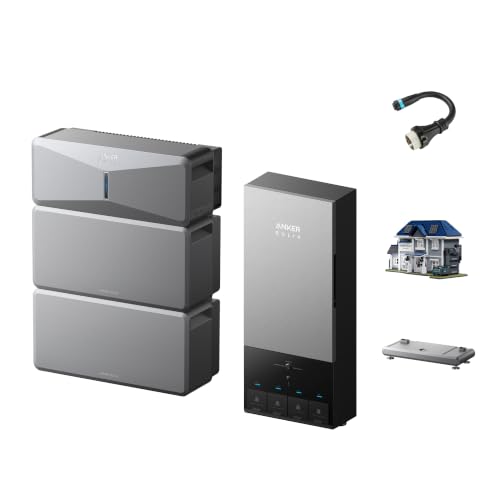
A more purpose-built whole-home system: a Power Dock plus battery module combination starting around 12kWh and expandable to 90kWh. Anker rates it for up to 10kW in a time-limited “Turbo” mode (roughly 90 minutes) once two or more battery modules are installed — that’s a short-duration boost figure, not an indefinite continuous rating, so confirm the actual sustained continuous-output number for your configuration before sizing any critical, always-on load against it. Per Anker’s own documentation, professional installation by a licensed electrician is mandatory for the Power Dock and grid connection — additional battery modules can reportedly be added afterward without a fresh electrician visit each time, though we would confirm that directly with an installer rather than assume it applies to every install. Seen at about $8,200 (ASIN B0GFKD7DD7) at time of writing.
View Anker SOLIX E10 on Amazon
A Note on Tesla Powerwall
Powerwall is the name most homeowners already associate with this category, but it is worth being direct about availability: Tesla sells Powerwall only through its certified installer network, not via Amazon or general retail. If you are comparing quotes, it belongs in the conversation as a benchmark for pricing and capacity, but you will not find a legitimate Amazon listing for it — be skeptical of any third-party seller claiming to offer one.
Where a Gas or Propane Generator Fits In
Batteries, whether portable or fixed, are ultimately limited by their capacity and how fast you can recharge them — solar recharge in particular is highly weather-dependent, which we cover in detail in How Many Solar Panels Do You Need to Recharge a Home Battery?. A gas or propane standby generator sidesteps that limit entirely: as long as fuel keeps flowing, it keeps running, which matters most for homes with a well pump, medical equipment with no interruption tolerance, or outages that regularly stretch past a few days in your area.
Some households land on a combination: a fixed battery or portable power station for near-silent, no-startup-delay coverage of the essentials, backed by a standby generator sized for the rare multi-day event or for running higher-draw appliances the battery cannot handle continuously. That combination costs more upfront than either option alone, so it makes the most sense where outages are both frequent and occasionally long.
A Simple Way to Decide
- Outages are short and infrequent, and you want the lowest-cost, no-permit option: portable power station.
- You want more capacity than a portable unit, plan to add solar, and are willing to pay for one professional install: fixed home battery.
- You need whole-panel coverage indefinitely, have a well pump or other high-draw essential circuit, or outages in your area regularly run multiple days: gas or propane standby generator, possibly paired with a battery for quiet daily coverage.
- You rent, move often, or are not ready to commit to permitted electrical work: portable power station, full stop.
Frequently Asked Questions
Can I upgrade from a portable power station to a fixed battery later?
Generally yes, though it is a separate purchase and install rather than an upgrade path within the same unit — a portable power station does not become a fixed system by adding hardware to it. Some manufacturers, like EcoFlow with the DELTA Pro Ultra line, sell units designed to work as either a portable unit or the base of a fixed system, which is worth asking about if you think you may want to scale up later.
Do fixed home batteries need a permit like a generator does?
In most areas, yes — the electrical work involved in tying a battery system into your panel typically requires a permit and inspection, similar to the standby generator process, even though there is no gas line involved.
Is a fixed battery quieter than a generator?
Yes, meaningfully — battery systems have no combustion engine and run silently, which is a real advantage over a gas generator’s audible operation, especially overnight or in close-set neighborhoods.
Disclosure: HomeMechanicals.com earns a commission on qualifying purchases made through the Amazon links in this post at no extra cost to you — see our full affiliate disclosure for details.
Pingback: Portable Generators for Winter Outages: Choosing One and Running It Safely - homemechanicals.com
Pingback: Financing a Standby Generator or Home Battery System: What Your Options Actually Cost - HomeMechanicals
Pingback: Anker SOLIX Buyer's Guide 2026: E10, F3800 Plus, C2000 - HomeMechanicals