This post contains Amazon affiliate links. As an Amazon Associate, HomeMechanicals.com earns from qualifying purchases — see our affiliate disclosure for details. Prices shown were verified on Amazon on September 15, 2026 and change frequently — always check the current price before buying.
Salt-free water conditioners have become a popular alternative to traditional water softeners, especially for households that want to reduce scale buildup without adding sodium to their water or dealing with salt bags and brine tanks. But before comparing products, there’s one thing worth saying plainly and repeating throughout this post: a salt-free conditioner is not a water softener. It does not remove calcium and magnesium from your water. If you want water that’s technically “soft” (hardness minerals actually removed), see our Best Water Softeners for Hard Water roundup instead. This post is specifically about template-assisted crystallization (TAC) systems, which take a different approach: scale prevention rather than mineral removal.
Disclosure: HomeMechanicals.com is a participant in the Amazon Associates program. We may earn a commission on qualifying purchases made through links in this article, at no added cost to you. Full policy on our affiliate disclosure page.
How TAC Actually Works (and What It Doesn’t Do)
Template-Assisted Crystallization media works by giving dissolved calcium and magnesium a nucleation site to crystallize onto, converting them into microscopic, inert crystals that stay suspended in the water rather than adhering to pipe walls, water heater elements, or fixtures. The water that comes out the other side still contains the same calcium and magnesium — a lab hardness test would still show it as “hard” water. What changes is the mineral’s physical behavior: it’s far less prone to depositing as scale.
This is a meaningfully different mechanism from a traditional ion-exchange softener, which swaps calcium and magnesium ions for sodium (or potassium) ions on a resin bed, physically removing hardness minerals from the water. Some practical differences that follow from this:
- No added sodium — relevant for people on sodium-restricted diets or who don’t want softened water for drinking/cooking.
- No brine tank, no salt bags, no regeneration cycle — less ongoing maintenance and no drain line needed for backwash/brine discharge.
- No true “soft” feel — TAC-treated water will not produce the slippery feel associated with softened water, because the minerals are still present.
- Effectiveness varies with water chemistry and flow rate — TAC performance is generally considered well-suited to moderate hardness levels; extremely hard water or very high flow rate demands are areas where some installers still recommend a conventional softener instead.
If your household’s main concern is scale buildup on faucets, showerheads, and water heaters — and you’re not concerned with achieving a true “soft water” feel or you have reasons to avoid added sodium — a TAC system is a reasonable, lower-maintenance option. If you specifically want reduced spotting, a soft-water feel, or you’re dealing with very high hardness, a true softener is the better-matched tool. For more on that decision, see Water Softener vs. Whole-House Filter.
How We Picked These Systems
All four systems below are explicitly built around TAC (template-assisted crystallization) media per their own product listings, confirmed via Amazon’s product catalog with live pricing verified on September 21, 2026. We excluded electronic/magnetic “descaler” products from this roundup deliberately — those use a different (and more debated) mechanism involving electromagnetic fields rather than TAC media, and lumping them in would blur an already-confusing category further.
Mid Tier
Premier Whole House Water Softener Alternative — 10 GPM TAC Salt-Free Descaler
A 10 gallon-per-minute rated TAC system, sized for typical single-family flow demand. Marketed explicitly as a “softener alternative,” which is accurate framing as long as buyers understand that means scale prevention, not mineral removal.
- Typical price: about $800
- View on Amazon

Scale Prevention Salt-Free Water Conditioner — 12 GPM TAC
Steps up to a 12 GPM flow rating, useful for larger households or homes with multiple bathrooms running fixtures simultaneously, where a lower-GPM system might see more pressure drop under peak demand.
- Price on Amazon: See current price
- View on Amazon

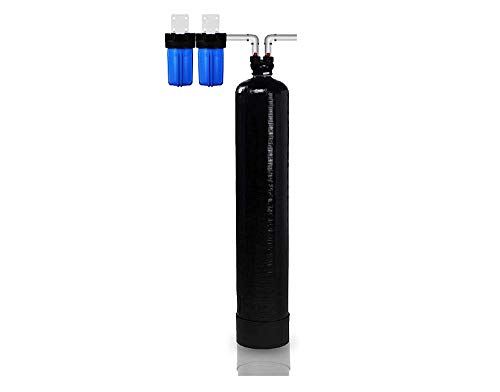
Premier Whole House Salt-Free + Anti-Scale System — 15 GPM with Dual Pre-Filters
Bundles a 15 GPM TAC conditioning stage with two additional pre-filter stages, which is a meaningful add if your water also has sediment or chlorine taste/odor issues you want addressed in the same install rather than with a separate filter system. Note: this listing’s own title uses the word "Softening" loosely — based on its described components (TAC media, no brine tank, no resin bed), it’s still a scale-prevention system, not a true ion-exchange softener, despite the wording.
- Typical price: about $1,150
- View on Amazon
Premium Tier
Scale Prevention Salt-Free Water Conditioner — 24 GPM TAC
The highest flow-rate TAC system in this roundup, aimed at larger homes or households with higher simultaneous water demand (multiple bathrooms, irrigation lines on the same feed, etc.). Higher GPM ratings generally mean less pressure drop at peak usage, which is the main practical benefit over the lower-GPM units above for bigger properties.
- Typical price: about $1,350
- View on Amazon

Below the TAC Tier: Cheaper Salt-Free Descalers
Genuine whole-house TAC systems start around $800. Below that price there is a second class of salt-free product — cartridge-style descalers that need no electricity, no backwash and no salt, but whose listings do not state what media they use. They are not the electromagnetic devices excluded above, and they may well use TAC media, but because the manufacturer does not say so we have kept them out of the roundup proper rather than claim a mechanism we cannot confirm.
Two worth knowing about, both from established water-treatment brands:
- A. O. Smith Whole House Salt-Free Scale Control (AO-WH-DSCLR) — about $400, rated by the manufacturer for up to 6 years or 600,000 gallons, with a 6-year warranty. View on Amazon
- WaterBoss Whole House Salt-Free Scale Control (WB-WH-DSCLR) — around $350, same 600,000-gallon rating. View on Amazon
Both manufacturers state the same operating limits, and they matter: these are specified for incoming water under 15 grains per gallon hardness, alkalinity under 250 mg/L, pH under 8.3 and iron under 0.3 ppm. Above any of those thresholds they are outside their rated range. Note also that both units are flow-rated at 7 GPM — below the 10–24 GPM systems in the roundup above, which may be a real constraint for a larger household running several fixtures at once. Neither unit softens water or removes hardness minerals, exactly as with TAC.
If TAC specifically is what you want and $800 is out of range, it is worth comparing against a traditional ion-exchange softener before settling — entry-level softeners can land in similar territory and they do remove hardness. See Water Softener vs. Whole-House Filter for that comparison.
At a Glance
| System | Tier | Flow / Capacity | Price |
|---|---|---|---|
| Premier 10 GPM TAC | Mid | 10 GPM | about $800 |
| Scale Prevention 12 GPM TAC | Mid | 12 GPM | about $940 |
| Premier 15 GPM + Pre-Filters | Mid/Premium | 15 GPM | about $1,150 |
| Scale Prevention 24 GPM TAC | Premium | 24 GPM | about $1,350 |
Installation Notes
Like any whole-house treatment system, TAC conditioners tie into your main water line and typically require professional installation to meet local plumbing code, especially where a permit is required for main-line work. TAC systems do have one installation advantage over traditional softeners: no drain line is needed since there’s no backwash or brine discharge cycle, which can simplify placement and sometimes reduce labor cost compared to a softener install. We’d still recommend having a licensed plumber handle the install rather than attempting it yourself, both for code compliance and warranty coverage.
Frequently Asked Questions
Will a TAC system remove hardness from my water test results?
No. If you send a water sample to a lab before and after installing a TAC system, the hardness number (grains per gallon or ppm) will read essentially the same. What TAC changes is the mineral’s tendency to deposit as scale, not its presence in the water. This is the single most common point of confusion with these products, and it’s worth confirming you understand it before you buy, since it affects what results you should actually expect.
Do I still need to descale my water heater with a TAC system installed?
TAC systems are designed to substantially reduce new scale formation, but manufacturers generally still recommend normal water heater maintenance, and results can vary with water chemistry, temperature, and flow conditions. Treat “reduces scale buildup” as the realistic claim, not “eliminates all scale forever.”
How long does the TAC media last before it needs replacing?
This varies by product and is usually stated as either a gallon-capacity rating or a multi-year estimate on the listing (several years is typical), but actual media life depends on your water’s mineral content and household usage volume. Check the specific product’s stated media life before buying, and budget for eventual media replacement as part of the system’s real cost of ownership.
Can I add a TAC conditioner to an existing whole-house filter?
Often yes — TAC conditioning and carbon/sediment filtration address different things and are commonly installed in sequence (filter first, then TAC conditioner, or vice versa depending on the manufacturer’s recommendation). If you’re considering this combination, our Water Softener vs. Whole-House Filter post and our Best Water Softeners for Hard Water roundup are both useful companion reading before you commit to a specific combination of equipment.
Bottom Line
All four systems above use genuine TAC media and span a reasonable price range for different flow-rate needs. None of them soften water in the technical sense, and any product description or review that implies otherwise is overstating what this technology does. If scale prevention without added sodium and without a brine tank fits what you’re looking for, TAC is a legitimate option. If you need actual hardness removal, go with a true ion-exchange softener instead.