HomeMechanicals.com is an Amazon Associate and earns from qualifying purchases. Product details come from manufacturer listings; see our research process.
Safety note: This is general information, not professional advice. Water heater, plumbing and electrical work should be done by licensed professionals following local codes, with permits where required. See our disclaimer.
City water typically arrives treated and tested. Well water is your responsibility from the aquifer to the tap, which is why well owners shopping for a “whole house filter” often end up with the wrong one. A cartridge system that works well on chlorinated city water can clog in weeks on iron-heavy well water, and a UV light installed on cloudy, iron-stained water may not disinfect it properly. The right well water system starts with a water test and is built in stages.
This guide explains what each type of well water treatment does, compares seven systems available on Amazon (cartridge, air-injection iron filters and UV), and covers the order they go in and the installation questions for your plumber. We compared manufacturer listings, published contaminant limits; we have not installed or tested these systems ourselves.
Step One: Test the Water First
The U.S. EPA and CDC both advise private well owners to test their water regularly. The CDC recommends testing at least once a year for total coliform bacteria, nitrates, total dissolved solids and pH. For choosing treatment equipment, also ask for iron, manganese, hardness and hydrogen sulfide (the rotten-egg smell), plus anything your county health department flags locally, such as arsenic. A state-certified laboratory gives you numbers you can size equipment against. Hardware-store strips are useful for spot checks but are not precise enough to choose an iron filter.
Two reference points help when you read the report. The EPA’s secondary (aesthetic) guideline for iron is 0.3 mg/L (ppm) and for manganese 0.05 mg/L. Above those levels, you typically see orange or black staining, metallic taste and fouled fixtures. Those are cosmetic guidelines. Bacteria, nitrate and arsenic are health issues, and a positive bacteria test should go to your local health department or a licensed well contractor to find and fix the cause, not just be treated at the tap.
Quick Comparison
| System | Type | Treats (listing claims) | Flow (listing) | Best for |
|---|---|---|---|---|
| iSpring WSP50ARB | Spin-down sediment prefilter | Sand, grit, rust particles (50 micron) | Up to 25 GPM | Protecting everything downstream |
| iSpring WGB32BM | 3-stage cartridge | Iron up to 3.0 ppm, manganese up to 1.0 ppm, sediment, chlorine | Up to 15 GPM | Low iron, small budgets, tight spaces |
| Waterdrop WHF3T-FG | 3-stage cartridge | Iron and manganese (SGS-tested reduction percentages), sediment, odor | 15 GPM | Low iron with odor or taste issues |
| AFWFilters Black Series | Air-injection backwashing tank | Iron up to 12 ppm, H2S up to 10 ppm, manganese up to 2 ppm | Check spec sheet | Moderate iron plus sulfur smell |
| Oceanic Water AIO 12×52 | Air-injection backwashing tank | Iron up to 27 ppm, H2S up to 17 ppm, manganese up to 11 ppm | Check spec sheet | Higher iron, larger homes |
| iSpring WCFM550K | Air-draw backwashing tank | Iron up to 12 ppm, manganese and H2S up to 20 ppm | Up to 12 GPM service | Iron and sulfur with programmable regeneration |
| iSpring UVF55FS | UV (last stage) | Microorganisms in clear, pretreated water | 12 GPM | Disinfection after filtration |
Contaminant limits and flow rates are the manufacturers’ listing claims. Your actual results depend on your water chemistry, pH, flow and maintenance.
How Well Water Treatment Is Built
Most well systems follow the same order, after the pressure tank:
- Sediment prefilter to catch sand and grit.
- Iron, manganese and sulfur removal, either catalytic cartridges (low levels) or an oxidizing, backwashing tank (higher levels).
- Water softener, if the test shows high hardness. Our best water softeners guide covers sizing by grain capacity.
- Carbon, if taste, odor or chlorine from shock treatment is a concern.
- UV disinfection last, because UV light only works on clear water.
Point-of-use reverse osmosis at the kitchen sink is the usual answer for drinking-water concerns like nitrate or arsenic. If your test shows either, pick an RO system certified for that contaminant rather than relying on a whole-house filter’s general claims. Our under-sink reverse osmosis comparison covers that step.
The Systems
iSpring WSP50ARB: A prefilter that protects what comes after

- [Flushable and Reusable] The whole house spin down sediment water filter is used to create a multi-layer gradient filtration syste…
- [Pressure-resistant and Durable Materials] Lead-free brass machine head, 50-micron food grade stainless steel mesh filter screen, …
- [Easy Installation] No welding or glue needed. Works well with copper, PEX, and CPVC pipes
This is not a complete treatment system. It is a 50-micron stainless steel mesh spin-down filter that catches sand, grit and rust particles before they reach finer filters, a softener or a UV chamber. The listing gives a maximum flow of 25 GPM, a lead-free brass head, and an auto-flushing module with auto, semi-auto and manual modes that purges collected sediment on a schedule. Its flush outlet needs to discharge somewhere appropriate, which your plumber will plan.
iSpring WGB32BM: Cartridge iron filter for low iron

- Whole house water filter that protect your family and household appliance from iron, manganese and more: Our 3rd stage iron water …
- DIY installation and maintenance – refer to our manual and our helpful YouTube videos for easy DIY installation. With 1 in. NPT in…
- Top-notch quality – the first stage high capacity polypropylene sediment filter achieves filtration down to 5 microns. The second …
A three-stage system with 20″ x 4.5″ cartridges: a 5-micron polypropylene sediment filter, a coconut-shell carbon block, and a catalytic iron and manganese stage (FM25B). The listing rates the iron stage for iron up to 3.0 ppm and manganese up to 1.0 ppm, with flow up to 15 GPM through 1-inch connections. It also states clearly that this system does not reduce total dissolved solids. The sediment and carbon stages are rated for 100,000 gallons, about a year for a family of four per the listing. Expect shorter cartridge life if your iron is near the top of the range. Above 3 ppm iron, or with a strong sulfur smell, step up to a backwashing tank.
iSpring also sells a compact 10″ version, the WGB31B-MKS iron, manganese and H2S system, with the same 3.0 ppm iron and 1.0 ppm manganese limits and a 50,000-gallon cartridge life. Our iSpring buyer’s guide covers the rest of the brand’s lineup.
Waterdrop WHF3T-FG: Cartridge system built for well water

- [SGS Tested and Certified] Tested by SGS, Waterdrop whole house water filter system effectively reduces 95.9% of iron、99.7% of man…
- [Certified Safe Materials] NSF/ANSI 372 certified for lead-free materials. The filter media meets NSF/ANSI 42, RoHS, and other key…
- [7-Stage Filtration] Using double iron and manganese removal cartridge and covered with high-quality carbon fiber filter achieve d…
Waterdrop’s well-water version uses a double iron and manganese removal cartridge plus a carbon fiber stage, at 15 GPM through 1-inch connections. The listing cites SGS testing showing 95.9% iron and 99.7% manganese reduction, NSF/ANSI 372 certification for lead-free materials, and says the filter media meets NSF/ANSI 42. The listing is inconsistent about the design, calling it both a 3-stage and a 7-stage system, so confirm the cartridge lineup with Waterdrop before buying. The listing does not state a maximum iron concentration the way iSpring’s does, so ask Waterdrop for one if your test shows more than about 3 ppm. Replacement intervals are listed as 6 to 12 months for the iron cartridges and 12 months for the carbon.
AFWFilters Black Series Air Injection: Moderate iron and sulfur

- AFWFilters Black Series Fleck 5600SXT Digital Air Injection System
- AFWFilters Installation Instructions Included. Easy to install yourself with our instructions and some basic plumbing skills. Most…
- AFWFilters Black Series Air Injection System Utilizes Catalytic Carbon Media, the Fleck 5600SXT Air Injection Control Valve, Bypas…
Air-injection filters work differently from cartridges. A pocket of air at the top of the tank oxidizes dissolved iron, manganese and hydrogen sulfide into particles, which the media bed traps. The tank then backwashes those particles down a drain on a schedule. No cartridges and no chemicals, but you do need a drain and enough well pump capacity for the backwash. This system pairs catalytic carbon media with a Fleck 5600SXT control valve and a bypass valve, with 1″ or 3/4″ connections. The listing claims removal of up to 12 ppm iron, 10 ppm hydrogen sulfide and 2 ppm manganese.
Oceanic Water AIO 12×52: Higher iron, larger homes

- High flow for larger homes, 4 or more people, 3 or more bathrooms. Removes iron up to 27 ppm, Hydrogen sulfide up to 17 ppm, Manga…
- The filter media in the tank traps the oxidized iron and sulfur until it is washed down the drain during the backwash cycle. The f…
- Removes iron, sulfur, and manganese and general filtering of your water. Whole House System for average size home
Another single-tank air-injection design on a Fleck 5600SXT AIO valve, in a larger 12″ x 52″ tank. Oceanic’s listing claims the highest limits in this guide: iron up to 27 ppm, hydrogen sulfide up to 17 ppm and manganese up to 11 ppm. It describes the unit as suited to homes with 4 or more people and 3 or more bathrooms, and says the media lasts about 5 years on average. Those limits are the manufacturer’s claims, and real performance at the high end depends heavily on pH and flow. If your numbers are near the top of any filter’s range, share your lab report with the manufacturer before you buy.
iSpring WCFM550K: Programmable air-draw iron and sulfur filter

- Advanced Filtration for Common Contaminants: The iSpring WCFM550K system reliably removes common water concerns like iron, mangane…
- Effortless Operation: The system features three main working stages: service, backwash, and air-draw, providing comprehensive wate…
- Flexible Regeneration Cycle: The regeneration cycle can be customized based on either time or treated water volume, offering flexi…
iSpring’s backwashing system cycles through service, backwash and air-draw stages under automatic control. The listing claims removal of up to 12 ppm iron and up to 20 ppm manganese and hydrogen sulfide, a 12 GPM service flow, and a 7- to 10-year effective life. Regeneration can be set by time or by water volume, with vacation mode and delayed regeneration. Two listing notes matter for well owners. The backwash flow is listed at up to 26 GPM, which many residential well pumps cannot supply, so confirm your pump’s output first. And the listing warns that phosphate treatment and organic contaminants (such as tannins) can interfere with oxidation-based iron removal.
iSpring UVF55FS: UV disinfection, last in line
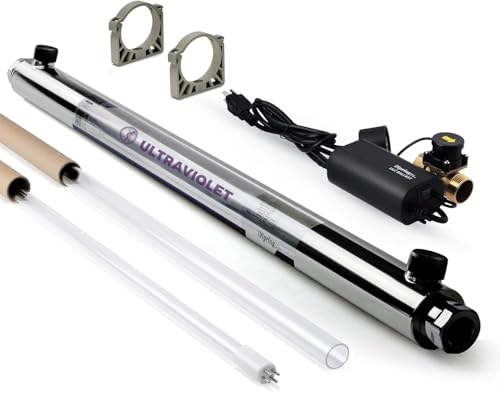
- Whole House Water Treatment: As the upgraded version of UV water filter iSpring UVF55, UVF55FS is a last step to add to your whole…
- Upgraded Ballast with Flow Sensor Switch: Ensured actual treatment with water's long dwell time in the 37.5-inch 304SS reactor cha…
- Easy Installation and Simple Maintenance: Mounting clips included for easy DIY installation. Annual replacement of the UV lamp and…
A 55-watt UV system in a 37.5-inch stainless reactor rated for 12 GPM through 1-inch connections. The flow sensor switch turns the lamp on when flow reaches 0.66 GPM in Auto mode, and the listing recommends annual lamp replacement and quartz sleeve cleaning every 6 to 12 months. UV light inactivates microorganisms but does not remove iron, sediment, hardness or chemicals, and those can coat the sleeve and block the light. That is why UV goes after the other stages. If you need disinfection because of known contamination, look for systems certified to NSF/ANSI 55 Class A and talk with your health department; the Amazon listing does not state an NSF/ANSI 55 certification for this unit.
All-in-one option: PRO+AQUA Elite bundle
If your water needs iron filtration, softening and sediment removal at once, the PRO+AQUA Elite 5-Stage Well Water Bundle is described as a multi-stage bundle with a filter, a well-water system and a softener (plus an RO system, per the title) designed to run in series. The listing is not consistent about size, describing it as suited to small and medium households while the title says ideal for 3-4 bathrooms, and it does not state iron or sulfur limits, so ask the seller for them. Bundles simplify ordering, but make sure every stage matches your test results.
How to Choose
Match the technology to your iron and sulfur numbers
- Iron under about 3 ppm, little or no odor: a cartridge system with a catalytic iron stage after a sediment prefilter (iSpring WGB32BM, listed to 3.0 ppm iron; Waterdrop WHF3T-FG, which lists no maximum, so confirm with the maker).
- Iron above 3 ppm or a noticeable rotten-egg smell: an air-injection or air-draw backwashing tank (AFWFilters, Oceanic, iSpring WCFM550K), sized to your flow and pump.
- Hardness as well as iron: iron removal first, then a softener. Some softeners tolerate small amounts of dissolved iron, but iron fouls resin over time.
- Bacteria present: fix the source with a well professional, then add UV after the filters as a safeguard.
Check your well pump and plumbing
Backwashing filters need a minimum flow rate to clean the media. Ask your plumber or well contractor for your pump’s GPM and compare it with the backwash rate in the manual. Backwash flow that is too low can leave the media poorly cleaned and is one reason iron filters underperform.
Plan the installation with a licensed plumber
Several listings describe their systems as DIY-friendly, but whole-house systems go on your main supply line after the pressure tank, backwashing units need a code-compliant drain connection (usually with an air gap), and powered valves and UV units need a nearby outlet. Have a licensed plumber do the install, and check local permit and drain rules. If the outlet does not exist, a licensed electrician adds it.
Count the ongoing maintenance
Cartridges get replaced every 6 to 12 months (more often with higher iron). Air-injection media lasts years but needs periodic replacement, and UV lamps are replaced about once a year. Our whole-house filtration comparison lays out maintenance by filter type.
FAQ
What is the best whole-house filter for well water?
There isn’t one answer, because wells differ so much. For low iron, a cartridge system with a catalytic iron stage is simplest. For higher iron or sulfur, an air-injection backwashing tank is the usual choice. Your lab results decide it.
Does a water softener remove iron?
Softeners can remove small amounts of dissolved (ferrous) iron, but they are designed for hardness. Iron above low levels tends to foul the resin, so most well systems put a dedicated iron filter ahead of the softener.
Will UV fix bacteria in my well?
UV can inactivate microorganisms in clear, pretreated water, but it does not fix the reason bacteria got into the well, such as a damaged cap or casing. Contact your local health department or a licensed well contractor, and retest after any repair or shock chlorination.
Why does my well water smell like rotten eggs?
Usually hydrogen sulfide gas, sometimes from sulfur bacteria. If the smell is only on the hot side, the water heater’s anode rod may be involved, which a plumber can check. If it is on both hot and cold, an air-injection or similar oxidizing filter is one common treatment option, once a lab test or well professional confirms the cause.
How often should I test my well?
The CDC recommends at least once a year for bacteria, nitrates, total dissolved solids and pH, and again after flooding, repairs, or any change in taste, color or smell.
General information only, not professional advice. Details can change or contain errors, so check with the manufacturer or an official source before you rely on them. Use of this site is subject to our Disclaimer and Terms of Service.