HomeMechanicals.com is an Amazon Associate and earns from qualifying purchases. Product details come from manufacturer listings; see our research process.
Safety note: This is general information, not professional advice. Heat pump installation involves refrigerant handling (EPA Section 608 certified technicians) and dedicated electrical circuits; use licensed professionals following local codes, with permits where required. See our disclaimer.
The best cold-climate mini-split is the one that still delivers most of its heating capacity at 5°F, not just the one with the lowest advertised operating temperature. Among the models on Amazon covered here, the Daikin Aurora 12k is the only listing that states capacity retained at 5°F (up to 100%), while the Cooper and Hunter Hyper Heat units list heating down to -22°F. In very cold places, plan to keep your existing furnace or baseboard heat as backup, and have the system sized with a load calculation and installed by licensed professionals.
This guide explains what “cold climate” and “hyper heat” actually mean on a spec sheet, how to read HSPF2 and SEER2, why defrost cycles and snow clearance matter, and how to size and back up a system for a northern winter. It then compares five systems. All product figures come from the Amazon listing for each model, and where a listing is silent or contradicts itself, we say so.
Quick Comparison
| Model | Capacity | Low-temp heating (listing) | Capacity at 5°F (listing) | Efficiency (listing) | Install |
|---|---|---|---|---|---|
| Cooper and Hunter Hyper Heat 12k | 12,000 BTU | Down to -22°F | Not stated | 24 SEER2; HSPF2 not stated | Professional required |
| Cooper and Hunter Hyper Heat 24k | 24,000 BTU | Down to -22°F | Not stated | 22.3 SEER2; HSPF2 not stated | Professional required |
| Senville AURA 24k | 24,000 BTU | Listing says “up to -22°F/-30°C” in general terms | Not stated | Not stated; ENERGY STAR | Professional required |
| Daikin Aurora 12k | 12,000 BTU class (13,500 BTU heating) | Down to -13°F | Up to 100% | 19.5 or 20 SEER2 (listing gives both); 10.2 HSPF2 | Listing silent; professional install advised |
| MRCOOL 4th Gen DIY 24k | 24,000 BTU | Not stated (cooling to 5°F only) | Not stated | Not stated in listing | Quick-connect line set; licensed electrician for wiring |
What “Cold Climate” and “Hyper Heat” Actually Mean
There is no single legal definition of a “cold-climate” or “hyper heat” mini-split. Manufacturers use the terms for systems with inverter compressors and refrigerant circuits designed to keep heating at low outdoor temperatures. Two very different numbers get used to support the claim:
- Rated low-ambient operating limit. The lowest outdoor temperature at which the unit will keep running in heating mode, such as -13°F or -22°F. This says nothing about how much heat it produces down there.
- Capacity retained at 5°F. How much of the unit’s rated heating output it still delivers at 5°F, expressed in BTU or as a percentage. This is the number that tells you whether the system can actually keep a room warm on a typical cold night.
In North America, the Northeast Energy Efficiency Partnerships (NEEP) developed a cold-climate air-source heat pump specification and maintains a product list based on criteria such as efficiency at 5°F and published capacity at low temperatures. It is a useful reference point. Check the NEEP list yourself for any model you are considering; this article does not claim that any product here is listed.
Why Capacity at 5°F Matters More Than the Minimum Temperature
All air-source heat pumps lose capacity as it gets colder outside, because there is less heat in the outdoor air to move and the compressor has to work harder to move it. At the same time, your house loses heat faster. The coldest nights are when demand peaks and output dips.
A unit that “works at -22°F” might still be delivering only a fraction of its rated output at that temperature. A unit that holds close to full capacity at 5°F is far more useful in a region where winter nights routinely fall into single digits. The Daikin Aurora listing is specific here: up to 100% heating capacity at 5°F, with continuous operation confirmed down to -13°F, and a heating capacity range of 4,400 to 18,800 BTU around a rated 13,500 BTU. For the other systems in this guide, ask for the manufacturer’s extended performance table, which lists capacity and power draw at 17°F, 5°F and below.
HSPF2 and SEER2 in Plain Terms
- SEER2 (Seasonal Energy Efficiency Ratio, updated test procedure) measures cooling efficiency over a season. Higher is better. The Cooper and Hunter 12k lists 24 SEER2 and the 24k lists 22.3 (some retailer pages show slightly different figures for the 12k, so verify on the AHRI certificate). The Daikin listing gives 19.5 SEER2 in the title and 20 SEER2 in the feature bullets; confirm the certified figure on the AHRI certificate or spec sheet.
- HSPF2 (Heating Seasonal Performance Factor, updated test procedure) measures heating efficiency over a season. Higher is better. For cold-climate buyers this matters more than SEER2. The Daikin lists 10.2 HSPF2. The other listings here do not state HSPF2, so look it up on each spec sheet or AHRI certificate.
Keep in mind that HSPF2 is calculated for a standard climate profile. In a much colder region, seasonal efficiency will be lower than the rating suggests, which is another reason to look at low-temperature performance data directly.
Defrost Cycles, Base-Pan Heaters and Snow
When outdoor air is cold and humid, frost builds up on the outdoor coil. The system periodically reverses into a short defrost cycle to melt it, during which the indoor unit stops blowing warm air for a few minutes. Features such as Daikin’s “Hot Start” are designed to avoid blowing cold air when heating resumes. Defrost cycles are normal and expected; frequent ones on damp, near-freezing days are typically not a defect.
Two installation details make a big difference in snow country:
- Base-pan heater. Melted frost drains out of the bottom of the outdoor unit. In very cold weather that water can refreeze in the base pan and build up ice against the coil or fan. Many cold-climate models include a base-pan heater or offer one as an accessory. Check the spec sheet for each model, since none of the listings here mention it.
- Height above the snow line. The outdoor unit needs free airflow and somewhere for defrost water to drain. Mount it on a stand or wall bracket above your area’s typical snow depth, away from roof drip lines and sheltered from drifting where possible. The Daikin listing includes a wall-mounting bracket. Your installer should confirm the bracket rating and wall structure.
If a system is already in place and struggling, our guide to why a mini-split is not heating covers frozen coils, defrost and other common causes.
Sizing: Load Calculation, Not Square Footage
Square-foot rules of thumb, such as “12,000 BTU for 500 square feet,” ignore the things that matter most in a cold climate: insulation, air leakage, window area, ceiling height and your local design temperature. The right approach is a Manual J heat-loss calculation done by an HVAC professional. It tells you how much heat each room needs on the coldest design day, which you then compare against each unit’s capacity at that temperature, not its nominal BTU rating.
Oversizing is also a problem. A unit too large for the space short-cycles in mild weather, controls humidity poorly in summer and runs less efficiently. Inverter systems modulate over a range (the Daikin lists 4,400 to 18,800 BTU heating), which helps, but the load calculation still comes first.
Backup Heat in Very Cold Places
In regions where winter design temperatures reach well below 0°F, many installers recommend keeping your existing furnace, boiler or electric baseboard as backup rather than removing it. The mini-split carries most of the heating season efficiently, and the backup system covers extreme cold snaps, defrost periods and any service outage. Single-zone wall units also heat one area well but do not distribute heat evenly to closed-off rooms, which is another reason to keep existing heat in place for the rest of the house. If you are weighing a whole-home approach, see our comparison of central AC, heat pumps, mini-splits and geothermal.
Also remember that a mini-split needs grid power. During an outage it stops, so a backup that can run without much electricity matters more in cold regions. If you plan to power it from a generator, have a licensed electrician install a transfer switch or interlock; never backfeed a panel through an outlet, and run generators outdoors well away from the house with working CO alarms indoors.
Professional Installation
Three of the five listings here (both Cooper and Hunter units and the Senville) state that professional installation is required, and the Daikin listing is silent on it. Opening a refrigerant circuit, brazing or flaring line sets, pulling a vacuum and adjusting charge must be done by an EPA Section 608 certified technician (or the provincial equivalent in Canada). The 230V circuit, disconnect and breaker need a licensed electrician, with permits as required by local code. Warranty terms often depend on who installs the system, so read each manufacturer’s warranty conditions before you buy.
The Models
Cooper and Hunter Hyper Heat 12,000 BTU: Highest listed SEER2 here

- Cooper & Hunter 12,000 BTU (1 Ton), 230V, 24 SEER2, Hyper Heat Single Zone Outdoor Condenser with one Wall Mounted Indoor Unit. Sm…
- Hyper Heat Performance in Extreme Cold: Engineered for extreme weather, this Hyper Heat system provides reliable heating in ambien…
- Whisper Quiet Operation: Designed for peaceful environments, the indoor wall-mount unit operates at low decibel levels, ensuring u…
This 1-ton, 230V single-zone system lists heating in ambient temperatures as low as -22°F and 24 SEER2 cooling efficiency. It comes with a pre-charged outdoor unit, a 16-foot insulated copper line set, communication cable, drain extension and a smart kit for phone control. The listing is direct that this is not a DIY system and professional installation by a licensed technician is required. It does not state HSPF2 or capacity at 5°F, so request the extended performance data before relying on it as primary heat in a northern climate.
Cooper and Hunter Hyper Heat 24,000 BTU: Larger-zone version
- Cooper & Hunter 24,000 BTU (2 Ton), 230V, 22.3 SEER2, Hyper Heat Single Zone Outdoor Condenser with one Wall Mounted Indoor Unit. …
- Hyper Heat Performance in Extreme Cold: Engineered for extreme weather, this Hyper Heat system provides reliable heating in ambien…
- Whisper Quiet Operation: Designed for peaceful environments, the indoor wall-mount unit operates at low decibel levels, ensuring u…
The 2-ton version shares the -22°F heating claim, the pre-charged condenser, the 16-foot installation kit and the smart kit. Listed cooling efficiency is 22.3 SEER2. The listing suggests uses such as large bedrooms, basements and open-concept areas. As with the 12k, it requires professional installation, ships by freight to the nearest accessible point outside the home, and does not list HSPF2 or 5°F capacity. A 24,000 BTU unit in a cold climate should be matched to a room-by-room load calculation, since a single wall head will not evenly heat several closed rooms.
Senville AURA 24,000 BTU: ENERGY STAR, voice control
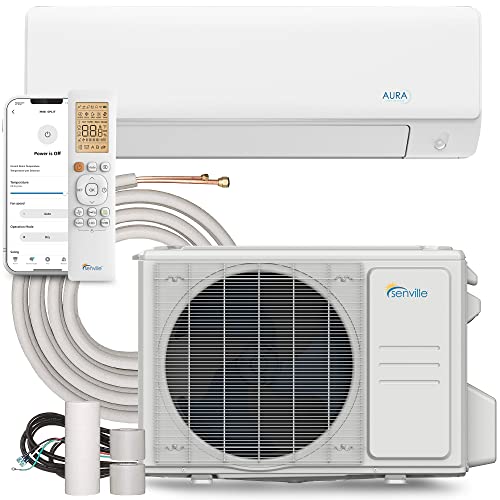
- MINI SPLIT AC WORKS WITH ALEXA: Experience seamless voice or app control to operate your mini split air conditioner from any locat…
- ULTRA-EFFICIENT MINI SPLIT AC/HEATING SYSTEM: This Energy Star Certified mini split ac/heating system utilizes a 208-230V DC Inver…
- VERSATILE DESIGN FOR HOME & BUSINESS: Whether it's your bedroom, living room, or commercial spaces like stores and restaurants, th…
The AURA is a 208-230V inverter system listed as ENERGY STAR certified, UL listed and AHRI certified, with Alexa and app control. The listing describes dependable cooling and heating “even in extreme conditions (up to -22°F/-30°C),” but does not separate the heating limit from the cooling limit, and it gives no HSPF2, SEER2 or capacity at 5°F. Check Senville’s spec sheet or the AHRI certificate for the heating performance table before you count on it as a primary heat source. The system includes the indoor unit, outdoor unit, 16-foot line set and communication wire, and the listing states that professional installation is required.
Daikin Aurora 12,000 BTU: Most complete cold-weather data in this group
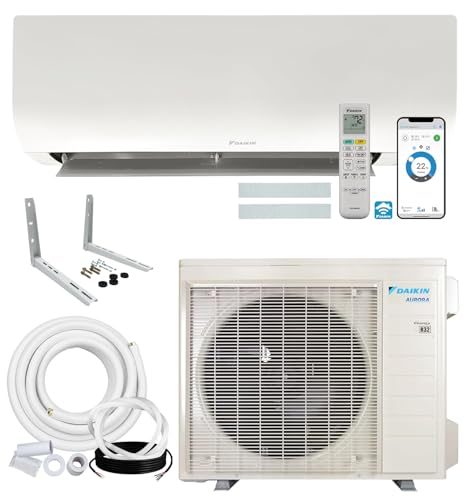
- Enhanced Low Ambient Capacity: Operates in cooling mode from 50°F to 114.8°F and heating mode from -13°F to 64.4°F, delivering up …
- All-Season Comfort: Designed for cold and harsh climates, this system excels in various applications like renovations, new constru…
- Effortless Comfort, anywhere: Easily control your environment with Daikin’s built-in Wi-Fi via the Daikin One Home app or voice co…
The Aurora listing gives the most complete cold-climate data in this group: heating from -13°F to 64.4°F, up to 100% heating capacity at 5°F, confirmed continuous operation down to -13°F, 10.2 HSPF2, 12 EER2, R-32 refrigerant and a 12-year manufacturer warranty, with an AHRI certificate number cited. Rated heating capacity is 13,500 BTU (4,400 to 18,800 BTU range). The listing gives 19.5 SEER2 in the title and 20 SEER2 in the bullets; confirm the certified figure on the AHRI certificate. The kit includes the outdoor unit with a wall-mounting bracket, the indoor unit and a 15-foot installation kit. Its -13°F minimum is higher than the -22°F claimed by some competitors, but the stated 5°F capacity is the more useful figure for most northern homes.
MRCOOL 4th Gen DIY 24,000 BTU: Quick-connect line set, with a cold-climate caveat

- Air Conditioner: 4th Generation DIY mini split air conditioner equipped with a low refrigerant alarm to prevent costly repairs and…
- Easy DIY Installation: No special tools, equipment, or training are required thanks to pre-charged Quick Connect line sets, making…
- Low Ambient Cooling: Capable of operating in cooling mode from as low as 5 degrees Fahrenheit, making it ideal for spaces up to 1,…
MRCOOL markets the 4th Gen DIY around pre-charged Quick Connect line sets that the manufacturer says need no special tools, equipment or training, plus a low refrigerant alarm, filter alerts, auto restart after power outages and a Wi-Fi smart kit. The listing suggests spaces up to 1,000 square feet. For cold climates, note what it does not say: the only low-temperature figure given is cooling operation down to 5°F. The listing gives no heating limit, HSPF2 or 5°F heating capacity (the cooling limit should not be read as the heating limit; other sources list a lower heating range), so check MRCOOL’s spec sheet before choosing it for primary heat in a northern winter. Even with the quick-connect line set, the 230V circuit and disconnect should be installed by a licensed electrician; check local code and permit requirements. Our MRCOOL buyer’s guide covers the brand’s lineup in more detail.
How to Choose
- Get a Manual J load calculation for the rooms you want to heat, at your local winter design temperature.
- Compare capacity at 5°F (or your design temperature) against that load, using the manufacturer’s extended performance table. Treat the minimum operating temperature as a secondary number.
- Check HSPF2 on the spec sheet or AHRI certificate. Where a listing contradicts itself, go with the certificate.
- Plan the outdoor location: a stand or wall bracket above snow depth, clear airflow, a drainage path for defrost water, and a base-pan heater if the model offers one.
- Keep your backup heat in very cold regions and decide how the two systems will share the load.
- Book licensed installers: an EPA 608 certified technician for refrigerant work and a licensed electrician for the 230V circuit. Check current utility and state or provincial rebates, which often require a qualifying installer.
For more options, including models aimed at milder climates, see our roundup of the best mini-split heat pump systems and the Pioneer mini-split buyer’s guide.
FAQ
Can a mini-split be the only heat source in a cold climate?
Sometimes, in a well-insulated home with a system sized for the design temperature and units that hold capacity at 5°F. In many northern homes, keeping a furnace, boiler or baseboard as backup is the safer plan for extreme cold and power or service interruptions.
What does “works at -22°F” mean?
It means the unit will keep running in heating mode down to that temperature. It does not tell you how much heat it produces there. Look for capacity at 5°F and below in the extended performance data.
Is the Daikin Aurora 19.5 or 20 SEER2?
The listing gives both: 19.5 SEER2 in the title and 20 SEER2 in the feature bullets. Check the AHRI certificate (the listing cites one) for the certified figure.
Why does a mini-split stop blowing heat for a few minutes in winter?
That is usually a defrost cycle melting frost off the outdoor coil. It is normal. If the outdoor unit is building up ice that does not clear, have a technician check drainage, the base pan and the defrost controls.
Can a homeowner install a cold-climate mini-split?
The Cooper and Hunter and Senville listings say professional installation is required. MRCOOL markets its DIY line set for owner installation, but the electrical connection still needs a licensed electrician and local code compliance. Refrigerant work is generally restricted to EPA 608 certified technicians (or the provincial equivalent in Canada), and rules for pre-charged quick-connect systems vary, so check local requirements.
Bottom Line
For cold-climate heating, judge mini-splits by capacity at 5°F and HSPF2, not by the lowest temperature on the box. The Daikin Aurora 12k has the most complete published cold-weather data here. The Cooper and Hunter Hyper Heat 12k and 24k claim the lowest operating limit at -22°F, but you need their performance tables to see how much heat they deliver there. The Senville AURA and the quick-connect MRCOOL 4th Gen need a spec sheet check before relying on them in a northern winter. Size with a load calculation, mount the outdoor unit above the snow, keep backup heat in very cold regions, and use licensed professionals for the refrigerant and electrical work.
General information only, not professional advice. Details can change or contain errors, so check with the manufacturer or an official source before you rely on them. Use of this site is subject to our Disclaimer and Terms of Service.