HomeMechanicals.com is an Amazon Associate and earns from qualifying purchases. Product details come from manufacturer listings; see our research process.
Safety note: This is general information, not professional advice. Water heater, plumbing and electrical work should be done by licensed professionals following local codes, with permits where required. See our disclaimer.
For most homes replacing an electric tank, a heat pump (hybrid) water heater is often the more efficient and easier upgrade: the Rinnai model lists an ordinary 240V / 30A circuit, and the hybrids here list a UEF of 3.75, against roughly 0.82 for a non-condensing gas tankless unit and close to 1.0 for electric tankless. Tankless wins when you need continuous hot water for long, back-to-back draws, or when there is no room for a tank. Gas tankless needs proper venting and a larger gas line. Whole-house electric tankless needs a very large electrical service, and that alone rules it out in many homes.
Below: the key differences, six models (three hybrids, three tankless) and a decision section. Product figures come from manufacturer listings; confirm them on the spec sheet before you buy.
Quick Comparison
| Model | Type | Efficiency (listing) | Delivery (listing) | Power / fuel (listing) | Venting |
|---|---|---|---|---|---|
| Rinnai REHP50 | Heat pump tank, 50 gal | 3.75 UEF | 73 gal first hour | 240V / 30A | None; needs condensate drain |
| Senville 50-Gallon Hybrid | Heat pump tank, 50 gal | 3.75 UEF | 69 gal first hour | 240V, 4.5 kW element (confirm circuit on spec sheet) | None; needs condensate drain |
| ACiQ 50-Gallon Hybrid | Heat pump tank, 50 gal | 3.75 UEF | 69 gal first hour | 240V (confirm circuit on spec sheet) | None; needs drainage |
| Rheem RTG 9.5 GPM Indoor | Gas tankless, non-condensing | 0.82 UEF | 9.5 GPM at 35°F rise | Natural gas, 199,900 BTU/hr | Direct vent, professional install |
| Stiebel Eltron Tempra 24 Trend | Electric tankless, 24 kW | Check spec sheet | Check spec sheet for GPM at your rise | 240V, 2x50A breakers, 100A draw, 150A min. service | None required |
| Rheem RTEX-24 | Electric tankless, 24 kW | Check spec sheet | Up to 5.9 GPM (rise not stated) | 240V, three 40A double-pole breakers, 200A service recommended | None required |
Efficiency: UEF Is Not the Whole Story
Uniform Energy Factor (UEF) is the standard US water heater efficiency rating; higher is better.
- Heat pump water heaters (about 3.75 UEF in these listings) move heat from the surrounding air into the tank instead of making it with a resistance element.
- Electric tankless (close to 1.0 in principle) uses resistance heating. Nearly all the electricity ends up in the water, but it cannot exceed 1.0. Check each model’s spec sheet for its rated UEF.
- Non-condensing gas tankless (0.82 UEF on the Rheem RTG listing) burns gas and sends some heat up the vent. Condensing gas tankless models recover more of that heat and rate higher, but they need a condensate drain and different venting.
A gas UEF and an electric UEF do not tell you which costs less to run, since therms and kWh are priced differently everywhere. Estimate annual therms or kWh and apply your own rates. Without gas service, the answer is simpler: by rated UEF, a heat pump tank typically uses a fraction of the electricity of electric tankless for the same hot water.
One cold-climate catch for hybrids: the heat a heat pump water heater removes from a heated basement in winter is heat your furnace or heat pump puts back. Net savings are lower in a heated space over a long winter, though in summer the unit typically cools and dries the surrounding air somewhat.
First-Hour Rating vs GPM: Two Different Questions
The two technologies are rated differently, which makes them hard to compare side by side.
- First-hour rating (FHR) applies to tanks. It is how many gallons of hot water the heater can deliver in one busy hour, starting with a full tank. The Rinnai REHP50 lists 73 gallons; the Senville and ACiQ list 69. Compare FHR to your household’s busiest hour, such as several showers plus a dishwasher in the morning.
- Gallons per minute (GPM) at a stated temperature rise applies to tankless. A tankless heater has no stored water, so the question is how much flow it can heat continuously. The rating only means something with the temperature rise attached: the difference between the incoming cold water and the hot water you want.
A tank delivers a high burst until stored hot water runs out. Tankless never runs out but caps how many fixtures can run at once.
Why Cold Groundwater Cuts Tankless Flow
This is the point most tankless shoppers in northern climates miss. A tankless heater has a fixed maximum heat output. The water flow it can handle is that output divided by the temperature rise it has to deliver. Double the rise and the flow roughly halves.
The Rheem RTG listing gives 9.5 GPM at a 35°F rise. (The listing calls 199,900 BTU/hr the output, but that figure is the input rating; 9.5 GPM at 35°F works out to roughly 166,000 BTU/hr of heat delivered to the water, consistent with the 0.82 UEF.) In much of Canada and the northern US, winter incoming water from municipal mains or wells can be in the 40s°F or colder. Heating 40°F water to 120°F is an 80°F rise, more than double the rated condition, so the same unit delivers well under half its headline flow, roughly 4 GPM by the same rule (about 166,000 BTU/hr divided by 500 x 80). That is typically one or two showers, not three or four; actual output varies by model and conditions.
Electric tankless is hit harder because its output is smaller. A 24 kW unit produces roughly 82,000 BTU per hour. Using the standard rule that heating one GPM by 1°F takes about 500 BTU per hour, that works out to roughly 2.3 GPM at a 70°F rise and about 2 GPM at an 80°F rise. These are rule-of-thumb estimates, not manufacturer ratings. The Rheem RTEX-24 listing says “up to 5.9 GPM” without stating the rise, so that figure reflects warm incoming water. Ask for the manufacturer’s flow chart at your winter groundwater temperature before you size anything.
Electrical, Gas and Venting Requirements
Heat pump tanks: an ordinary 240V circuit
The Rinnai REHP50 listing specifies 240V / 30A, the same class of circuit many standard electric tanks already use. A licensed electrician should confirm breaker and wire size.
Electric tankless: very large service
Whole-house electric tankless is the most demanding option electrically. The Stiebel Eltron Tempra 24 Trend listing calls for two 50A breakers, a 100A draw and a minimum recommended service of 150A. The Rheem RTEX-24 listing calls for three 40A double-pole breakers, three sets of #8 AWG copper conductors with ground and a recommended 200A service panel. Many older homes have 100A service, and a 200A panel may lack spare capacity once other large loads are counted. A licensed electrician should run a load calculation; a panel or service upgrade is a permitted job and may involve your utility.
Gas tankless: venting and gas line sizing
The Rheem RTG is rated at 199,900 BTU/hr. A typical gas tank heater uses a fraction of that, so the existing gas line is often too small, and the gas meter’s capacity matters too once a furnace and range are running at the same time. Non-condensing units also need the specific vent materials the manufacturer specifies. The listing describes direct venting and says professional installation is required. A licensed gas fitter should size the gas line, install the venting to the manual and local code, and pull the permit.
Space, Air Volume and Placement
Tankless units mount on a wall. Heat pump tanks are typically taller than standard tanks and need room air to work with. The ACiQ listing specifies 700 to 1,000 cubic feet of air circulation and says not to install it in unheated spaces below 37°F. That rules out a small closet without ducting or a louvered door, and an unheated northern garage in winter. Below a hybrid’s operating range, many units rely on their electric elements and run like a standard electric tank, which erodes the efficiency advantage; check each manual, since the ACiQ listing simply says not to install it there.
Condensate, Noise, Recovery and Maintenance
- Condensate: heat pump tanks produce condensate that needs a floor drain or condensate pump. Condensing gas tankless units also produce acidic condensate that typically needs a neutralizer. The non-condensing RTG is not designed to condense in normal operation.
- Noise: hybrids have a fan and compressor. ACiQ lists 49.5 dB(A) and describes this as one of the quietest water heaters on the market; the other hybrid listings do not state a sound level, so compare spec sheets, and consider placement away from bedroom walls. Electric tankless is close to silent; the Stiebel listing describes it as noise free in use. Gas tankless has a combustion fan.
- Recovery: hybrids in heat pump-only mode recover slowly. Hybrid or auto modes bring in the elements when demand spikes.
- Maintenance: tankless heat exchangers need periodic descaling (flushing), especially with hard water. Hybrids need their air filter cleaned and their tank flushed like any tank heater. Service on the sealed refrigerant system is work for an EPA Section 608 certified technician, not a homeowner task.
The Models
Rinnai REHP50: Hybrid with the highest listed first-hour rating

- Energy-efficient performance: Energy Star Certified. Extracts heat from ambient air to deliver consistent hot water with zero emis…
- High first-hour delivery: Provides up to 73 gallons of hot water in the first hour‚Äîideal for households of 3‚Äì4 people with hig…
- Demand-Response Enabled: Saves you money by communicating with local utilities to reduce energy usage during peak hours
The REHP50 listing gives a 3.75 UEF, a 73-gallon first-hour rating aimed at households of 3 to 4, and ENERGY STAR certification. It runs on 240V / 30A with standard 3/4-inch MNPT water connections and R134a refrigerant. It is demand-response enabled for utility peak programs. The listing states zero clearance on the top, back and sides, though the room still needs adequate air volume. The residential warranty is listed as 10 years on tank and parts and 1 year on labor.
Senville 50-Gallon Hybrid: Long compressor coverage

- Energy-Saving Hybrid Water Heater – Advanced heat pump water heater technology extracts heat from the air to warm water efficientl…
- High Efficiency Performance – With a 3.75 UEF rating and a 69-gallon First Hour Rating (FHR), this hybrid water heater delivers re…
- 50 Gallon Electric Water Heater Capacity – Perfect for medium to large households, providing consistent hot water for showers, lau…
The Senville hybrid lists ENERGY STAR, UL and AHRI certification, a 3.75 UEF, a 69-gallon first-hour rating and a 4.5 kW backup element. Its claim of up to 70% less electricity than a standard electric tank is a best-case manufacturer estimate. The warranty is listed as 7 years on parts and 10 years on the compressor. The listing does not state the circuit size, so get it from the installation manual before your electrician quotes the job.
ACiQ 50-Gallon Hybrid: Lists a sound level, clearest placement rules

- CERTIFIED ACiQ SELLERS: Everything you need for reliable HVAC solutions!
- INDOOR INSTALLATION: It performs best in stable indoor temperatures and should not be installed in unheated spaces below 37°F.
- PERFECT LOCATION: Ideal for basements or garages, this 50 gallon hot water heater electric unit requires 700–1,000 cubic feet of a…
The ACiQ listing is the most explicit about placement: 700 to 1,000 cubic feet of air, proper drainage, and no installation in unheated spaces below 37°F. It lists a 3.75 UEF, a 69-gallon first-hour rating for 3 to 5 people, Wi-Fi and 49.5 dBA operation. The 12-year tank and parts warranty requires online registration, so register on installation day.
Rheem RTG 9.5 GPM Indoor: Whole-house gas tankless

- High Performance Natural Gas Tankless Water Heater delivers endless instant hot water on demand for whole house residential use | …
- Energy Efficient Non-Condensing Gas Tankless Water Heater with 0.82 Uniform Energy Factor (UEF) saves up to 34% on energy costs vs…
- Ideal Whole House Tankless Gas Water Heater for large families and multi-bathroom homes with 3-4 water points running simultaneous…
This non-condensing natural gas unit lists 9.5 GPM at a 35°F rise, 199,900 BTU/hr, a 0.82 UEF, indoor direct-vent installation, a digital temperature control in 1°F steps, freeze protection and flame failure protection. The 9.5 GPM figure assumes a small rise; northern winter flow will be far lower. The listing says professional installation is required and gives a 15-year heat exchanger and 5-year parts warranty. Budget for a gas fitter to check gas line and meter capacity.
Stiebel Eltron Tempra 24 Trend: Electric tankless, no venting

- CONTINOUS FLOW – Hot showers will never be interrupted again. Enjoy continuous, on-demand hot water with an unlimited supply, when…
- SPACE & ENERGY SAVER – Its small, sleek white design saves space yet still provides endless hot water for your whole house, and no…
- SILENT OPERATION – One electronic switch will activate the hot water heater and it’s noise free while in use. Digital temperature …
The Tempra 24 Trend is a 24 kW, 240V unit with auto-modulation, a digital display, a copper heating system and an output range of 68°F to 140°F. It needs no venting. The electrical requirement is the deciding factor: two 50A breakers, a 100A draw and a 150A minimum recommended service. At 24 kW, simultaneous flow is limited with cold groundwater. The listing gives a 7-year leakage and 3-year parts warranty.
Rheem RTEX-24: Electric tankless with explicit wiring specs
- Get the performance you expect. Choose the right size water heater for your home and verify electrical requirements before install…
- 24kW model provides up to 5.9 GPM
- Multiple fixture applicatons
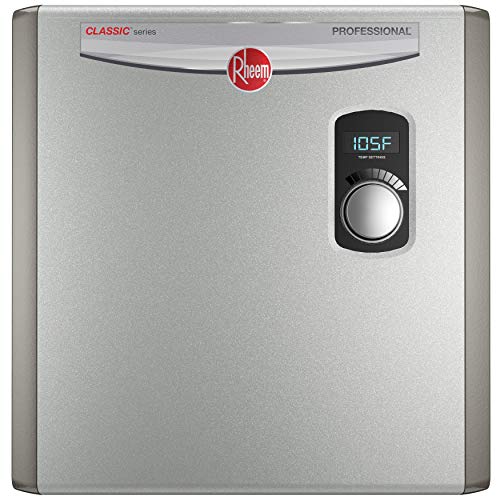
The RTEX-24 is another 24 kW, 240V unit. Its listing spells out the wiring: three 40A double-pole breakers, three sets of #8 AWG copper conductors with ground, and a recommended 200A service panel. It lists up to 5.9 GPM (without stating the temperature rise), thermostatic control from 80°F to 140°F in 1-degree steps, and no venting. The warranty is listed as 5 years on leaks and 1 year on parts. Rheem’s listing itself advises verifying electrical requirements before installation.
Which Fits Your Home
Choose a heat pump water heater if:
- You are replacing an electric tank and already have a 240V circuit nearby.
- You have a basement, garage or utility room with enough air volume that stays above the unit’s minimum temperature.
- You have no gas service, or want to move away from it, and do not want a service upgrade.
- Your hot water use comes in normal peaks that a 69 to 73 gallon first-hour rating can cover.
Choose gas tankless if:
- You already have natural gas and room to route a vent, and a gas fitter confirms the line and meter can supply about 200,000 BTU/hr.
- You want continuous hot water for long showers or a large tub, and you size the unit at your winter temperature rise, not the 35°F headline.
Choose electric tankless if:
- Your electrician confirms you have the service capacity (150A to 200A recommended for these 24 kW units) with spare room on the panel.
- Your incoming water is relatively warm, or demand is modest, such as a smaller home, a cabin or a point-of-use application.
- You cannot fit a tank or run a vent.
Cold-climate rule of thumb
In northern climates with cold groundwater and long winters, the hybrid tank in a heated basement is often the simplest match: the Rinnai lists an ordinary 240V / 30A circuit, and stored hot water can cover short peaks without the flow cap a tankless unit has (colder inlet water still lengthens recovery). Gas tankless can work well when sized for a 70°F to 80°F rise. Whole-house electric tankless is the hardest fit, because it combines the largest electrical demand with the steepest flow loss in cold weather.
How to Choose
- Find your winter groundwater temperature. Measure cold tap water after running it, or ask your utility. Calculate your rise to 120°F.
- Count simultaneous fixtures. A shower typically uses about 1.5 to 2.5 GPM. Multiply by the number that run at once and compare against each tankless unit’s flow at your rise, or against a tank’s first-hour rating.
- Plan for permits. Water heater work involves plumbing, electrical and often gas and venting. Use licensed trades and follow local code.
- Check incentives. The federal 25C credit ended for equipment placed in service after December 31, 2025. Check current utility, state or provincial rebate programs, some of which may cover heat pump water heaters; availability varies and changes.
For deeper dives, see our guides to the best heat pump water heaters, gas vs electric tankless water heaters, the tankless vs traditional water heater cost comparison, and the Rinnai tankless buyer’s guide.
FAQ
Is a heat pump water heater more efficient than tankless?
By rated UEF, yes. The hybrids listed here are rated 3.75 UEF, against 0.82 for the non-condensing Rheem RTG and close to 1.0 in principle for electric tankless. Operating cost still depends on your gas and electricity rates and where the unit is installed.
Why does a tankless heater deliver less hot water in winter?
Colder incoming water means a larger temperature rise, and a tankless unit’s flow drops as the rise increases. A unit rated 9.5 GPM at a 35°F rise delivers well under half that at an 80°F rise.
Can a 100A panel handle an electric tankless water heater?
Usually not for a whole-house unit. The Stiebel Tempra 24 listing recommends at least 150A service and Rheem recommends 200A for the RTEX-24. A licensed electrician should run a load calculation.
Will a heat pump water heater make the basement cold?
It cools and dehumidifies the room it is in. In winter, your heating system replaces some of that heat. Make sure the room meets the manufacturer’s air volume requirement, such as ACiQ’s 700 to 1,000 cubic feet.
What maintenance does each type need?
Tankless units need periodic descaling of the heat exchanger. Hybrids need air filter cleaning, tank flushing and a clear condensate drain. Before winter, review our water heater winterizing checklist for freeze protection on either type.
Bottom Line
For many homes replacing an electric tank, a heat pump water heater such as the Rinnai REHP50, Senville or ACiQ hybrid offers the highest rated efficiency of the options here (the Rinnai lists a 240V / 30A circuit; confirm the circuit for the others). Gas tankless like the Rheem RTG suits homes with gas service, a vent route and a demand for continuous hot water, provided it is sized for winter groundwater. Electric tankless units like the Stiebel Tempra 24 and Rheem RTEX-24 make sense only where the electrical service can support them. Confirm specs on the manufacturer’s sheet and use licensed trades for the installation.
General information only, not professional advice. Details can change or contain errors, so check with the manufacturer or an official source before you rely on them. Use of this site is subject to our Disclaimer and Terms of Service.