HomeMechanicals.com is an Amazon Associate and earns from qualifying purchases. Product details come from manufacturer listings; see our research process.
Safety note: This is general information, not professional advice. Any connection to your home’s wiring must be made by a licensed electrician using a transfer switch or interlock; never backfeed through an outlet. Run generators outdoors only, at least 20 feet from the house, and keep working CO alarms inside. See our disclaimer.
A gas furnace burns gas for heat, but it cannot run without electricity. The blower, the inducer fan that vents exhaust, the igniter and the control board all stop when the power goes out, so a winter outage leaves you with a full gas line and a cold house. The good news is that a gas furnace’s electrical draw is modest compared with most heating equipment, which puts it within reach of a portable power station, as long as it is sized correctly and connected safely.
This guide explains how to estimate your furnace’s power needs, how long a power station of a given size can realistically run it, and which six power stations on Amazon fit the job. It also covers the connection question, which is the part most people get wrong. The specs here come from manufacturer listings and typical furnace nameplate ratings; nobody has tested these units for this guide.
Step 1: Find Your Furnace’s Electrical Load
A gas or propane furnace’s electrical load comes from four parts:
- Blower motor, the biggest load. Older PSC (permanent split capacitor) blowers often draw several hundred watts or more; variable-speed ECM blowers usually draw less at the lower speeds they use most of the time.
- Inducer (draft) motor, a small fan that runs whenever the burners fire.
- Igniter, which draws power for a short time at the start of each cycle.
- Control board and thermostat, a small, steady draw.
Together, these typically land between a few hundred watts and about 1,000 watts while the furnace is running, with a short surge when the blower starts. The furnace’s rating plate (usually inside the access panel) lists the total amps or the blower motor’s full-load amps. Multiplying volts by amps (120V x amps) gives a conservative upper bound in watts; the real average is usually lower. For precise numbers, an HVAC technician can measure the actual draw, or a licensed electrician or technician can measure it with a meter.
Oil furnaces and boilers add other loads (an oil burner motor, or circulator pumps on hydronic systems), but the same method applies. Electric furnaces, electric baseboard heat and central heat pumps are different: they draw thousands of watts and are generally beyond what a portable power station can run for meaningful periods.
Step 2: Estimate the Duty Cycle
A furnace does not run continuously. It cycles on and off to hold the thermostat setting, and how much of each hour it runs depends on outdoor temperature, insulation and the thermostat setting. On a mild night it might run a quarter of the time; in a deep cold snap in a drafty house, it might run most of the time. Lowering the thermostat a few degrees during an outage can stretch battery runtime.
Multiply running watts by the fraction of time the furnace runs to get your average load. A 600W furnace that runs half the time averages about 300W.
Step 3: Match Capacity to Your Outage
Power stations are rated in watt-hours (Wh). After inverter losses, roughly 85% of the rated capacity is a common planning estimate for usable AC energy. The table below shows estimated furnace-only runtime at three average loads. These are planning estimates, not guaranteed results; real runtime depends on your furnace, the cold and the battery’s condition.
| Power station capacity | Usable (about 85%) | At 200W average | At 350W average | At 500W average |
|---|---|---|---|---|
| 2,048 Wh | About 1,740 Wh | About 8.5 hours | About 5 hours | About 3.5 hours |
| 3,072 Wh | About 2,610 Wh | About 13 hours | About 7.5 hours | About 5 hours |
| 4,096 Wh | About 3,480 Wh | About 17 hours | About 10 hours | About 7 hours |
If you also need the refrigerator, a sump pump or lights from the same unit, add their average loads before dividing. For multi-day outages, you will need expansion batteries, a recharge source or a generator. Our 3-day outage guide runs the numbers for a fuller household load.
Step 4: Check the Output Specs That Matter for a Furnace
- Continuous output: should comfortably exceed the furnace’s running watts plus anything else on the same unit.
- Surge capacity: covers the blower motor’s starting draw.
- Pure sine wave output: furnace control boards and ECM motors expect clean AC power. Confirm pure sine wave output on the manufacturer’s spec sheet.
- Boost modes don’t count: features like EcoFlow X-Boost and BLUETTI Power Lifting generally work by lowering voltage, which suits resistive loads like kettles and heaters, not motors. Size on the continuous rating.
- Grounding and polarity: many furnaces use flame sensing that depends on proper grounding and correct polarity. Some portable power sources handle neutral and ground differently from utility power, so your electrician and the furnace manufacturer’s guidance should confirm the setup will work.
Step 5: Plan a Safe Connection
Most furnaces are hardwired to a dedicated circuit with a service switch, not plugged into an outlet. Do not cut the wiring and add a plug yourself, and never feed power backward through a wall outlet. A licensed electrician can install one of these, with a permit where your jurisdiction requires it:
- A single-circuit furnace transfer switch with an inlet or cord connection, which lets you switch the furnace between utility power and a portable source.
- A panel interlock or multi-circuit transfer switch with a power inlet, which can also cover the fridge, sump pump and lights.
- A manufacturer’s home panel, such as the home panels and transfer kits some makers (EcoFlow, for example) sell for their larger stations. Compatibility varies by model, so check with the maker and your electrician.
Some local codes restrict cord-and-plug furnace connections, which is another reason to let the electrician choose the method. Keep working carbon monoxide alarms in the home. A furnace that is running normally vents its exhaust, but alarms are the safety net for any fuel-burning appliance.
Power Stations That Fit a Furnace Backup Plan
Jackery Explorer 2000 v2: Light, compact 2kWh option

- High-Capacity Power Solution: With 3 AC ports delivering a total output of 2200W and a massive 2042Wh capacity, the Jackery Explor…
- Smallest & Lightest 2kWh Power: Weighing just 39.5 lbs, the Jackery Explorer 2000 v2 weighs less than other bulky units, making it…
- Ultra-Fast & Versatile Charging: Power up and go — Charge the Explorer 2000 v2 from 0 to 80% in just 66 minutes with AC Fast Charg…
The listing gives 2,042Wh of LiFePO4 capacity, 2,200W of AC output across 3 AC ports, a 20 ms UPS switchover certified to UL1778, and a weight of 39.5 lb. It charges from 0 to 80% in 66 minutes on AC per the listing. At 2kWh, it suits shorter outages or overnight furnace runs at a reduced thermostat setting.
BLUETTI Elite 200 V2: Low standby draw, long cycle life
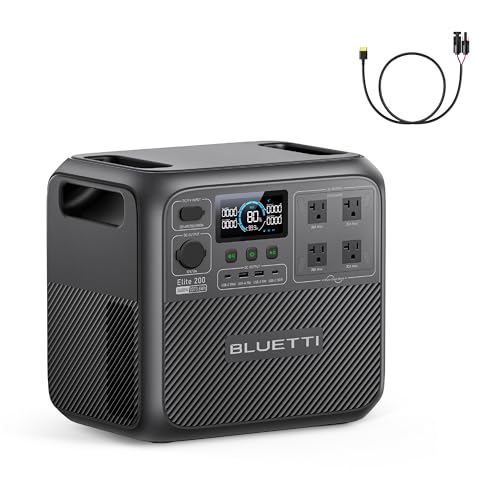
- [2600W Continuous & 3900W Power Lifting] – With BLUETTI's HyperWatt tech, the Elite 200 V2 delivers a robust 2600W of continuous A…
- [Less Waste, More Usable Power] – An advanced energy management system and high-efficiency components reduce standby power consump…
- [Longest Lifespan of 17-Year] – Equiped with the industry's first CNAS-certified true automotive-grade LiFePO4 battery, and passed…
BLUETTI lists 2,073.6Wh, 2,600W of continuous output (3,900W in Power Lifting mode, which, as noted above, is not for motor loads), four AC outlets, and a standby draw of 10W, which matters on long, low-load runs like a cycling furnace. The listing claims more than 6,000 cycles and a 17-year lifespan for its LiFePO4 battery. A grounding screw is included per the listing, which your electrician may use depending on the connection method.
EcoFlow DELTA 3 Max: Fast recharge between outages

- Ultra-Fast Charging, 0–80% in Just 1.13 Hours – Thanks to EcoFlow’s advanced X-Stream technology, DELTA 3 Max can recharge from 0–…
- Up to 3400W Continuous X-Boost Mode – Power 99% of Appliances – With an impressive 3400W X-Boost output, this portable power stati…
- Ultra-Quiet Performance & Rapid 10ms Transfer Time – Designed for home backup, DELTA 3 Max kicks in with less than 10ms transfer t…
The listing gives 2,048Wh of LFP capacity, 2,400W of output (3,400W X-Boost), a 10 ms transfer time and 0 to 80% charging in about 1.13 hours. EcoFlow lists an extended 5-year service period. Fast recharging matters in a winter outage if you are topping up from a generator for a few hours a day.
Anker SOLIX C2000 Gen 2: Expandable to about 4kWh
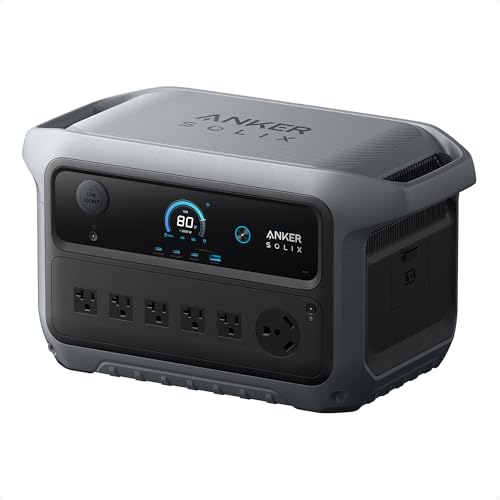
- Ultra-Efficient Power for Longer Runtime: Uses only 9W on standby, powering a dual-door fridge for up to 32 hours.
- Up to 4kWh Expandable Capacity: Add an expansion battery to reach 4kWh and run a dual-door fridge for up to 64 hours.
- Six Ways to Recharge, 100% in 58 Min: Experience lightning-fast recharging with AC and solar—fully charged in 58 minutes.
Anker lists 2,048Wh of LiFePO4 capacity, 2,400W rated output (4,000W peak), a 9W standby draw and a full recharge in 58 minutes. It can be expanded to about 4kWh with an add-on battery, per the listing. It weighs 41.7 lb. The expansion path suits anyone who wants to start at 2kWh and add capacity later.
Jackery HomePower 3000: The 3kWh middle ground

- Essential Home Backup: With a robust 3600W output (7200W surge) and a 3072Wh capacity, the Jackery HomePower 3000 provides reliabl…
- ≤20ms UPS: Featuring a UL-certified UPS that switches seamlessly within ≤20ms, the Jackery HomePower 3000 Portable Power Station r…
- Power for Essentials: The Jackery HomePower 3000 keeps your essentials charged at once with versatile AC, USB-C, USB-A, and DC por…
The HomePower 3000 lists 3,072Wh of LFP capacity, 3,600W of output (7,200W surge), a UL-certified UPS with switchover in 20 ms or less, and 4,000 cycles to 70% capacity. At 3kWh, it can cover a furnace plus a refrigerator through a typical evening-to-morning outage, depending on load. Most residential gas furnaces run on 120V, so check your furnace’s rating plate against the station’s outlet specs.
EcoFlow DELTA Pro 3: Room to grow for whole-home backup

- Energize Almost Everything. The EcoFlow DELTA Pro 3 supports 120V/240V voltage and has a 4000W output (6000W with X-Boost, scalabl…
- Forget Refueling. Featuring a 4096Wh LFP battery capacity, expandable to 48kWh with extra batteries or smart generators, providing…
- Plug and Play. Experience hassle-free power with the DELTA Pro 3, a versatile portable power station that's easy to set up, even a…
The DELTA Pro 3 lists 4,096Wh, 4,000W output at 120V and 240V, and expansion to 48kWh with extra batteries or EcoFlow’s smart generators. For a furnace alone, it is more than you need, but it makes sense if the furnace is one part of a larger plan that includes a well pump, sump pump or 240V loads, connected through an electrician-installed panel or transfer switch. It carries a 5-year warranty per the listing.
Quick Comparison
| Power station | Capacity | Continuous AC output | Listing notes |
|---|---|---|---|
| Jackery Explorer 2000 v2 | 2,042 Wh | 2,200W | 39.5 lb, 20 ms UPS |
| BLUETTI Elite 200 V2 | 2,073.6 Wh | 2,600W | 10W standby, 6,000+ cycles |
| EcoFlow DELTA 3 Max | 2,048 Wh | 2,400W | 0-80% in about 1.1 hours, 10 ms transfer |
| Anker SOLIX C2000 Gen 2 | 2,048 Wh (expandable to about 4 kWh) | 2,400W | 9W standby, 41.7 lb |
| Jackery HomePower 3000 | 3,072 Wh | 3,600W | 20 ms UPS, 4,000 cycles to 70% |
| EcoFlow DELTA Pro 3 | 4,096 Wh (expandable to 48 kWh) | 4,000W | 120/240V, 5-year warranty |
How to Choose
- Short outages, furnace only: a 2kWh unit with low standby draw and a thermostat set a few degrees lower.
- Overnight, furnace plus fridge: 3kWh or an expandable 2kWh unit.
- Multi-day outages: a large expandable station, or a power station paired with a generator that runs outdoors to recharge it, placed at least 20 feet from the house and away from windows, doors and vents, with working CO alarms inside. Our power station vs. generator guide for winter outages compares the two, and our winter portable generator guide covers safe generator placement.
- Keep it warm: LiFePO4 batteries generally should not be charged below freezing. Store and run the station in the heated part of the house, and check the manual for the maker’s stated charging temperature range.
- Do not count on winter solar: short days and snow-covered panels limit recharge, so plan around wall charging before the storm and a generator or car charging during it.
FAQ
Can a 2,000Wh power station run a gas furnace?
Usually yes, for hours rather than days. At an average furnace load of 200 to 500W, a 2kWh station gives roughly 3.5 to 8.5 hours by the estimates above. It needs a safe connection installed by a licensed electrician.
Can I just plug my furnace into a power station?
Only if the furnace already has a code-compliant plug connection installed by an electrician. Most furnaces are hardwired. Never rewire it yourself, and never backfeed through an outlet.
Will a power station run a heat pump or electric furnace?
Generally not for long. Central heat pumps and electric furnaces draw thousands of watts, and many need 240V. Large expandable systems can run some heat pumps for limited periods. Check with an HVAC technician and the power station’s maker before relying on it.
What size generator does a furnace need?
The furnace alone usually needs well under 2,000 running watts, but most people also want the fridge and a few circuits. Use our generator size calculator to total your loads.
Why does my furnace start but shut off on backup power?
One possible cause is flame sensing that depends on proper grounding or polarity, which some portable power sources don’t provide the way utility power does. Have your electrician or HVAC technician check the connection, rather than bypassing any safety control.
General information only, not professional advice. Details can change or contain errors, so check with the manufacturer or an official source before you rely on them. Use of this site is subject to our Disclaimer and Terms of Service.