This post contains Amazon affiliate links. As an Amazon Associate, HomeMechanicals.com earns from qualifying purchases — see our affiliate disclosure for details. Prices shown were verified on Amazon on September 15, 2026 and change frequently — always check the current price before buying.
This post contains Amazon affiliate links. HomeMechanicals.com earns a commission on qualifying purchases at no extra cost to you.
A tankless (on-demand) water heater skips the 40-50 gallon storage tank and heats water only as it flows through the unit. That means no standby heat loss, a smaller footprint, and, on paper, a longer service life than a tank heater. It also means the unit has to be sized correctly for your household’s peak hot-water demand, and in most cases it needs a licensed plumber or electrician to install it safely and to code. Below are five real tankless units, three gas and two electric, with specs and prices pulled directly from Amazon’s product catalog so you can compare them side by side.
Free tool: enter your fixtures and region to get the flow rate and the gas BTU or electric kW you need. Tankless water heater size calculator →
Quick Comparison
| Model | Fuel | Flow Rate | Output | Typical price | Best For |
|---|---|---|---|---|---|
| Rinnai RX130iN | Natural gas or propane | Up to 7.1 GPM | Condensing, UEF 0.97 | about $1,250 | Best overall gas pick |
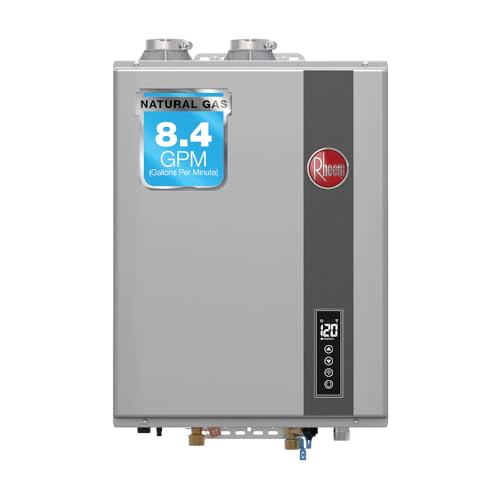
| Rheem RTGH Series | Natural gas | 8.4 GPM at 35°F rise | 157,000 BTU/hr, condensing, UEF 0.93 | about $1,050 | Best value condensing gas |
| Rheem RTG Series | Natural gas | 7.0 GPM at 35°F rise | 160,000 BTU/hr, non-condensing, UEF 0.82 | about $800 | Budget gas pick |
| Stiebel Eltron Tempra 24 Trend | Electric | Depends on rise; see spec notes below | 24kW, 240V | about $530 | Best overall electric |
| Westinghouse 14kW | Electric | 3.4 GPM at 43°F rise | 14kW, 240V | about $300 | Budget / point-of-use electric |
Prices are snapshots taken via the Amazon Creators API in early September 2026 and change frequently. Click through for the current price before you decide.
Best Gas Tankless Water Heaters
Best Overall Gas: Rinnai RX130iN Condensing Smart Sense
Rinnai is one of the longest-established names in tankless gas water heating, and the RX130iN backs that up with a 15-year warranty on the heat exchanger (5 years on parts and labor). It runs on either natural gas or propane through Rinnai’s Smart Sense gas control, can be installed indoors or outdoors (an RX-OVC vent cap is required outdoors), and is rated for up to 7.1 GPM, roughly four fixtures running at once depending on your climate’s incoming water temperature. As a condensing unit, its 0.97 Uniform Energy Factor (UEF) is at the high end of what’s available for residential gas tankless heaters, which typically translates into lower gas bills than a non-condensing unit of similar capacity.
- Flow rate: up to 7.1 GPM
- Fuel: natural gas or propane (Smart Sense control)
- Efficiency: condensing, UEF 0.97
- Warranty: 15-year heat exchanger, 5-year parts, 5-year labor (with registration)
- Typical price: about $1,250

Best Value Condensing: Rheem RTGH Series (8.4 GPM)
Rheem’s RTGH Series is a condensing unit rated at 8.4 GPM at a 35°F temperature rise, drawing on a 157,000 BTU/hr burner. Rheem markets it as capable of supplying 3-4 simultaneous showers, and its 0.93 UEF puts it close to the Rinnai above at a lower price point at the time we checked. It’s an indoor, direct-vent unit with CSA certification, built-in freeze protection, and a 15-year heat exchanger warranty with 5 years on parts.
- Flow rate: 8.4 GPM at 35°F rise
- Output: 157,000 BTU/hr, condensing, UEF 0.93
- Venting: indoor, direct vent
- Warranty: 15-year heat exchanger, 5-year parts
- Typical price: about $1,150 (listed as reduced from a typical price of about $1,190)
Budget Gas Pick: Rheem RTG Series (7.0 GPM, Non-Condensing)
The non-condensing RTG Series trades some efficiency for a lower purchase price. At 7.0 GPM and 160,000 BTU/hr it’s sized for 2-3 simultaneous fixtures rather than a large multi-bathroom household, and its 0.82 UEF is solid for a non-condensing design but well behind the condensing units above. Non-condensing units also vent differently (higher-temperature exhaust, different venting material) than condensing units, which is one more reason a licensed installer needs to evaluate the specific unit against your home’s existing venting before you buy.
- Flow rate: 7.0 GPM at 35°F rise
- Output: 160,000 BTU/hr, non-condensing, UEF 0.82
- Features: LeakGuard leak detection, digital temperature control
- Typical price: about $650

Best Electric Tankless Water Heaters
Best Overall Electric: Stiebel Eltron Tempra 24 Trend
Stiebel Eltron is a German manufacturer with a long track record in electric tankless heating, and the Tempra 24 Trend is a 24kW, 240V unit that needs no venting at all, a real install-cost advantage over any gas unit. Stiebel Eltron specifies a minimum recommended electrical service of 150A for this model, which matters: many older homes have 100A or 125A panels, and confirming your panel can support the unit (or budgeting for a panel upgrade) is a job for a licensed electrician, not a guess. Output temperature range is 68°F to 140°F, and the company backs it with a 7-year leakage warranty and 3-year parts warranty.
- Power: 24kW, 240V
- Electrical requirement: minimum recommended 150A service
- Output range: 68°F to 140°F
- Venting: none required
- Warranty: 7-year leakage, 3-year parts
- Typical price: about $510 (listed as reduced from a list price of about $650)

Budget / Point-of-Use Electric: Westinghouse 14kW
At 14kW, the Westinghouse unit is a smaller-capacity electric heater best suited to a single bathroom, a secondary point of use, or a warmer-climate home with higher incoming water temperature (a smaller required temperature rise means the same kW can deliver more usable GPM). The manufacturer’s own spec lists 3.4 GPM at a 43°F rise (62°F in to 105°F out), supporting two fixtures at once, well short of whole-house gas or high-kW electric units, so size your expectations accordingly. It requires a dedicated 60A double-pole breaker and 6 AWG wire at 240V, again electrical work for a licensed electrician.
- Power: 14kW, 240V
- Flow rate: 3.4 GPM at a 43°F rise (per manufacturer spec)
- Electrical requirement: dedicated 60A double-pole breaker, 6 AWG wire
- Certification: ETL listed
- Typical price: about $280

Gas vs. Electric Tankless: Which Fits Your Home?
Gas tankless units, especially condensing models like the Rinnai and Rheem RTGH above, generally deliver higher flow rates and handle whole-house, multi-bathroom demand more comfortably in cold-climate regions where incoming water runs well below 50°F. They need a gas line sized for the unit’s BTU load and correct venting (condensing and non-condensing units vent differently), both permit-and-licensed-trade territory in most jurisdictions.
Electric tankless units skip gas and venting entirely, which simplifies installation in homes without a gas line, but they trade that simplicity for a hard physical limit: electric resistance heating needs a lot of amperage to produce a large temperature rise at a useful flow rate. That’s why whole-house electric units like the Stiebel Eltron typically call for 150A or more of dedicated service, and why smaller electric units like the Westinghouse are realistically point-of-use or single-bathroom solutions rather than whole-house replacements, particularly in colder climates.
How to Size a Tankless Water Heater to Your Household
Sizing a tankless unit comes down to two numbers: your peak simultaneous flow rate and your required temperature rise.
- Add up GPM for fixtures you would realistically run at once. A shower typically draws about 2.0-2.5 GPM, a kitchen faucet 1.0-1.5 GPM, and a washing machine roughly 2.0 GPM. Two showers plus a running dishwasher might add up to 5-6 GPM of simultaneous demand.
- Find your temperature rise. Subtract your incoming (groundwater) temperature from your target output temperature. Incoming water can run from the high 30s°F in northern winters to the mid-70s°F in the Sun Belt; a common target output is 120°F. A home with 50°F incoming water and a 120°F target needs a 70°F rise, a much bigger job for the unit than the same target with 70°F incoming water (50°F rise).
- Match flow rate at your actual rise, not the unit’s headline GPM. Every tankless unit’s rated GPM drops as the required temperature rise increases. A unit rated for 8 GPM at a 35°F rise might only deliver 4-5 GPM at a 70°F rise. Manufacturer spec sheets list GPM at multiple rise points for exactly this reason; check the rise-specific number, not just the headline figure, before you buy.
As a rough sizing check for gas units, BTU/hr is approximately 500 multiplied by GPM multiplied by temperature rise in °F. That’s useful for sanity-checking a spec sheet, not a substitute for a proper load calculation from your installer.
One common complaint worth knowing about before you buy: a tankless unit needs a minimum flow rate to activate (often around 0.4-0.5 GPM), so a very low-flow fixture may not trigger it at all, and some units produce a brief burst of cold water — sometimes called the “cold-water sandwich” — when the unit cycles off between two short, closely-spaced draws. It’s a normal characteristic of the technology rather than a defect, but it’s the kind of thing buyers are frequently surprised by after installation rather than before.
Installation Requirements: Why This Isn’t a DIY Weekend Project
Every unit on this list, gas or electric, involves work that in most jurisdictions requires a licensed tradesperson and a permit.
- Gas units need a gas line sized correctly for the unit’s BTU/hr load, often larger than what feeds an existing tank heater, and correct venting material and routing for either non-condensing (higher exhaust temperature) or condensing (PVC-compatible, with condensate drainage) operation.
- Electric units need a dedicated circuit sized to the manufacturer’s amperage spec, and in some cases, as with the Stiebel Eltron’s 150A recommendation, confirmation that your home’s electrical panel has enough total capacity, which may mean a panel upgrade.
- Both types typically require a plumbing permit and inspection, and manufacturers generally recommend professional installation to keep the warranty valid, and installation by anyone other than a licensed pro will often void the manufacturer’s warranty outright, not just create a safety risk; several of the units above say so directly in their own product listings.
We’re deliberately not walking through DIY gas line or panel work here. Get quotes from a licensed plumber and/or electrician, confirm permit requirements with your local jurisdiction, and treat any installer who skips the permit step as a red flag.
Curious what tankless actually costs once installation, energy savings, and maintenance are factored in over the long run? See our tankless vs. traditional water heater cost comparison for the full breakdown.
Maintenance: Descaling in Hard-Water Areas
Tankless heat exchangers have narrow water passages that are more sensitive to mineral scale buildup than a tank heater’s larger reservoir. Manufacturers generally recommend flushing (descaling) at least once a year; in hard-water areas (roughly 7-10 grains per gallon) that interval often shortens to every 6-8 months, and in very hard water (10+ gpg) to every 4-6 months. Skipping descaling in hard water reduces efficiency over time and can shorten the unit’s service life. If you’re on well water or in a known hard-water region, budget for either a whole-house water softener or more frequent professional descaling as part of the real cost of owning a tankless unit. We cover softener and filtration options in our Water Systems coverage on this site.
Bottom Line
If you have an existing gas line and want the highest flow capacity, the Rinnai RX130iN or Rheem RTGH Series condensing units are the strongest picks here. If budget is the main driver and household demand is modest, the Rheem RTG Series non-condensing unit or the Westinghouse 14kW electric unit are reasonable starting points. Whole-house electric only makes sense once you’ve confirmed your panel can support a unit like the Stiebel Eltron Tempra 24 Trend. In every case, get sizing and installation confirmed by a licensed pro before you buy; a tankless unit that’s undersized for your home’s peak demand or temperature rise will disappoint no matter how good the spec sheet looks.