This post contains Amazon affiliate links. As an Amazon Associate, HomeMechanicals.com earns from qualifying purchases — see our affiliate disclosure for details. Prices shown were verified on Amazon on September 15, 2026 and change frequently — always check the current price before buying.
This post contains Amazon affiliate links. HomeMechanicals.com earns a commission on qualifying purchases at no extra cost to you.
The tankless-vs-tank decision usually comes down to one question: does the higher upfront cost of a tankless unit actually pay for itself? The honest answer is that it depends heavily on your fuel type, household size, how long you plan to stay in the home, and local labor and energy costs. Below we walk through real unit prices for two tankless models, typical installed-cost ranges for both types from 2026 industry cost data, and the savings and payback numbers reported by ENERGY STAR, the Department of Energy, and trade-industry sources, so you can run the math for your own situation rather than take a marketing claim at face value.
Free tool: enter your fixtures and region to get the flow rate and the gas BTU or electric kW you need. Tankless water heater size calculator →
Upfront Cost: Unit Plus Installation
| Water Heater Type | Typical Installed Cost Range | What Drives the Range |
|---|---|---|
| Traditional tank (40-50 gallon) | $600 – $2,500 (gas models toward the upper end, often $1,400-$2,800) | Tank size, fuel type, local labor rates |
| Gas tankless (like-for-like or conversion) | $2,100 – $5,600 | Whether it’s a straightforward swap or a full conversion needing new gas line sizing and venting |
| Electric tankless | $1,400 – $3,000 | Whether your panel already has enough spare capacity or needs an upgrade |
Source ranges come from 2026 cost-guide data aggregated from Angi, HomeGuide, and Fixr. Your actual quote depends on your home’s existing gas line size, venting path, electrical panel capacity, and local labor rates, so treat these as planning ranges, not a quote.
Two Real Tankless Units, Priced
To make the numbers concrete, here are two real, currently-listed tankless units we’d consider putting into that installed-cost range above.
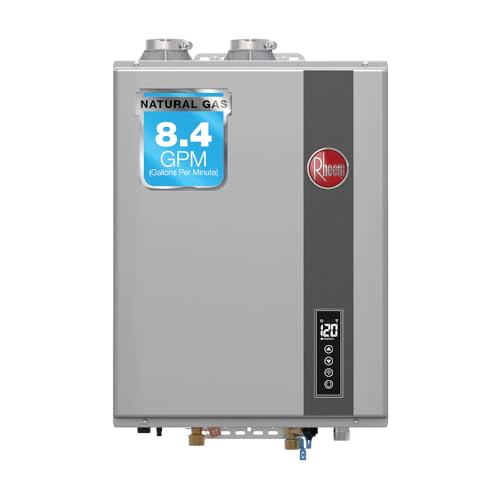
Gas Example: Rheem RTGH Series (8.4 GPM, Condensing)
This condensing unit is rated at 8.4 GPM at a 35°F rise, 157,000 BTU/hr, with a 0.93 Uniform Energy Factor (UEF) and a 15-year heat exchanger warranty. Unit Typical price: about $1,150. Add labor: a like-for-like tankless swap typically runs $600-$1,500, while a full tank-to-tankless conversion (new venting, larger gas line, remounting) typically runs $1,200-$2,500 depending on how much of your existing gas and venting infrastructure has to change.
Electric Example: Stiebel Eltron Tempra 24 Trend (24kW)
This unit needs no venting at all but does specify a minimum recommended 150A electrical service, which can mean a panel upgrade in older homes. Unit Price on Amazon: See current price. Add labor: electrical work for a dedicated circuit, plus a possible panel upgrade if your service isn’t already large enough, typically brings the all-in installed cost to somewhere in the broader $1,400-$3,000 electric tankless range cited above.

Traditional Tank Comparison Point
We looked for a directly comparable 40-50 gallon storage tank water heater through the same Amazon product data we used for the tankless units above, and didn’t find one worth linking. Standard residential tank water heaters are heavy, large, and generally sold through plumbing supply houses, HVAC contractors, or big-box stores rather than shipped through Amazon, so this comparison point uses published 2026 cost-guide figures instead of a specific product link: roughly $600-$2,500 installed for a 40-50 gallon unit, gas models generally running higher than electric.
A 15-Year Cost Walkthrough
Here’s a simplified side-by-side using the Rheem RTGH gas tankless example against a mid-range traditional gas tank, over a 15-year ownership horizon. These are planning estimates built from the ranges above and the savings data in the next section, not a guarantee of your actual costs.
| Traditional Gas Tank | Gas Tankless (Rheem RTGH example) | |
|---|---|---|
| Installed cost, year 0 | ~$1,400-$2,800 | ~$2,250-$3,550 |
| Expected lifespan | 8-12 years (up to ~15 with regular flushing) | ~20 years (ENERGY STAR/DOE-cited) |
| Likely mid-horizon replacement (within 15 years) | One replacement fairly likely, adding another ~$1,400-$2,800 | Unlikely to need replacement within 15 years |
| Annual energy cost difference | Baseline | Roughly $70-$100/year lower (see next section) |
| Annual maintenance | Low; periodic tank flush | $150-$350/year typical, more in hard water |
The single biggest variable most cost calculators skip is the traditional tank’s shorter lifespan: if you’re planning to stay in the home 15+ years, there’s a real chance you buy and install a second tank heater in that window, which a tankless unit likely avoids. That avoided second purchase is worth factoring into your own math even though it’s not guaranteed to happen on any specific schedule.
Energy Savings: What the Data Actually Shows
Savings estimates vary by source, and we’d rather show you the range than pick one flattering number:
- ENERGY STAR states that an ENERGY STAR certified gas tankless water heater saves a family of four around $95 per year on gas bills compared to a standard gas storage model, or roughly $1,800 over the unit’s lifetime.
- Other sources citing Department of Energy data put average gas tankless savings closer to $108 per year versus a standard gas tank.
- More general industry estimates put gas tankless savings at roughly $70-$100 per year versus a gas tank, and electric tankless savings at roughly $100-$130 per year versus a standard electric tank.
Your actual savings depend on household size, hot water usage patterns, your local energy rates, and your incoming water temperature. Treat any of these figures as a typical range, not a number you’re guaranteed to see on your own utility bill.
Payback Period: When Does Tankless Actually Break Even?
This is where sources disagree the most, largely because they use different assumptions about upfront premium and annual savings:
- A commonly cited Consumer Reports-based estimate puts payback at a wide 12 to 27.5 years overall, roughly 22-27 years for gas models and 12-20 years for electric models, when comparing full retail costs against modest annual savings.
- A more favorable trade-industry estimate, assuming a $1,000-$2,500 upfront premium over a tank and $100-$150 per year in savings, puts payback closer to 7-12 years for a gas tankless unit replacing a gas tank.
The gap between those two estimates comes down to how much of a premium you’re actually paying (a straightforward swap vs. a full conversion) and how much you save annually, which depends on your household. Note: the federal Section 25C Energy Efficient Home Improvement Credit, which previously offered up to 30% (capped at $600) for qualifying gas tankless water heaters, expired December 31, 2025 and is not available for units installed in 2026. If you installed a qualifying unit in 2025, you may still be able to claim it on that year’s return. Check for state energy-office programs and utility rebates instead — some utilities still offer $300-$1,000 rebates on qualifying units — and confirm current eligibility with a tax professional before factoring any incentive into your payback math.
Lifespan and the Cost of a Second Tank
Traditional tank water heaters typically last 8-12 years, extendable toward 15 years with regular flushing and anode rod maintenance. Tankless units are commonly cited by ENERGY STAR and the DOE as having a roughly 20-year life expectancy. Over a long ownership horizon, that difference means a tank owner may pay for installation labor a second time within the same period a tankless owner pays for it once. That’s a real cost difference worth weighing, but it’s a probability, not a certainty; a well-maintained tank can outlast a poorly maintained tankless unit.
Installation Complexity Drives Your Real Number
The install-cost ranges above are wide because the job itself varies a lot. A like-for-like tank swap (same fuel, same general location, existing venting works) is the cheapest and fastest option. Converting from a tank to a gas tankless unit usually means resizing the gas line, changing the venting (especially moving from a non-condensing to a condensing unit, or vice versa), and remounting the unit, which adds real labor hours. Going electric tankless sidesteps gas and venting work entirely but can require a dedicated high-amperage circuit and, in some cases, a full panel upgrade. In every case this is licensed-trade and usually permitted work: get a written scope from a licensed plumber and/or electrician before you commit to a number, and don’t accept a quote from anyone proposing to skip the permit. Self-installation, or installation by anyone other than a licensed pro, typically voids the manufacturer’s warranty on top of the code/safety risk — factor that into any DIY temptation. If you’re converting from a tank in a larger home, also ask about a recirculation pump: it’s a common add-on for reducing wait time at distant fixtures and frequently adds $200-$500+ to the installed cost that a basic online estimate won’t include.
Don’t Forget Maintenance Costs
Tankless units need periodic descaling to clear mineral buildup from their narrow heat exchanger passages, typically $150-$350 per year, rising to $300-$600 per year in hard-water areas where more frequent flushing is needed. Traditional tanks are less sensitive to scale in the same way, but still benefit from periodic flushing and anode rod checks to reach the upper end of their lifespan. If you’re in a hard-water region, factor descaling costs into either heater type’s ongoing cost, and consider whether a whole-house water softener (covered in our Water Systems content) makes sense regardless of which water heater you choose.
Which Should You Actually Buy?
- Tight upfront budget, or you don’t expect to stay in the home long: a traditional tank costs less today, even though it likely costs more to run and may need replacing sooner.
- Staying 10+ years, existing gas line, above-average household hot water demand: a gas tankless unit like the Rheem RTGH Series has a realistic shot at paying back its premium within your ownership window, especially factoring in the avoided second tank purchase.
- No gas line, or you want to avoid venting work, and your panel already has spare capacity: an electric tankless unit like the Stiebel Eltron Tempra 24 Trend is worth pricing out, but get your panel capacity confirmed by an electrician before you buy.
- Very hard water in your area: budget for more frequent descaling on a tankless unit either way, and weigh whether a water softener is worth adding regardless of which heater you pick.
Bottom Line
Tankless water heaters cost more upfront and the reported payback period varies enormously by source, from roughly 7 years on the optimistic end to over 20 years on the conservative end. The strongest case for tankless is a household that uses a lot of hot water, plans to stay in the home long enough to reach payback, and already has (or is willing to install) the gas or electrical infrastructure the unit needs. If that doesn’t describe your situation, a traditional tank remains a reasonable, lower-upfront-cost choice. Either way, get your specific numbers, gas line sizing, panel capacity, and local labor rates, confirmed by a licensed pro before you commit.
Pingback: Building a Whole-Home Resilience System: How Water, Power, and HVAC Work Together - HomeMechanicals