HomeMechanicals.com is an Amazon Associate and earns from qualifying purchases. Product details come from manufacturer listings; see our research process.
Safety note: This is general information, not professional advice. Any connection to your home’s wiring must be made by a licensed electrician using a transfer switch or interlock; never backfeed through an outlet. Run generators outdoors only, at least 20 feet from the house, and keep working CO alarms inside. See our disclaimer.
A dual-fuel portable generator runs on either gasoline or propane, which gives you a second fuel source when gas stations are closed or a storm drags on for days. The trade-off is output: the listings here that publish separate propane ratings put propane roughly 8 to 12 percent below gasoline, so you size for the propane number if propane is your long-outage plan. For whole-home backup through a transfer switch, look for a 120/240V generator with an L14-30R or 14-50R outlet, CO shutdown, and enough propane running watts to cover your essential loads.
Below are seven gas and propane generators on Amazon, including one tri-fuel model. Figures are based on manufacturer specifications from each listing; gaps or unclear specs are flagged so you can confirm them in the manual.
The Short Answer
- For running most of a house through a transfer switch: a 9,000+ running-watt open-frame model with a 14-50R outlet, such as the Westinghouse 12500 Dual Fuel or the Generac tri-fuel.
- For essentials plus sensitive electronics: a dual-fuel inverter such as the WEN DF680iX, which also offers a 240V L14-30R outlet.
- For a fridge, furnace blower, lights and internet only: a smaller unit like the Champion 4000-Watt inverter or the WEN DF475T.
- For any of them: run it outdoors only, at least 20 feet from the house with exhaust pointed away, keep CO alarms inside, and have a licensed electrician install a transfer switch or interlock. Never backfeed through a dryer outlet or any other receptacle.
Gas vs Propane: What the Wattage Derating Means
Propane carries less energy per unit volume than gasoline, so the same engine produces less power on propane. Manufacturers publish separate ratings for each fuel, and where listings give both figures, the gap is fairly consistent:
| Generator | Gas running / peak (W) | Propane running / peak (W) | Propane running as % of gas |
|---|---|---|---|
| Westinghouse 6500 Dual Fuel | 5,300 / 6,500 | 4,800 / 5,800 | about 91% |
| Westinghouse 12500 Dual Fuel | 9,500 / 12,500 | 8,500 / 11,200 | about 89% |
| Champion 4000-Watt Inverter | 3,000 / 4,000 | 2,700 running (propane starting not listed) | 90% |
| WEN DF680iX Inverter | 5,100 / 6,800 | 4,500 / 6,000 | about 88% |
| WEN DF475T | 3,800 / 4,750 | 3,500 / 4,350 | about 92% |
| DuroMax XP13000EH | Listing gives 13,000 watts total only; confirm running and propane ratings on the spec sheet | ||
| Generac Tri-Fuel | 9,500 running (fuel not specified) / 12,500 on gas | Listing does not give separate propane or natural gas ratings; confirm on the spec sheet | |
Use running watts, not peak watts, for anything that runs continuously; peak (surge) watts only cover the brief inrush when a motor starts. And if propane is your long-outage fuel, size your load list against the propane running number.
Why Propane Matters in Cold Climates and Long Outages
Propane stores well
Gasoline degrades over months, even with stabilizer, and stale fuel is a common reason a generator will not start after sitting all summer. Propane does not go stale, so a few full cylinders can sit ready for years. Cylinders must be stored outdoors, upright, and never in a basement, garage or living space.
Propane is easier to get during a multi-day outage
Gas stations need electricity to pump fuel. Having both fuels means you can use whatever is available, and larger propane cylinders run longer between refills than a 4 to 7.5 gallon gas tank.
Deep cold reduces propane vapor pressure
Propane boils at about -44°F, so it still vaporizes in a typical northern winter, but pressure in the cylinder drops as temperatures fall. A small 20 lb cylinder running a large generator in subzero weather can struggle to supply enough vapor, and output may sag. Larger cylinders, keeping spares, and following the manufacturer’s cold-weather guidance all help. Our portable generator winter outage guide covers cold-weather operation in more detail.
Inverter vs Open-Frame Generators
Two of the seven generators here are inverters (Champion 4000-Watt and WEN DF680iX); the rest are conventional open-frame designs.
- Power quality: inverter generators convert engine output to DC and back to a clean AC sine wave. Champion’s listing gives less than 3% total harmonic distortion (THD). Open-frame listings in this group do not state a THD figure; conventional generators typically produce a less clean waveform, though automatic voltage regulation (the Generac lists AVR) helps hold voltage steady.
- Sensitive electronics and furnace boards: modern furnace control boards, ECM blower motors, computers and smart appliances can be sensitive to poor power quality. Some furnace boards also need correct polarity and a proper ground reference to sense flame. If your furnace is the main reason you are buying, an inverter or a low-THD conventional unit is the safer choice; confirm with your furnace manufacturer and HVAC contractor. Our guide to backing up a gas furnace explains furnace power needs.
- Noise and output: inverters throttle down at light loads (Champion lists 64 dBA at 23 feet). Open-frame units run at fixed speed and are generally louder, but deliver more watts for their size, which is why the 9,000+ watt models here are all open-frame.
120/240V Outlets and Transfer Switches
The outlet panel tells you how a generator can connect to a home. Here is what the common receptacles mean:
- 5-20R: standard 120V 20A household outlets, for extension cords to individual appliances.
- TT-30R: a 120V RV outlet. It is meant for RVs, not for powering a home’s 120/240V panel.
- L14-30R: a 30A, 120/240V twist-lock outlet. This is the common connection for a generator inlet box feeding a manual transfer switch or panel interlock. At 240V, a 30A circuit tops out around 7,200 watts.
- 14-50R: a 50A, 120/240V outlet. It allows a larger inlet and transfer switch, up to roughly 12,000 watts, and is found on the larger generators here.
A 120/240V feed reaches both legs of the panel and can run 240V loads such as well pumps. Whatever the outlet, the house connection must be a transfer switch or an interlock with a dedicated inlet, installed by a licensed electrician with any required permit. Backfeeding through a dryer outlet can energize utility lines and injure line workers.
Bonded vs floating neutral
A generator’s neutral is either bonded to its frame or floating. A house already has its neutral-to-ground bond at the main panel, so the right generator configuration depends on the transfer equipment, especially whether it switches the neutral. A mismatch can cause nuisance GFCI tripping or an unsafe ground path. The WEN DF680iX listing specifically mentions a bonded-neutral 240V configuration (for EV Level 2 charging). If you plan to connect any generator to a transfer switch or interlock, have your electrician check the generator’s neutral configuration against the transfer equipment before it is put into service.
CO Shutdown Features
Several models here include automatic CO shutdown, which stops the engine if CO builds up around it: Westinghouse’s CO sensor on the 6500, Champion’s CO Shield, WEN’s Watchdog on the DF680iX, and Generac’s COsense. The listings for the Westinghouse 12500, DuroMax XP13000EH and WEN DF475T do not mention CO shutdown. It is a backup, not permission to run a generator in a garage or near windows. Run it outdoors only, at least 20 feet from the house with the exhaust pointed away, and install battery or battery-backup CO alarms on every level of the home.
Comparison Table
| Model | Type | Fuels | Gas running W | 240V outlet | CO shutdown | Start |
|---|---|---|---|---|---|---|
| Westinghouse 12500 Dual Fuel | Open-frame | Gas, propane | 9,500 | 14-50R (also L14-30R) | Not listed | Remote, electric, recoil |
| Generac Tri-Fuel | Open-frame, AVR | Gas, propane, natural gas | 9,500 (fuel not specified) | 14-50R and L14-30R | COsense | Electric |
| DuroMax XP13000EH | Open-frame | Gas, propane | Not given (13,000 W total) | 50A transfer-switch-ready outlet | Not listed | Push button |
| Westinghouse 6500 Dual Fuel | Open-frame | Gas, propane | 5,300 | L14-30R | Yes | See manual |
| WEN DF680iX | Inverter | Gas, propane | 5,100 | L14-30R | Watchdog | Electric |
| WEN DF475T | Open-frame | Gas, propane | 3,800 | L14-30R | Not listed | Electric |
| Champion 4000-Watt | Inverter | Gas, propane | 3,000 | None (120V only) | CO Shield | Recoil |
The Generators
Westinghouse 12500 Dual Fuel: Most output with a 50A outlet

- 9500 Running Watts and 12500 Peak Watts (Gasoline); 8500 Running Watts, 11200 Peak Watts (Propane); Remote Start with Included Key…
- Features Two GFCI 120V 5–20R 20A Standard Household Receptacle, One Transfer Switch Ready 120V L14-30R 30A, and One RV Ready 120/2…
- Powered by a Heavy Duty 457cc Westinghouse 4-Stroke OHV Engine Featuring a Long-Lasting Cast Iron Sleeve with Automatic Low Oil Sh…
The listing gives 9,500 running and 12,500 peak watts on gasoline, and 8,500 running and 11,200 peak watts on propane, from a 457cc engine. Depending on your loads, that propane rating may cover a well pump, furnace, fridge, freezer, sump pump and lighting running together; add up your own running watts first. Outlets include two GFCI 5-20R receptacles, an L14-30R and a 120/240V 14-50R. The listing describes the L14-30R as “120V,” while L14-30 receptacles are normally 120/240V; confirm in the manual. It adds remote, electric and recoil start, a 6.6-gallon tank (up to 12 hours), a voltage and hour display, and a 3-year limited warranty. The listing does not mention CO shutdown, so CO alarms in the home are essential.
Generac Tri-Fuel (12,500 Starting Watts): The tri-fuel option

- TRI-FUEL FLEXIBILITY FOR ANY SITUATION: Run on gasoline, liquid propane, or natural gas with a simple dial turn, delivering 9,500 …
- STABLE POWER WITH AUTOMATIC VOLTAGE REGULATION: Built-in AVR continuously stabilizes output voltage, protecting connected equipmen…
- 12,500 STARTING WATTS FOR HIGH-SURGE LOADS: The 500cc Generac OHV engine delivers 12,500 starting watts on gas — 32% more surge ca…
This Generac adds a third fuel: natural gas. The listing gives 9,500 running and 12,500 starting watts, with only the 12,500 figure explicitly stated for gasoline; it does not say which fuel the 9,500 running figure applies to, and it does not break out propane or natural gas ratings, and natural gas output is typically lower than gasoline output, so confirm all three on the spec sheet. It lists a 500cc engine, AVR, COsense CO shutdown, electric start, a 7.5-gallon tank (up to 9.5 hours at 50% load), and both an L14-30R and a 14-50R outlet. Generac states it works with its HomeLink manual transfer switches; it weighs 219 lbs.
Natural gas allows long runtime without refueling. However, connecting a portable generator to a home’s natural gas line is gas-fitting work: it needs a licensed gas fitter, an approved connection and shutoff, correct line sizing, and a permit where required. Do not attempt it yourself. Even on natural gas, the generator must sit outdoors at least 20 feet from the house.
DuroMax XP13000EH: Large dual-fuel, all-metal build

- With 13,000 watts of power, the XP13000EH Dual Fuel generator will keep your whole home running during a storm or power outage
- DuroMax is the industry leader in Dual Fuel portable generator technology, with a full assortment ranging from digital inverters t…
- At the core of all our products resides a robust DuroMax engine. Designed for Power. Designed to Last
DuroMax lists this as a 13,000-watt dual-fuel generator with push-button start, a front-facing fuel selector, an all-metal frame and power panel, copper windings, no-flat tires, and a transfer-switch-ready 50 amp outlet. The listing bullets do not give separate running watts or propane ratings, and they do not name the 50A receptacle type, so check the spec sheet before sizing your load list. No CO shutdown is mentioned.
Westinghouse 6500 Dual Fuel: Mid-size with L14-30R and CO sensor
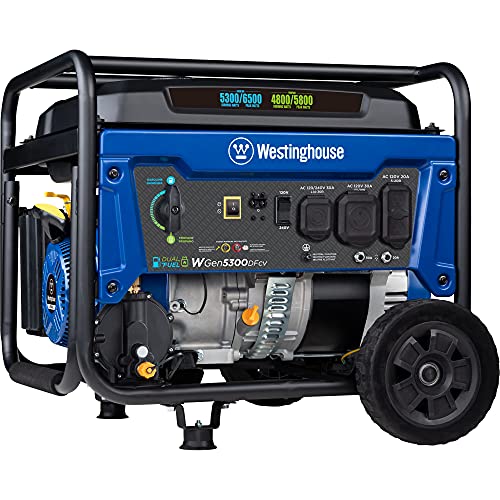
- Gasoline: 5300 Running Watts & 6500 Peak Watts; Propane: 4800 Running Watts & 5800 Peak Watts; 4.7 Gallon Fuel Tank with Fuel Gaug…
- Features One 5–20R 120V 20V Household Duplex Receptacle, One RV-Ready TT-30R 30A Receptacle, and One Transfer Switch Ready L14-30R…
- Plug-and-Play: Comes with Oil, an Oil Funnel, Propane Hose, Tool Kit, Wheel Kit, and a User’s Manual to Get You Started Right Out …
The listing gives 5,300 running and 6,500 peak watts on gasoline, and 4,800 running and 5,800 peak watts on propane, from a 274cc engine with automatic low-oil and CO shutdown. A 120/240V selector, a transfer-switch-ready L14-30R, a TT-30R RV outlet and a 5-20R duplex make it a practical choice for essentials through a 30A transfer switch. The 4.7-gallon tank runs up to 14.5 hours per the listing (check the manual for the load that figure assumes). Three-year limited warranty.
WEN DF680iX: Dual-fuel inverter with 240V

- 224cc dual-fuel engine runs on both gasoline (6800 surge watts, 5100 rated watts) and propane (6000 surge watts, 4500 rated watts)
- Bonded-neutral 240V configuration provides low-power Level 2 charging for battery and hybrid electric vehicles
- The WEN Watchdog CO Shutdown Sensor helps protect both you and your family by automatically turning off the generator if dangerous…
The DF680iX combines inverter power with a 120/240V L14-30R outlet. The listing gives 5,100 rated and 6,800 surge watts on gasoline, and 4,500 rated and 6,000 surge watts on propane, from a 224cc engine. It includes Watchdog CO shutdown, electric start, a carburetor-draining fuel shutoff, a TT-30R, two 120V receptacles, USB ports and a tool-free LPG quick-connector. WEN describes a bonded-neutral 240V configuration for low-power EV Level 2 charging; if you plan to use it with a transfer switch, have your electrician confirm that configuration suits your transfer equipment. Three-year warranty per the listing.
WEN DF475T: Smallest 240V option here

- Switch between gasoline (4750 surge watts, 3800 running watt) and propane (4350 surge, 3500 running) with the simple turn of the s…
- Voltage easily goes from 120V to 240V, perfect for transfer switches and emergency backup
- Electric start powers the 224cc 4-stroke OHV engine with the turn of a key
The DF475T gives 3,800 running and 4,750 surge watts on gasoline, and 3,500 running and 4,350 surge watts on propane. It switches between 120V and 240V and includes an L14-30R, two GFCI 5-20R outlets and a 12V DC plug, with electric start on a 224cc engine. The 4-gallon tank runs up to 11 hours at half load. It suits a short essentials list. The listing does not mention CO shutdown. Two-year warranty.
Champion 4000-Watt Dual Fuel Inverter: Quiet essentials and electronics

- Operate your 4000-watt portable generator right out of the box on either gasoline or propane, plus features CO Shield carbon monox…
- With an ultra-quiet 64 dBA from 23 feet, enjoy 4000 starting watts, 3000 running watts and up to 10 hours run time on gasoline, an…
- The optional, sold-separately parallel kit enables this inverter to connect with another Parallel Ready Champion Inverter or Power…
Champion lists 4,000 starting and 3,000 running watts on gasoline (up to 10 hours), and 2,700 running watts on propane (up to 25 hours), at 64 dBA from 23 feet. Power quality is listed at less than 3% THD, and CO Shield shuts the engine down if CO builds up. Outlets are 120V only: a TT-30R (the listing calls it 25A, although a TT-30R is normally a 30A configuration, so confirm the rating in the manual), a 5-20R duplex and 12V. It is parallel ready with a separate kit. With no 240V outlet, it suits extension-cord power to a fridge, router and lights. Three-year limited warranty.
How to Choose
1. List what must run and add up running watts
Check nameplates. Rough typical figures: a fridge runs around 100 to 200 watts with a higher start-up draw, a gas furnace blower and controls a few hundred to around 1,000 watts, a 1/2 hp sump pump several hundred to about 1,000 running watts with a much higher start, and a 240V well pump often 1,000 watts or more running with a start-up draw two to three times higher. Total the running watts of everything that runs together, then add the largest single starting surge.
2. Size against propane if you will run on propane
Leave about 20 percent headroom over your total. If your list needs 4,000 running watts and you plan to run on propane, a model with 4,500 propane running watts falls short once you add that headroom (about 4,800 watts needed), while one with 8,500 has room to spare.
3. Decide how it connects
For 240V loads or panel-level backup, choose a generator with an L14-30R (30A) or 14-50R (50A), and match it to the inlet and transfer switch or interlock your licensed electrician installs. Ask the electrician to confirm the generator’s neutral configuration at the same time.
4. Weigh power quality against output
If you are protecting electronics or a sensitive furnace board, favor an inverter or a unit with published low THD. If you need 9,000+ watts, an open-frame model is the realistic choice.
5. Plan fuel and placement
Pick a spot at least 20 feet from doors, windows and vents, and think about how you will keep it there in snow. Store propane cylinders outdoors and stabilize gasoline. If outages are long and frequent, compare portable units against a permanently installed standby generator, or a battery option in our power station vs generator comparison.
FAQ
Is a dual-fuel generator worth it over gas-only?
For home backup, usually yes. Propane stores without going stale and is easier to stockpile for long outages, and having two fuels covers you if one is hard to get. The cost is roughly 8 to 12 percent less output on propane, based on the listings here.
Can a dual-fuel generator run a whole house?
The largest here, around 9,500 running watts on gasoline, can cover many homes’ essentials plus some larger loads, but usually not central air, electric heat and an electric range together.
Is a transfer switch required?
To power any hardwired circuit, yes: a transfer switch or a panel interlock with an inlet, installed by a licensed electrician. Never backfeed through an outlet. For individual plug-in appliances, heavy-duty outdoor-rated extension cords are the alternative.
Does CO shutdown mean it can run in the garage?
No. CO shutdown is a last line of defense. Generators belong outdoors only, at least 20 feet from the home, with CO alarms inside.
Bottom Line
For panel-level backup with room for a well pump, the Westinghouse 12500 and the Generac tri-fuel lead on output and 50A outlets, with the Generac adding natural gas and CO detection. The WEN DF680iX offers inverter power with 240V, and the Westinghouse 6500 is a solid mid-size 30A option. Size on propane running watts, have a licensed electrician install the transfer switch or interlock and check the neutral configuration, and keep the generator outdoors with CO alarms inside.
To work out how much energy your essentials use per day, see how many kWh it takes to run a house.
General information only, not professional advice. Details can change or contain errors, so check with the manufacturer or an official source before you rely on them. Use of this site is subject to our Disclaimer and Terms of Service.