HomeMechanicals.com is an Amazon Associate and earns from qualifying purchases. Product details come from manufacturer listings; see our research process.
Safety note: This is general information, not professional advice. Any connection to your home’s wiring must be made by a licensed electrician using a transfer switch or interlock; never backfeed through an outlet. Run generators outdoors only, at least 20 feet from the house, and keep working CO alarms inside. See our disclaimer.
When an ice storm takes the power out for two days, the backup question gets specific very quickly. Can it keep the furnace blower and igniter running? Will it start at 10°F? Where will it sit, and what happens when it runs out? A portable power station and a portable generator answer those questions in opposite ways, and for winter outages the differences matter more than they do in summer.
This guide compares the two for cold-weather outages, with three power stations and three dual-fuel inverter generators available on Amazon, a side-by-side table, and the safety and connection rules that apply to both. We compared Amazon listing details and U.S. Consumer Product Safety Commission (CPSC) guidance; we have not run these units ourselves.
The Short Answer
- Choose a power station if your outages are usually under a day, you need silent power indoors (CPAP, router, fridge, furnace blower), you cannot safely place a generator 20 feet from the house, or you do not want to store fuel.
- Choose a generator if outages last several days, you need to run larger loads like a well pump or sump pump for long periods, and you have a safe outdoor spot plus a way to store fuel.
- Consider both if outages in your area run multiple days. A generator run outdoors for a few hours a day can recharge a power station that runs quietly indoors overnight.
Power Station vs. Generator: Side by Side
| Factor | Portable power station | Dual-fuel inverter generator |
|---|---|---|
| Where it runs | Indoors (no exhaust) | Outdoors only, at least 20 ft from the house (CPSC) |
| Runtime | Limited by stored energy (about 3 to 4 kWh per unit in this guide) | As long as you can safely refuel |
| Cold-weather behavior | LiFePO4 batteries generally should not be charged below freezing unless the maker specifies low-temperature charging; keep in a heated space | Cold starts can be harder; follow the manual’s cold-weather oil and fuel guidance |
| Noise | Near-silent at light loads | Engine noise (two of the listings here cite 52 and 61 dBA; the load is not specified) |
| Fuel and maintenance | None beyond keeping it charged | Gasoline or propane storage, oil changes, periodic test runs |
| Recharge or refuel in an outage | Solar (weak in winter), a generator, or a car on some models | Refuel with gas or swap propane tanks |
| Carbon monoxide risk | None from the unit | Serious; working CO alarms are essential in the home |
| House connection | Licensed electrician: transfer switch, interlock, or the maker’s home panel | Licensed electrician: transfer switch or interlock with an inlet |
What Winter Changes
The loads are different
In summer, backup planning is mostly about the fridge, fans and maybe a window AC. In winter it is about heat. A gas furnace needs electricity for its blower, inducer motor, igniter and controls, typically a few hundred watts to around 1,000 watts depending on the blower motor, so a modest power source can keep a gas furnace running if it is properly connected. Electric resistance heat, electric furnaces and central heat pumps draw several thousand watts or more, which is beyond what most portable power stations can run for long. Check your furnace’s nameplate, and use our generator size calculator to total your running and starting watts.
Cold affects both options
Lithium iron phosphate (LiFePO4) batteries, used in all three power stations below, generally should not be charged below freezing unless the manufacturer specifically supports it, and usable capacity drops in the cold. Keep a power station inside the heated part of the house. Generators run outdoors in the cold by design, but starting a cold engine is harder. Electric start helps, fuel should be fresh or stabilized, and propane pressure drops in very cold weather, which can reduce output from a small tank. Read the manual’s cold-weather section before the storm, not during it.
Solar recharging is weakest when you need it most
Short days, a low sun and snow-covered panels mean winter solar input can be a fraction of a summer day’s. If you are counting on solar to recharge a power station during a winter outage, plan conservatively.
Power Stations for Winter Backup
EcoFlow DELTA Pro 3: Largest single unit here, 120/240V

- Energize Almost Everything. The EcoFlow DELTA Pro 3 supports 120V/240V voltage and has a 4000W output (6000W with X-Boost, scalabl…
- Forget Refueling. Featuring a 4096Wh LFP battery capacity, expandable to 48kWh with extra batteries or smart generators, providing…
- Plug and Play. Experience hassle-free power with the DELTA Pro 3, a versatile portable power station that's easy to set up, even a…
The DELTA Pro 3 lists a 4,096Wh LFP battery, 4,000W of AC output (6,000W with X-Boost), 120V and 240V support, and expansion to 48kWh with extra batteries or EcoFlow’s smart generators. The listing also gives a 10 ms switchover for UPS-style use and a 5-year warranty. Note that X-Boost-style modes typically work by lowering voltage for resistive loads like heaters and kettles, so do not count on that figure for motors such as a furnace blower or well pump. EcoFlow’s listing calls it plug-and-play, but connecting it to your home’s circuits still requires a licensed electrician and the appropriate EcoFlow panel or a transfer switch.
Anker SOLIX F3800 Plus: High output, generator-friendly
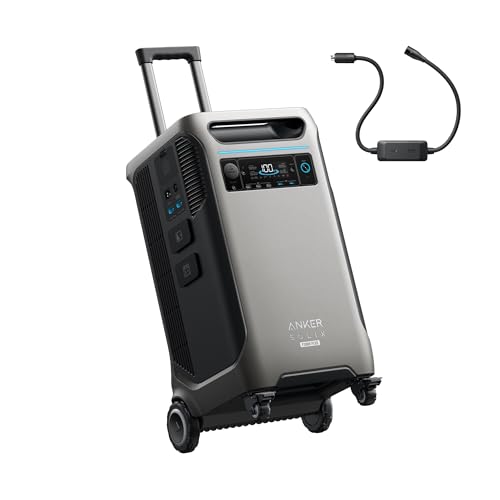
- The F3800 Plus Power Station and 240V Generator Adapter will be dispatched separately. If you receive one item before the others, …
- Power Your Home for Weeks: F3800 Plus starts at 3.84kWh, enough to power your home for a full day. Need more? Expand to 26.9kWh wi…
- Power More Appliances Simultaneously: F3800 Plus offers a massive 6,000W output, 58% more than other portable power stations at th…
This listing bundles the F3800 Plus with Anker’s 240V generator adapter. The listing gives a 3,840Wh LiFePO4 battery, 6,000W AC output, 120V/240V support, expansion to 26.9kWh with six batteries, and 3,200W of solar input. For winter, the most relevant feature is the 240V gas generator support through a 6,000W bypass, which lets an outdoor generator charge the station and pass power through. It carries a 5-year warranty per the listing.
Jackery HomePower 3000: Mid-size, essentials-focused

- Essential Home Backup: With a robust 3600W output (7200W surge) and a 3072Wh capacity, the Jackery HomePower 3000 provides reliabl…
- ≤20ms UPS: Featuring a UL-certified UPS that switches seamlessly within ≤20ms, the Jackery HomePower 3000 Portable Power Station r…
- Power for Essentials: The Jackery HomePower 3000 keeps your essentials charged at once with versatile AC, USB-C, USB-A, and DC por…
The HomePower 3000 lists 3,072Wh of LFP capacity, 3,600W output (7,200W surge), a UL-certified UPS with switchover in 20 ms or less, and a TT-30 RV port. Jackery’s listing estimates it can keep a refrigerator running for 1 to 2 days, and gives full AC recharge in about 2.2 hours, or 1.7 hours with AC and DC combined. It is rated for 4,000 cycles to 70% capacity. The listing mentions a TT-30 port but no 240V output, so it appears aimed at essentials rather than 240V loads; confirm on Jackery’s spec sheet.
Dual-Fuel Inverter Generators for Winter Backup
All three generators below are inverter models, which produce cleaner power than many open-frame generators, and all can run on gasoline or propane. Propane does not go stale the way gasoline can and is easy to store, but its output ratings are usually lower. Our winter portable generator guide covers larger open-frame models and placement in snow.
Generac iQ5200 DF: CO detection, 50-state compliant

- 50-STATE CARB-COMPLIANT DUAL-FUEL INVERTER GENERATOR: The iQ5200 DF (Model 8947) is CARB and EPA certified for sale in all 50 stat…
- CLEAN INVERTER POWER WITH LESS THAN 3% THD: Variable-speed inverter technology produces less than 3% total harmonic distortion, ma…
- 5,200 STARTING WATTS AND PARALLEL-READY FOR MORE POWER: Handles the starting surge of a 13,500 BTU RV air conditioner on gas; conn…
Generac’s listing gives 3,900 running and 5,200 starting watts, under 3% total harmonic distortion, CARB and EPA certification for all 50 states, and COsense, which detects rising carbon monoxide and shuts the engine down. Runtime is listed at up to 9 hours at 50% load or 15 hours at 25% load on its 3.2-gallon tank. Outlets include a 120V 30A L5-30R and two 120V 20A GFCI outlets. It has electric start with an included 12V battery and weighs 111 lb per the listing. The warranty is listed as 3 years residential.
Westinghouse 5000 Peak Watt Dual Fuel Inverter: Lowest listed noise

- 5000 Peak Watts and 3900 Rated Watts at Less Than 3% THD – Telescoping Handle – Gas or Propane Powered – Remote Start With Include…
- Features a 5–20R 120V Duplex Household Outlet, an RV-Ready TT-30R 30 Amp Outlet and Two USB Outlets – Great Choice for Travel Trai…
- Led Data Center: Rotating Digital Display Shows Fuel Level, Power Output, Remaining Run Time, Voltage Output, and Lifetime Hours
The listing gives 5,000 peak and 3,900 rated watts with under 3% THD, remote, electric and recoil start, a 5-20R duplex, a TT-30R 30A outlet and two USB outlets. It lists noise as low as 52 dBA and up to 18 hours of runtime on its 3.4-gallon gas tank; the listing does not state the load, and economy mode is listed as a feature. Its warranty is listed as 3 years. The listing does not mention a CO shutoff feature. Westinghouse sells some 5000-watt dual fuel models with a CO sensor (the DFc variants) and some without, so confirm which one you are buying on Westinghouse’s spec sheet, and have CO alarms in the house regardless.
Champion 4500-Watt Dual Fuel Inverter: Clear propane ratings

- Dual Fuel: Operate your 4500-watt portable generator right out of the box on either gasoline or propane, plus features CO Shield c…
- Quiet Technology and Extended Run Time: 61 dBA is great for RVs, tailgating, or camping with 4500 starting watts, 3500 running wat…
- Parallel Ready: The optional parallel kit (sold separately) enables this inverter to connect with another Champion inverter to inc…
Champion’s listing is the most explicit about fuel differences: 4,500 starting and 3,500 running watts with up to 14 hours of runtime on gasoline, and 3,150 running watts with up to 21 hours on propane. It includes CO Shield auto shutoff, electric start, a parallel kit option (sold separately), and a 3-year limited warranty. The listed noise is 61 dBA.
How to Choose
1. List your winter must-run loads
Start with the furnace (if gas or oil), refrigerator, sump pump or well pump, lights, router and any medical devices. Total the running watts and note the biggest starting surge. Pumps and fridges have starting surges well above their running watts.
2. Estimate how long you need to run them
Power stations are rated in watt-hours. Divide usable capacity (roughly 85% of the rated figure after inverter losses is a common planning estimate) by your average load to get hours. If the answer is shorter than your typical outage, you need more capacity, a recharge plan, or a generator. Our 3-day outage guide runs these numbers for common scenarios.
3. Be honest about placement
The CPSC says to run portable generators outside only, at least 20 feet from the house, with the exhaust pointed away from the home and any building where people could be. Never run one in a garage, basement, crawl space or shed, even with the door open. If you do not have a spot like that which you can reach safely in snow and ice, a power station is the safer choice.
4. Plan the house connection before the storm
Never plug a generator or power station into a wall outlet or dryer receptacle to feed the house. Backfeeding can electrocute utility workers and damage equipment. A licensed electrician can install a transfer switch, a panel interlock with a power inlet, or a manufacturer’s home panel, with a permit where required. Until then, use only outdoor-rated, properly sized extension cords, and keep cords and the generator’s exhaust away from doors, windows and vents.
5. Install CO alarms either way
Every home with fuel-burning appliances or a generator needs working carbon monoxide alarms on each level and outside sleeping areas. A generator’s CO shutoff is a backup, not a replacement for alarms in the house.
FAQ
Can a portable power station run a furnace?
A gas furnace’s blower and controls typically draw a few hundred watts to around 1,000 watts, which power stations in this guide can supply for hours, not days, depending on capacity. Furnaces are usually hardwired, so a licensed electrician needs to provide a safe connection. Electric furnaces and heat pumps draw far more.
Is a power station safer than a generator?
For carbon monoxide, yes; a power station produces no exhaust and can run indoors. It still needs a proper house connection, and its battery should be kept within the manufacturer’s temperature range.
Should I run a generator on propane in winter?
Propane avoids stale fuel and is easy to store, but outputs are usually lower than on gasoline, and small tanks can struggle to deliver enough vapor in deep cold. Check your generator’s propane rating and keep spare tanks.
Can I charge a power station with a generator?
Often, but check the manual; many power stations accept AC charging from an inverter generator. The generator runs outdoors as usual, and the power station runs indoors. Anker’s F3800 Plus listing specifically supports a 240V generator connection through its adapter.
Is a home battery better than either?
Permanently installed home batteries offer larger capacity and automatic switchover, at a higher installed cost. Our power station vs. home battery comparison and our guide to home batteries vs. generators by climate cover that decision.
General information only, not professional advice. Details can change or contain errors, so check with the manufacturer or an official source before you rely on them. Use of this site is subject to our Disclaimer and Terms of Service.