HomeMechanicals.com is an Amazon Associate and earns from qualifying purchases. Product details come from manufacturer listings; see our research process.
Jackery is a well-known consumer brand in portable lithium power, and it is probably best known for two things: the Explorer line of portable power stations and the foldable SolarSaga solar panels that pair with them. Over the last few years the brand has pushed further into territory that used to belong to fuel generators and wired home batteries, with higher-output units, 120V/240V support, expandable battery stacks and transfer-switch accessories. This guide covers the Jackery models a homeowner is most likely to be comparing in 2026, what each one actually is based on its published specifications, and how to match a unit to the loads you care about. Everything below sticks to manufacturer-stated specs plus general knowledge about the category.
How the Jackery lineup is organized
The models in this guide fall into three overlapping groups. Understanding the naming saves a lot of confusion, because several products share the same battery platform and differ mainly in how they are packaged.
- Explorer — the portable power station line. These are self-contained units with a handle or luggage-style design, an inverter, AC outlets and USB ports. The Explorer 2000 Plus, Explorer 2000 v2 and Explorer 5000 Plus all sit here. Solar panels are optional add-ons.
- HomePower — Jackery’s home-backup-oriented naming, applied to expandable LFP systems intended to be paired with a transfer switch and to carry selected household circuits rather than just a few extension cords. The HomePower 3600 Plus and HomePower 2000 Plus v2 are in this group.
- Solar Generator bundles — not a separate battery platform at all, but a power station shipped together with SolarSaga panels (and sometimes an extra battery pack) under a single listing. The Solar Generator 5000 Plus is the Explorer 5000 Plus platform sold with two 200W panels; the HomePower bundles in this guide also include panels. Jackery’s listings note that panels and the power station often ship in separate packages.
Across the current generation, the common thread is lithium iron phosphate chemistry (written as LiFePO4 or LFP), which the brand pairs with its ChargeShield charging technology on several models. LFP is the chemistry most home-backup products have moved to, because it tolerates deep cycling and sits in a safer thermal position than older lithium formulations. Capacity is quoted in watt-hours (how much energy is stored) and output in watts (how much can be drawn at once) — two numbers that need to be read separately, since a big battery with a small inverter still cannot start a well pump.
The models worth knowing
Jackery HomePower 3600 Plus with Extra Battery and 2x200W Panels
This is the most backup-focused bundle in the group. The HomePower 3600 Plus unit is rated at 3600W output with a 3584Wh base capacity, and the listing describes 7200W and dual-voltage 120V/240V operation when two units are run in parallel, with the stack expandable to 21kWh. The bundle here adds an extra battery for 7168Wh total plus two 200W solar panels. Jackery states charging from 0–100% in about two hours via hybrid AC+DC, or about 2.5 hours on AC alone, and describes high-temperature-resistant ceramic membrane cells tested at 302°F, a design it says is meant to resist thermal runaway; that is a manufacturer claim, not a guarantee.
It fits a homeowner who wants heavy loads — the listing cites pumps, heaters and dryers — without committing to a permanently wired battery. The listing describes it as plug-and-play when paired with Jackery’s manual transfer switch (MTS), but connecting any battery to home wiring is still electrical work for a licensed electrician (see Installation and safety). The listing also emphasizes a luggage-style chassis that Jackery says is 34% smaller and 29.3% lighter than other models. The trade-off is that 240V capability depends on running two units in parallel, so a single unit is a 120V device.

- Essential Home Backup: The Jackery HomePower 3600 Plus delivers 3600W output (7200W in parallel) to run pumps, heaters, and dryers…
- Safe Power That Lasts: Built with high-temp resistant ceramic membrane battery cells tested at 302 °F, the Jackery HomePower 3600 …
- Plug-and-Play: With its easy plug-and-play design, the Jackery HomePower 3600 Plus, paired with MTS, powers your home effortlessly…
Jackery Solar Generator 5000 Plus with 2x200W Panels
This is the top of the range in output terms: 5040Wh of LiFePO4 capacity, 7200W rated AC output with 14,400W surge, native 120V and 240V support, and expansion stated up to 60kWh. Jackery says it can run major appliances including a 5-ton air conditioner or a water heater (startup draw varies by appliance, so check each nameplate and Jackery’s specifications), accepts both high- and low-voltage solar panels, and can take up to 4000W of solar input for a recharge in roughly two hours. The listing also cites ChargeShield 2.0 and durability it rates at up to 11 years of daily use (the listing title says 10-year lifespan, so treat the figure as approximate), and claims up to 13 days of backup, a number that depends on the loads assumed and the expansion level.
The bundle includes two 200W SolarSaga panels, which is a sensible starting point for topping up rather than a full daily recharge. The listing’s shipping note refers to an “E5000 v2” unit while the title says 5000 Plus, so confirm the exact model and what ships before ordering. Jackery pairs this platform with its 60A Smart Transfer Switch, which the listing says can cover up to 12 circuits at 120V or six circuits at 240V. That makes it the closest thing in the lineup to a conventional whole-home battery, and the most install-dependent choice in the group.

- Handles Even the Big Appliances: Run major home appliances with 7200W of rated power (14,400W surge). Supports both 120V and 240V …
- Backup That Lasts for 13 Days: A 5040Wh capacity, expandable up to 60kWh — enough to keep your home running through an extended ou…
- More Power From the Sun: Compatible with both high-and low-voltage solar panels, recharge in about 2 hours with up to 4000W input,…
Jackery Explorer 5000 Plus Power Station
Mechanically this is the same platform as the Solar Generator 5000 Plus — 5040Wh, 7200W rated and 14,400W surge output, 120V/240V, expandable to a stated 60kWh (retailer pages differ on how many Battery Pack 5000 Plus add-ons one unit accepts, so check Jackery’s manual), up to 4000W solar input and compatibility with the 60A Smart Transfer Switch — sold on its own, with solar panels optional.
Choose this version if you already own compatible panels, if you plan to recharge primarily from the grid or a vehicle, or if you want to size a solar array separately rather than take the bundled 200W pair. For homeowners whose main goal is riding out multi-day outages on essential circuits, buying the station first and adding panels later is a reasonable sequence.
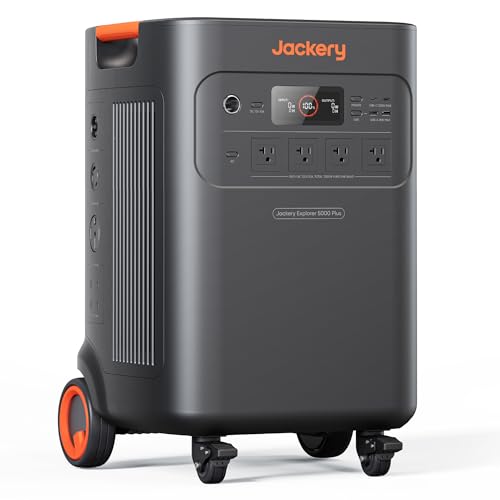
- Handles Even the Big Appliances: Run major home appliances with 7200W of rated power (14,400W surge). Supports both 120V and 240V …
- Backup That Lasts for 13 Days: A 5040Wh capacity, expandable up to 60kWh — enough to keep your home running through an extended ou…
- More Power From the Sun: Compatible with both high-and low-voltage solar panels, recharge in about 2 hours with up to 4000W input,…
Jackery Explorer 2000 Plus with 2x100W Mini Solar Panels
The Explorer 2000 Plus holds up to 2,042.8Wh and delivers up to 3,000W, which the listing says covers heavy loads such as air conditioners and RV use. It supports up to five expandable battery packs, taking the system from 2kWh to 12kWh, and two units can be connected in parallel for up to 24kWh. Jackery states a two-hour full charge when connected to six SolarSaga panels, and cites a built-in cooling system, temperature-resistant cells, ChargeShield fast charging and a LiFePO4 pack rated for up to 10 years of use.
This is the mid-size workhorse: more inverter headroom than the 2000 v2 at the same nominal capacity, with a clear expansion path. It suits RV owners, job-site use and homeowners who want one unit that can cover a refrigerator, a furnace blower and electronics, then grow later. The bundled 2x100W mini panels are compact and travel-friendly rather than a serious recharging array.

- Magnificent Performance: Featuring up to 2,042.8 Wh gigantic capacity, the Jackery 2000 Plus Power Station can power a range of he…
- Ultra Fast Charging: Charge directly from the sun or via wall outlet, conveniently, quickly and additionally worry free. Only 2 ho…
- 2kWh – 24kWh Flexible Expansion: The Jackery Explorer 2000 Plus supports up to 5 expandable battery packs, featuring power expande…
Jackery Explorer 2000 v2 Power Station (2-Pack)
The Explorer 2000 v2 pairs 2042Wh of LiFePO4 capacity with three AC ports and 2200W of total output. Jackery emphasizes size and weight — 39.5 lbs, described as 41% lighter and 34% smaller than typical units in the class — along with 20ms UPS switching, 100W USB-C PD fast charging, AC fast charging from 0 to 80% in 66 minutes, a full charge in 102 minutes using Emergency Super Charging, and a Silent Charging Mode under 30dB. The pack is rated for up to 10 years of use. One important note from the listing: the Explorer 2000 v2 does not support parallel connection of two units.
This two-pack therefore behaves as two independent 2kWh stations, not a 4kWh system. That is genuinely useful if you want one unit on a desk or media setup for UPS protection and a second for the kitchen or a camper, but it is the wrong choice if your goal is a single large backup bank.

- Note: The Explorer 2000 v2 does not support parallel connection of two units.
- High-Capacity Power Solution: With 3 AC ports delivering a total output of 2200W and a massive 2042Wh capacity, the Jackery Explor…
- Smallest & Lightest 2kWh Power: Weighing just 39.5 lbs, the Jackery Explorer 2000 v2 weighs less than other bulky units, making it…
Jackery HomePower 2000 Plus v2 with 2x200W Solar Panels
The HomePower 2000 Plus v2 offers 2048Wh of LFP capacity and 2400W output, expandable to 12kWh, bundled with two 200W solar panels. Its distinguishing features are software-led: Smart Energy Management and Priority Routing, which Jackery describes as keeping essential circuits running according to priorities you set during a shortage. The listing cites 6000+ LFP cycles, a 140W USB-C port with AVS protocol support, and describes it as the lightest expandable 2kWh system on the market and 34% lighter than the previous generation.
It is the natural entry point for someone who wants home-backup behavior — circuit prioritization, expandability, bundled solar — at 2kWh rather than 5kWh. Larger loads like electric water heating, many well pumps or central air may exceed what 2400W can run or start, so check each appliance’s starting watts.

- Accessible Home Backup Generator: With 2400W output and a 2048Wh capacity that can be expanded to 12kWh, you can feel confident yo…
- Never Lose Power to What Matters Most: Smart Energy Management and all-new Priority Routing seamlessly keep essential circuits run…
- Built to Last 16 Years: With 6000+ LFP batterey cycles, enjoy peace of mind for many, many years to come.
Jackery model comparison
| Model | Type | Capacity (expansion) | Rated AC output | Best fit |
|---|---|---|---|---|
| HomePower 3600 Plus + Extra Battery & 2x200W | Expandable home backup bundle with panels | 7168Wh bundle (unit 3584Wh, to 21kWh) | 3600W; 7200W and 120V/240V in parallel | Heavy loads such as pumps, heaters and dryers with a manual transfer switch |
| Solar Generator 5000 Plus + 2x200W | Power station with panels | 5040Wh (to 60kWh) | 7200W rated, 14,400W surge, 120V/240V | Multi-day backup of essential circuits |
| Explorer 5000 Plus | Power station, panels optional | 5040Wh (to 60kWh) | 7200W rated, 14,400W surge, 120V/240V | Same platform for buyers sizing their own solar |
| Explorer 2000 Plus + 2x100W mini panels | Portable power station with panels | 2042.8Wh (to 12kWh; 24kWh with two units) | 3,000W | RV, outdoor and mid-size home backup with room to grow |
| Explorer 2000 v2 (2-Pack) | Two independent portable stations | 2042Wh each; no parallel connection | 2200W each, 3 AC ports | Two-location coverage and 20ms UPS for electronics |
| HomePower 2000 Plus v2 + 2x200W | Expandable home backup bundle with panels | 2048Wh (to 12kWh) | 2400W | Entry-level circuit-priority backup for essentials |
How to choose
Start with the loads, not the capacity. Add up the running watts of what you actually need during an outage and check the starting surge of anything with a motor or compressor — a furnace blower, a sump or well pump, a refrigerator. Our generator size calculator works the same way for a battery: the rated output number has to clear your largest simultaneous draw, and only then does watt-hour capacity determine runtime.
Next, decide whether you want outlet-level power or circuit-level power. If you plan to plug appliances directly into the unit, a 2kWh Explorer is often enough and far easier to live with. If you want lights, the furnace and the fridge to simply come back on, you are in transfer-switch territory, which points to the HomePower models or the 5000 Plus platform with Jackery’s 60A Smart Transfer Switch. The distinction between those two approaches is covered in more depth in portable power station vs. home battery backup.
Then think about recharging. Bundled 100W or 200W panels extend runtime; they rarely replace a full day’s household consumption on their own. If outages in your area last days rather than hours, work out the array size you would actually need using how many solar panels do you need to recharge a home battery, and note that the 5000 Plus platform accepts up to 4000W of solar input while smaller units accept much less. Finally, if you are weighing batteries against fuel-burning options or comparing brands, see our best solar generators for whole-home backup roundup for the wider field.
A few practical tie-breakers: weight and form factor matter more than buyers expect, since a unit that lives in a basement and gets carried upstairs twice a year is a different purchase from one that goes camping. Expandability is worth paying attention to at purchase time, because battery packs are platform-specific. And if UPS behavior for a computer or medical device is part of the goal, the Explorer 2000 v2’s stated 20ms switching is the relevant spec in this group.
Installation and safety
A power station used as a plug-in appliance needs no special work: you plug loads into its outlets. The moment you want it to feed your home’s wiring, the rules change.
- Never backfeed. Do not connect any power station to a dryer outlet, generator inlet or breaker in an attempt to energize household circuits without proper equipment. Backfeeding endangers utility crews and anyone in the house.
- Use the right interconnection device. Connecting a battery to home circuits requires a transfer switch, smart panel or breaker interlock. Jackery sells a manual transfer switch for the HomePower platform and a 60A Smart Transfer Switch for the 5000 Plus platform, but these are electrical equipment: have installation done by a licensed electrician, and pull permits as your local code requires.
- Check local code and inspection requirements before buying accessories. Rules for energy storage placement, circuit counts and labeling vary by jurisdiction, and some areas treat stationary battery installations differently from portable ones.
- Respect ventilation and placement. Keep units in a dry, ventilated space within their stated operating temperature range, clear of flammable materials, and do not operate a unit with damaged cabling or connectors.
- Follow Jackery’s documentation for solar panel voltage limits, expansion battery pairing and parallel operation. Mixing incompatible panels or attempting parallel connection on a model that does not support it — the Explorer 2000 v2, for example — can damage equipment and may affect warranty coverage.
Batteries also do not solve gas-appliance problems. If your outage plan involves a gas water heater, furnace or range, any work on gas lines, venting or appliance circuits belongs to a licensed plumber, gas fitter or HVAC technician per local code.
Frequently asked questions
Can a Jackery power station run my whole house?
It depends entirely on what “whole house” means for your home. The 5000 Plus platform is rated at 7200W with 14,400W surge and supports 120V and 240V, which Jackery says covers major appliances including a 5-ton air conditioner, and it pairs with a transfer switch for up to 12 circuits at 120V. That is enough to carry a selected set of circuits in many homes. Homes with electric heat, electric water heating and a large air conditioner running simultaneously will still exceed what any single battery of this size can support, so most real installations prioritize essential circuits rather than everything.
Do I need a transfer switch to use one during an outage?
Not if you are plugging appliances straight into the unit’s outlets with extension cords, which is the simplest way to begin. You do need a transfer switch, smart panel or interlock — installed by a licensed electrician, with permits where required — if you want the battery to power your home’s existing wiring and outlets. There is no safe shortcut around that step.
How long will one of these actually last in an outage?
Divide usable watt-hours by your average draw. A 2048Wh unit supporting a 150W load draws down over roughly 13 hours of continuous use before inverter overhead; the same unit running a 1500W space heater lasts a small fraction of that. Jackery’s longer backup claims assume expanded battery capacity and modest, prioritized loads. Expansion packs and solar input are what turn an overnight bridge into multi-day coverage. For a worked example of planning around a longer event, see our guide to backup power for a 3-day outage.
Is LiFePO4 worth it over older lithium batteries?
For home backup, the general consensus in the category is yes. LFP cells tolerate far more charge cycles than earlier lithium-ion formulations and behave better thermally, which is why Jackery quotes figures such as 6000+ cycles on the HomePower 2000 Plus v2 and long service lifespans across the Plus line. The trade-offs are weight and bulk per watt-hour compared with some older chemistries, and cold-weather charging limits that apply to lithium batteries generally — worth planning for if the unit will be stored in an unheated garage.